
Selecting Turf Infill Materials for Saudi Sports
Recent Posts
How to Upgrade Campus Recreation for Daily Use
September 13, 2026
Best Padel Court Materials for Saudi Conditions
September 12, 2026
Best Outdoor Fitness Equipment for Saudi Sites
September 11, 2026
Riyadh Padel Flooring Options for Lasting Play
September 10, 2026
Share Post
A turf field can look complete the day it is installed and still fail to perform as intended within a season. In Saudi Arabia, selecting turf infill materials is not a finishing decision. It directly affects surface temperature, traction, shock absorption, drainage, fiber stability, maintenance requirements, and the long-term value of the asset.
For schools, municipalities, developers, compounds, and destination projects, the right infill must be specified as part of the complete surface system. Turf yarn, pile height, backing, base construction, drainage design, intended sport, player profile, and maintenance access all influence the correct choice. A material that works on a lightly used landscape installation may be unsuitable for a high-traffic football pitch in Riyadh or a multi-use recreation area exposed to coastal conditions in Jeddah.
Why Turf Infill Is a Performance Layer
Infill occupies the space between synthetic turf fibers. Its weight helps keep fibers upright, its profile supports ball response and foot stability, and its resilience contributes to player comfort. It also protects the carpet backing from direct wear and helps maintain a more consistent surface as the field receives repeated use.
That does not mean more infill is automatically better. Excessive infill can make a surface feel hard or slow, reduce visible fiber, and create migration issues. Too little infill leaves fibers unsupported, accelerates wear, and can compromise traction. The correct infill depth and material blend must follow the turf system design, not a generic installation habit.
For project stakeholders, the central question is simple: what level of performance must the facility deliver over its operating life? A community pitch with scheduled maintenance has different requirements from a school field with daily use, a hospitality development focused on visual quality, or a competition-oriented training facility.
Selecting Turf Infill Materials for Saudi Conditions
Saudi conditions raise the standard for every component in an artificial turf system. High solar exposure can elevate surface temperatures substantially. Fine dust can enter the pile and alter drainage behavior. Heavy use during evenings and weekends can compact infill quickly, particularly in goalmouths, center-field zones, and high-turn areas.
The right specification therefore needs to balance thermal behavior with mechanical performance. Infill should be selected not only for its first-day feel, but for how it will react after repeated brushing, watering, dust exposure, seasonal heat cycles, and concentrated foot traffic.
Silica Sand: Stable and Widely Applicable
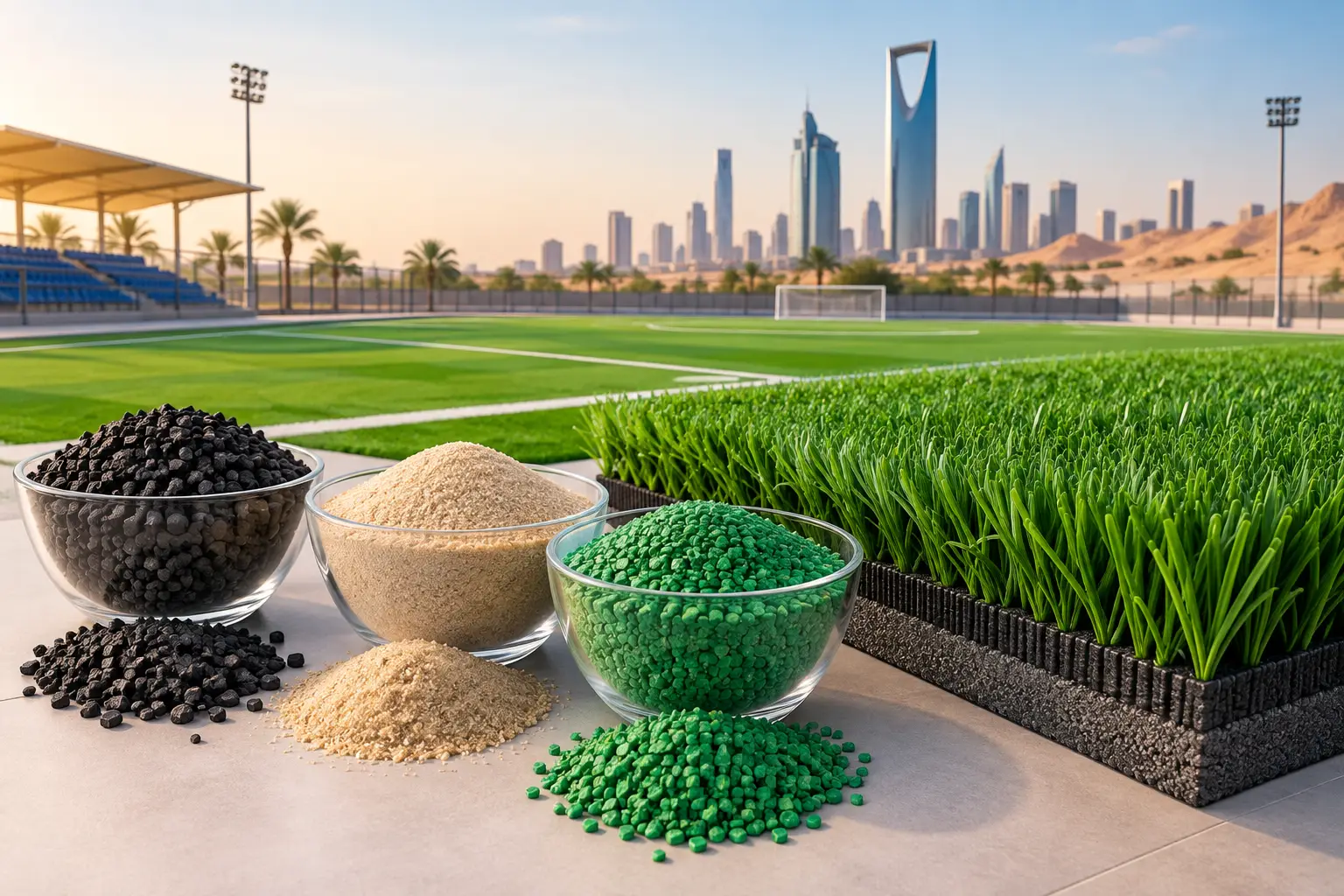
Clean, graded silica sand is commonly used as a ballast layer in artificial turf systems. Its principal strengths are weight, dimensional stability, availability, and predictable installation behavior. It helps secure the carpet, supports fibers, and can contribute to a firm, consistent base layer when installed at the correct depth.
However, silica sand alone does not provide the resilience required for many sports applications. It is often paired with a performance infill layer, particularly on football, rugby, and multi-use fields where shock absorption, rotational resistance, and player comfort matter. Grain size, cleanliness, roundness, and moisture content should be controlled. Poorly graded or contaminated sand can compact, interfere with drainage, and cause uneven play.
SBR Rubber: Proven Performance With Clear Controls
SBR rubber granules have been widely used in sports turf because they provide cushioning, energy return, and a cost-effective performance layer. For heavily used community and training fields, SBR can remain a practical option when it is sourced from a suitable supplier, installed correctly, and supported by a defined maintenance program.
The trade-off is that rubber infill can retain heat and may migrate beyond the playing area if containment and housekeeping are weak. Product quality also varies considerably. Procurement teams should require material documentation, particle-size consistency, appropriate testing records, and clear confirmation of the proposed system’s suitability for the project brief. The lowest-cost rubber granule is rarely the lowest lifecycle-cost choice.
EPDM and TPE: Engineered Alternatives
EPDM and thermoplastic elastomer, or TPE, are engineered infill options that can offer controlled particle geometry, consistent color, and dependable elastic performance. These materials are often considered where a premium finish, specific performance target, or defined material profile is required.
EPDM is valued for weather resistance and can be specified in different colors, while TPE can provide a recyclable thermoplastic option depending on the product and local waste-management route. Both may carry a higher initial cost than SBR, and neither should be treated as universally superior. Their suitability depends on heat performance, expected traffic, maintenance capability, and the full turf system beneath them.
A premium infill cannot compensate for weak base works, unsuitable turf yarn, or poor installation tolerances. It must function as one engineered layer within the field build-up.
Organic and Natural Infill Options
Cork and other organic-based infills are increasingly considered for projects seeking lower heat retention and a more natural material profile. Cork can offer favorable thermal characteristics and a softer feel underfoot. It may suit selected premium, recreational, or low-to-moderate use facilities where the operating team understands its maintenance needs.
Its limitations need to be acknowledged early. Organic infills can be lighter, may move in strong wind or heavy rain, and can require more frequent top-up or redistribution. Moisture behavior, local supply reliability, storage conditions, and the project’s maintenance regime must be assessed before specification. Infill selection should be based on verified system performance, not appearance or sustainability claims alone.
Start With the Sport and User Profile
A football field, padel perimeter landscape zone, school multi-use court, and decorative turf installation should not receive the same infill specification. The sport determines the target relationship between traction, cushioning, ball bounce, ball roll, and surface speed. The user profile determines how tolerant the facility can be of maintenance interruptions and variable play conditions.
For football and intensive multi-sport use, the specification may require a layered approach with sand ballast and resilient infill, supported by appropriate pile height and a shock pad where the performance brief calls for it. A school facility may prioritize safety, predictable behavior, and simple maintenance. A residential or hospitality landscape area may need stable ballast and visual fiber support rather than a high-performance rubber layer.
Where children, casual users, and competitive players will share the same surface, the design team should define which use governs the specification. Trying to make one turf system perform equally for every activity can create compromises that satisfy no one.
Heat, Drainage, and Dust Must Be Designed Together
Heat management begins with realistic expectations. No infill material eliminates solar gain on an exposed artificial turf field. Surface temperature is influenced by fiber color, pile density, infill composition, ambient conditions, wind, and direct sun exposure. Lighter-colored components and lower heat-retention materials can help, but they do not replace shade planning, irrigation strategy where appropriate, and sensible programming during peak heat.
Drainage is equally critical. Infill must allow water to pass through the pile into the permeable base and drainage system without carrying fines that block the structure below. The field needs correctly designed falls, suitable aggregate layers, stable edges, and positive discharge routes. If water remains on the surface, the cause may be compaction, blocked drainage, incorrect infill gradation, or a base-construction issue. It should not be assumed to be a turf-carpet problem.
Dust management is a practical Saudi operating consideration. Routine brushing redistributes infill, lifts compacted fibers, and helps remove surface debris before it works into the pile. Facilities near open land, construction activity, or high-wind zones may require a more frequent maintenance schedule than a protected urban site.
Specify Maintenance Before Awarding the Project
The infill decision should include a maintenance plan from the outset. A field handed over without equipment, training, and inspection intervals is likely to lose performance long before its expected service life.
Operators should know how to monitor infill depth, identify compacted zones, brush fibers in the correct direction, remove debris, and arrange periodic deep cleaning or decompaction when required. High-wear areas should be reviewed more frequently than the rest of the field. Consistent records are valuable because they show whether a recurring issue comes from user volume, irrigation, drainage, equipment practices, or an underlying installation defect.
For institutional procurement, the specification should also define acceptance criteria. This includes approved material samples, particle gradation, installation depths, distribution tolerances, edge containment, and post-installation inspection. These controls protect the client from substitutions that may appear similar but perform differently over time.
Use a System-Level Approval Process
Material samples are useful, but a sample jar cannot prove field performance. Approval should be based on the proposed turf system as a whole: the carpet, infill, optional shock pad, base design, drainage, line marking, seams, and maintenance method. Supplier documentation should align with the intended use and applicable safety or sports-performance requirements for the project.
StepX Sports approaches turf systems as full-scope recreational infrastructure, not as isolated rolls of carpet and bags of infill. That distinction matters on projects where durability, safe play, and disciplined handover standards are expected.
The best infill choice is the one that remains stable, playable, and maintainable after years of real use – not the one that simply looks right at practical completion. Begin with the users, the climate, and the operating plan, then specify every layer to support the same long-term outcome.