
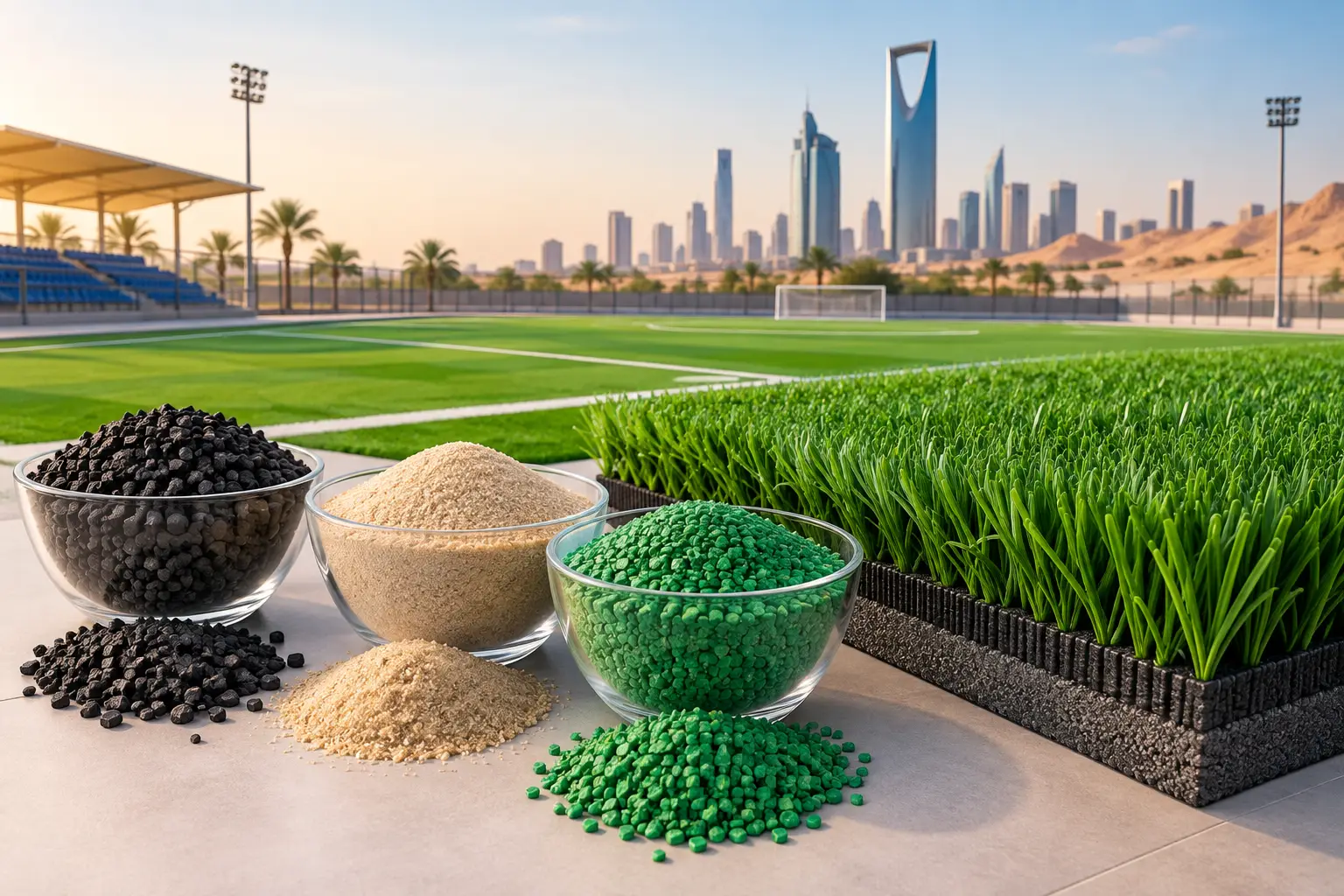
How to Select Padel Flooring for Saudi Courts
Recent Posts
How to Upgrade Campus Recreation for Daily Use
September 13, 2026
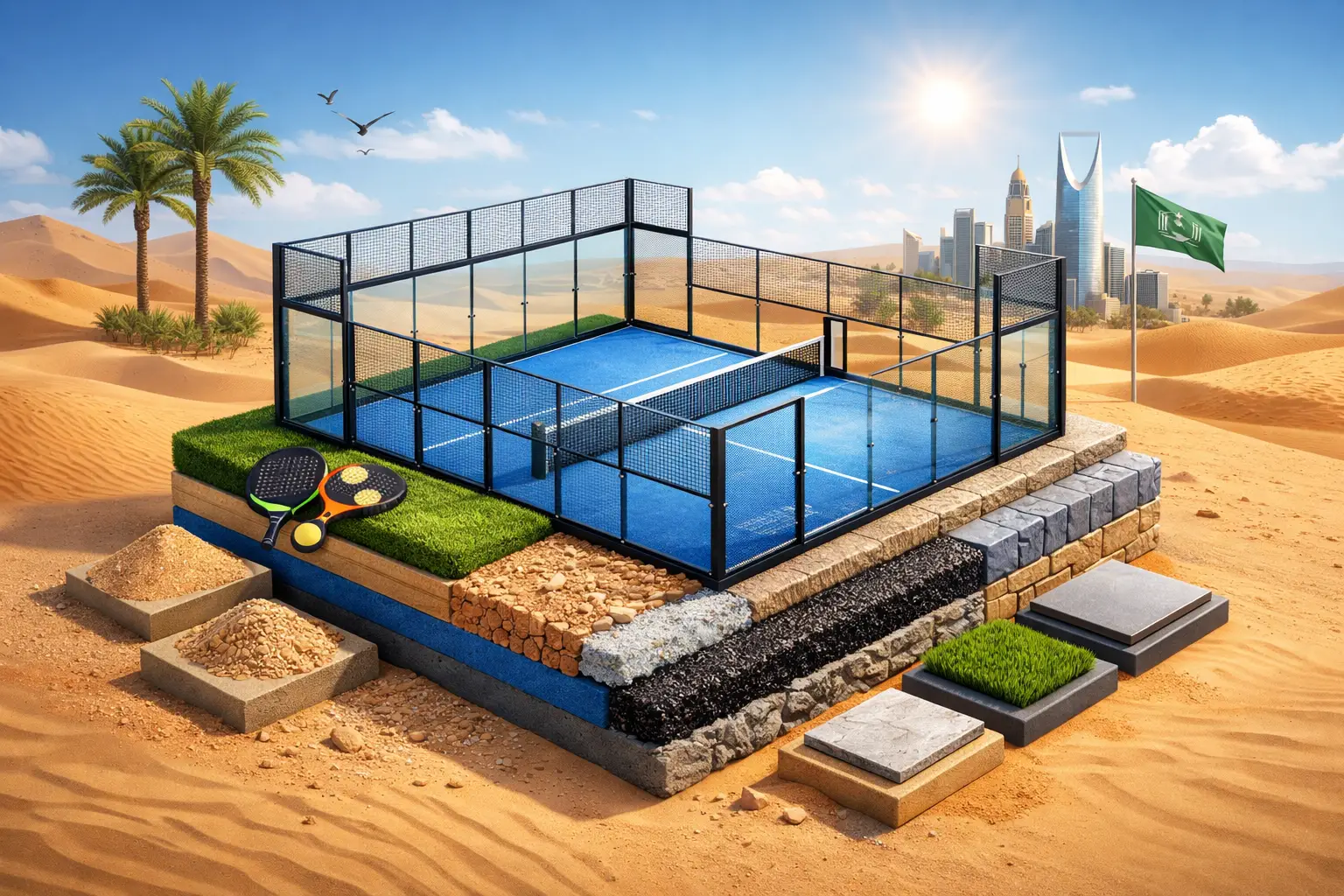
Best Padel Court Materials for Saudi Conditions
September 12, 2026
Best Outdoor Fitness Equipment for Saudi Sites
September 11, 2026
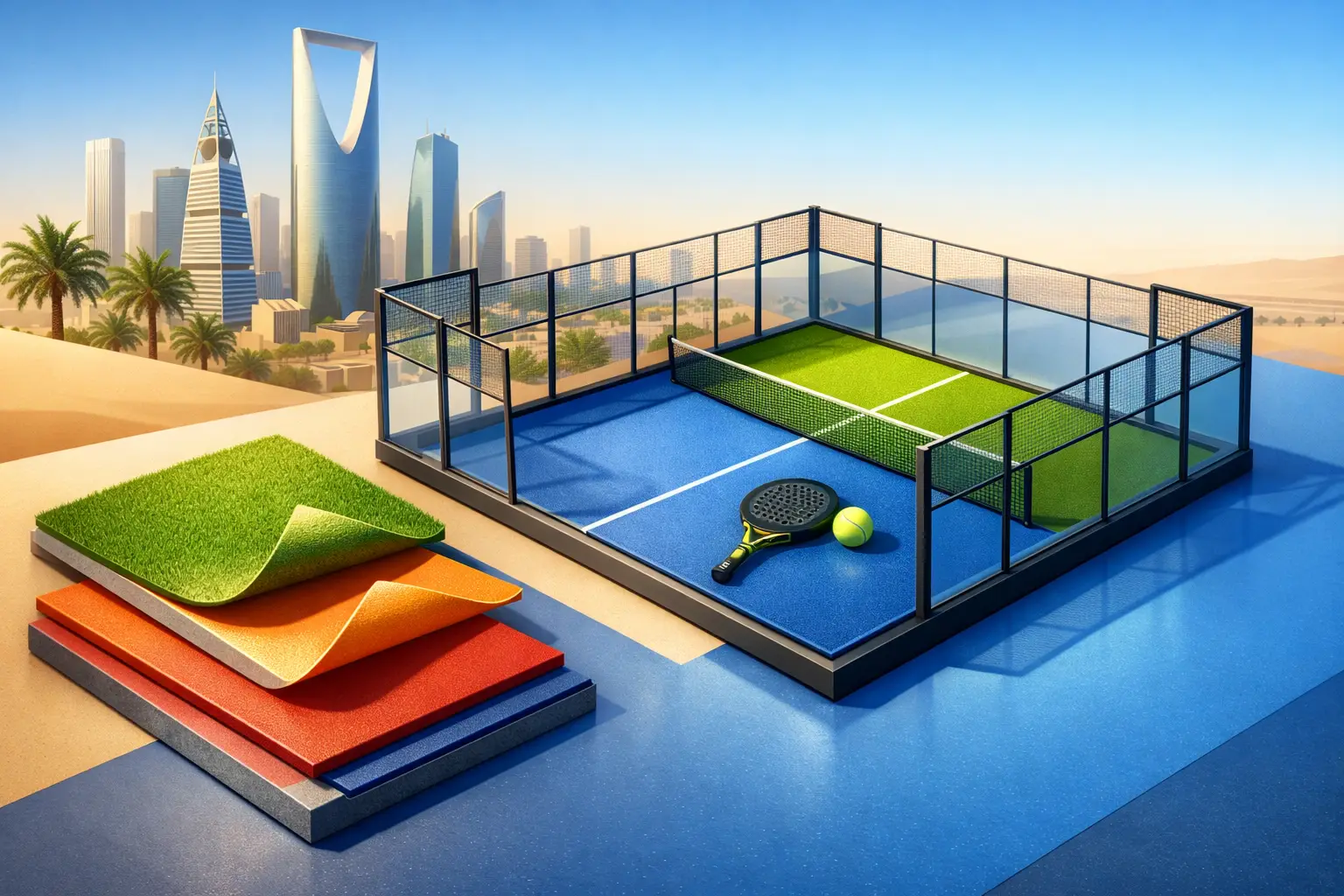
Riyadh Padel Flooring Options for Lasting Play
September 10, 2026
Share Post
A padel court can look premium on opening day and still become a costly operational issue within a few seasons. Loose seams, excessive heat buildup, poor ball response, standing water, and accelerated fiber wear usually trace back to one decision made before installation: the flooring specification. Knowing how to select padel flooring means assessing the complete playing system, not simply choosing a turf color or pile height.
For developers, schools, compounds, hospitality operators, and public-sector clients in Saudi Arabia, the surface must deliver consistent play while standing up to intense UV exposure, high ground temperatures, windblown dust, frequent cleaning, and concentrated foot traffic. The right choice protects the player experience, the court structure, and the long-term value of the asset.
Start With the Court’s Intended Use
The correct padel flooring depends first on how the court will operate. A private villa court with limited weekly use has different requirements from a high-turnover commercial club, a school campus, or a destination development that may host coaching, events, and extended evening play.
High-traffic venues need dense, resilient synthetic turf that recovers after repeated directional movement and retains a stable, even surface. Facilities focused on recreational use may prioritize comfort and lower maintenance demand, while competitive venues should place greater weight on predictable ball bounce, controlled traction, and player confidence during fast changes of direction.
This is also the point to decide whether the court will be fully outdoor, covered, or enclosed within a climate-managed facility. Outdoor courts in Riyadh, Jeddah, Dammam, and other exposed Saudi locations require a more demanding specification than indoor installations. The flooring, adhesive system, infill, drainage design, and base construction must all be selected as one coordinated assembly.
How to Select Padel Flooring by Performance
Most professional padel courts use synthetic turf engineered for the sport. However, not all artificial turf is suitable. General landscape turf may appear similar at first glance but is not designed for the sliding behavior, ball interaction, seam strength, or sustained traffic of padel.
A padel-specific surface should provide controlled grip. Players need enough traction to accelerate, stop, and change direction safely, but the surface cannot be overly abrasive or restrictive. Excessive grip can increase stress on ankles and knees, while a surface that is too loose or slick undermines stability.
Ball behavior matters equally. The pile structure, fiber density, infill level, and underlying base influence how the ball rebounds and rolls after contacting the surface. A properly specified system produces a consistent response across the full court rather than soft areas near seams, corners, or drainage points.
Choose the right pile and fiber construction
Pile height alone does not define performance, but it remains a useful starting point. Padel turf is commonly specified in short-pile formats that support a controlled, fast game while minimizing displacement under play. The best specification depends on the manufacturer’s tested system, infill method, expected use, and approved installation detail.
Fiber shape and yarn quality deserve close review. Textured or fibrillated fibers can help retain infill and support stability, while monofilament constructions can offer a refined playing feel and appearance. Neither option is automatically better. The decision should be based on verified durability, maintenance requirements, and the behavior of the complete system under expected site conditions.
Ask for technical data on fiber composition, stitch rate, pile weight, backing strength, UV stabilization, and tuft bind. These details reveal far more about service life than surface appearance alone. A dense, well-engineered turf may carry a higher initial cost, but it can reduce repair frequency and protect the quality of play over the operating life of the court.
Select infill for stability and heat management
Infill helps support the fibers, distribute player loads, and influence ball response. Silica sand is widely used in padel systems because it provides weight, stability, and a predictable playing surface when installed at the correct level.
The quality, gradation, and cleanliness of the sand are critical. Poorly graded infill can compact unevenly, migrate, or create inconsistent traction. Insufficient infill leaves fibers unsupported and vulnerable to early wear. Excessive infill can slow the court and affect playability. The installation team should apply and brush infill in controlled stages, then verify the final level across the court.
For Saudi conditions, heat cannot be treated as a secondary concern. Turf color, fiber formulation, infill selection, and exposure all affect surface temperature. Lighter visual tones may help reduce heat absorption, but they must still meet the desired aesthetic and visibility requirements. Shade structures can materially improve daytime comfort, yet they must be coordinated with the court structure, lighting, wind loads, and drainage plan.
Build the Surface on a Stable, Draining Base
Even the best turf will underperform on an unstable base. Padel flooring relies on a flat, structurally sound substrate that maintains line, level, and drainage throughout the court footprint. Cracks, settlement, ponding, and poor edge detailing will quickly transfer to the playing surface.
The preferred base solution depends on site conditions, structural design, and whether the court is installed at grade, on a podium, or within an existing building. In many outdoor projects, a properly designed concrete slab provides the dimensional accuracy and long-term stability required for the court system. It must be finished to precise tolerances and include a drainage strategy that moves water away from the surface and surrounding structure.
Do not treat drainage as an add-on. Water that remains beneath or around the turf can compromise adhesives, encourage contamination, affect infill behavior, and create avoidable maintenance issues. The full detail should account for surface falls, perimeter drainage, discharge routes, waterproofing where relevant, and the movement of water during intense rainfall or washdown.
Check joints, seams, and edge details
Seams are among the most heavily scrutinized parts of a padel floor because they experience repeated lateral loading. They should be accurately aligned, securely bonded using compatible materials, and protected from lifting at edges or transitions. Poor seam workmanship is not a cosmetic issue. It can become a trip hazard and interrupt play.
Perimeter details require the same precision. Turf must interface cleanly with the glass, steel frame, access gates, and any drainage channels without gaps, exposed adhesive, or areas where infill can escape. A turnkey contractor should coordinate these interfaces before installation rather than trying to correct them after the court is assembled.
Specify for Saudi Climate and Operating Reality
A flooring system that performs well in a mild European climate may not automatically perform to the same standard in Saudi Arabia. Extreme solar exposure can fade fibers, weaken inferior backing materials, and accelerate degradation in adhesives that have not been selected for high-temperature service.
Request evidence of UV resistance, heat tolerance, and suitability for outdoor use in hot, arid environments. Certified materials and globally accepted testing standards are valuable, but field-proven installation practice is equally important. The contractor must understand how to store materials on site, prepare the base, manage adhesive curing, install infill, and inspect the finished court under local conditions.
Dust and sand are practical considerations as well. They can accumulate within fibers and alter the movement of infill if routine grooming is ignored. Design the court with realistic maintenance access, specify a maintenance plan from day one, and ensure the operator understands the required brushing, debris removal, infill checks, and periodic surface inspection.
Balance Initial Cost Against Lifecycle Value
Lowest-cost flooring often creates the highest lifecycle cost. A cheaper turf system may look acceptable at handover but can lose fibers, fade, loosen at seams, or require premature replacement under heavy play and outdoor exposure. Disruption to bookings, repairs around the steel structure, and reputational damage can quickly outweigh an initial saving.
A stronger procurement approach evaluates total value: material quality, warranty terms, supplier credibility, installation controls, expected maintenance, replacement availability, and contractor accountability. It should also consider whether the selected flooring integrates correctly with the court manufacturer’s frame, glass, lighting, and drainage details.
For institutional and commercial projects, require samples and technical submittals before approval. Review the proposed turf and infill as a system, not as isolated products. Confirm that the contractor will inspect base tolerances, document installation stages, and complete final checks for flatness, infill distribution, seam integrity, and safe transitions.
Treat Flooring as Part of the Player Experience
Padel flooring is where every rally begins, ends, and changes direction. It should feel stable underfoot, respond consistently to the ball, remain presentable under daily use, and support safe play through years of operation. That outcome comes from disciplined design, certified materials, precision installation standards, and a maintenance plan that matches the venue’s actual traffic.
StepX Sports approaches padel surfaces as part of a full-scope court system built for Saudi conditions. When flooring is selected with the base, drainage, structure, climate, and operating model in view, the result is more than a visually impressive court. It becomes a dependable recreational asset that keeps communities active and gives every player confidence underfoot.