
Artificial Turf Installation for Compounds
Recent Posts
Selecting Turf Infill Materials for Saudi Sports
September 14, 2026
How to Upgrade Campus Recreation for Daily Use
September 13, 2026
Best Padel Court Materials for Saudi Conditions
September 12, 2026
Best Outdoor Fitness Equipment for Saudi Sites
September 11, 2026
Share Post
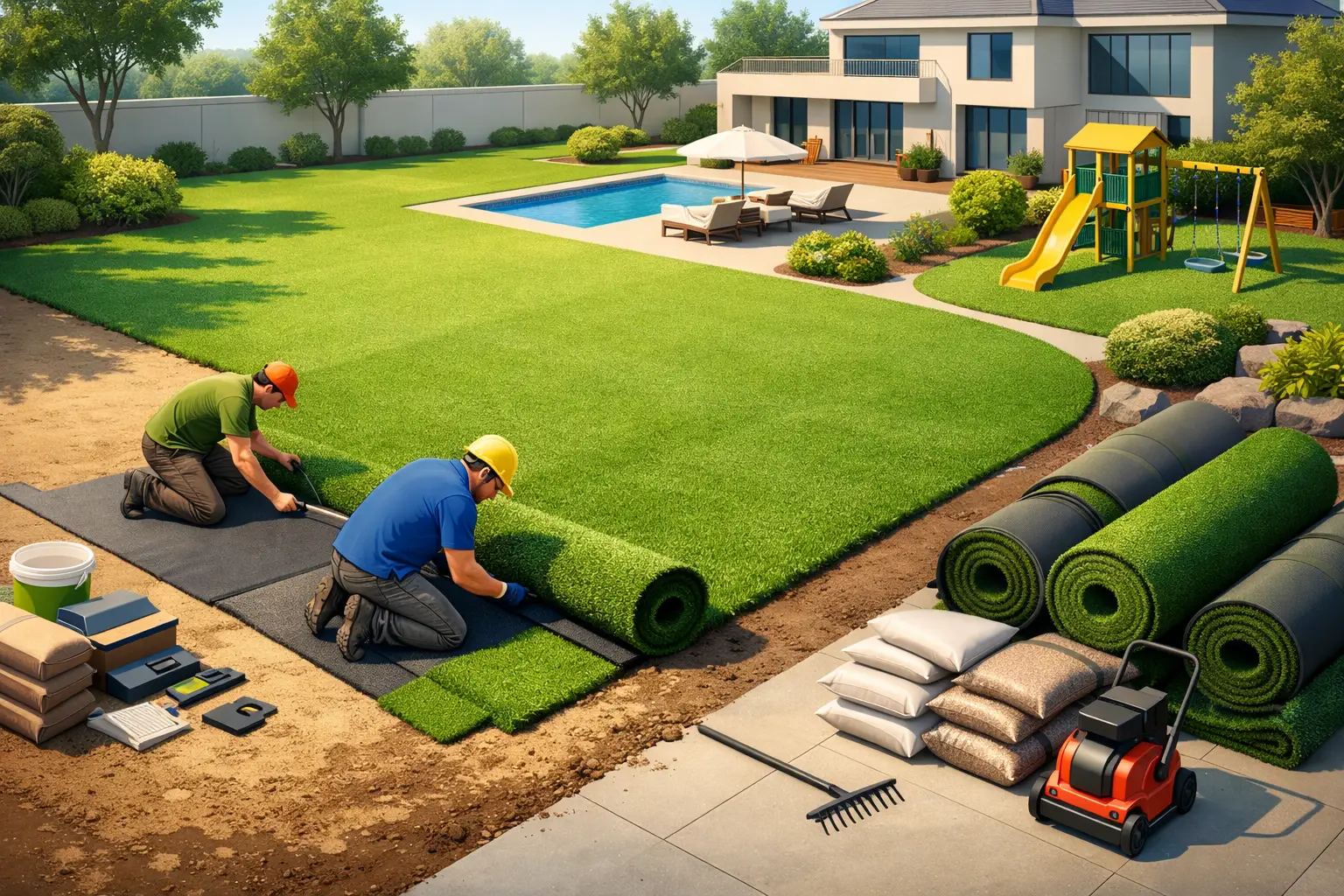
A compound landscape has to work harder than it looks. It may serve children after school, residents in the evening, weekend football games, shaded seating zones, and daily pedestrian circulation – often under intense sun and continuous use. Artificial turf installation for compounds is therefore not a simple finishing item. It is a surface-engineering decision that affects safety, maintenance budgets, visual quality, and the long-term experience of the community.
For developers, operators, and facilities teams, the objective is clear: create green, usable outdoor space that remains stable, clean, and presentable through demanding Saudi conditions. That result depends on correct site preparation, a purpose-led turf specification, dependable drainage, and controlled installation from the first excavation to final inspection.
Why Compounds Need a Different Turf Strategy
Residential and corporate compounds are mixed-use environments. A landscaped lawn near a clubhouse does not face the same demands as a mini football area, a children’s play zone, or a high-traffic path between villas. Treating every area as a standard turf application can lead to early wear, uneven surfaces, trapped heat, poor drainage, and avoidable maintenance.
The right solution begins with how people will use the space. Decorative turf may prioritize appearance and a natural visual finish. Recreation areas need greater fiber resilience, appropriate pile height, secure infill retention, and a base designed to resist movement. Areas around playground equipment or outdoor fitness zones may require impact-attenuating systems beneath or alongside the turf to support a safer user experience.
Saudi Arabia adds another level of technical consideration. High UV exposure, extreme summer temperatures, airborne dust, and periodic heavy rainfall place pressure on materials and construction quality. A compound surface must be built for Saudi conditions, not selected from a generic catalog without reviewing the site, usage pattern, and operating expectations.
Artificial Turf Installation for Compounds Starts Below the Surface
The visible green layer receives attention, but the base construction determines whether the installation performs over time. An attractive turf product installed over an unstable or poorly graded substrate will not stay level for long. Depressions, open seams, water pooling, and edge failure usually begin with deficiencies below the turf.
Site Assessment and Levels
Before construction, the contractor should review existing levels, access routes, surrounding hardscape, irrigation conditions, utility locations, and anticipated water flow. The finished turf must sit at the correct elevation against curbs, paving, play equipment, and drainage points. This avoids trip edges and prevents runoff from entering adjacent buildings, walkways, or landscaped areas.
Grading is especially important in compounds where small spaces meet multiple finishes. Water needs a defined route away from occupied areas, even where the turf itself has a permeable backing. A site that drains well on paper can still fail if the sub-base is compacted incorrectly or if discharge points are blocked by curbs and landscape borders.
Sub-Base Construction and Compaction
A properly engineered sub-base provides stability, load distribution, and drainage. Its thickness and material composition depend on soil conditions, intended use, and whether the area will receive foot traffic only or more intensive sports activity. Recreation spaces generally require more structural control than ornamental zones.
The base should be placed in controlled layers and compacted to the required density. This is not a stage to rush. Inadequate compaction may not be visible at handover, yet it can produce settlement after repeated use or seasonal ground movement. A precision installation team verifies levels throughout the process rather than attempting to correct irregularities at the final turf stage.
Drainage That Performs in Real Conditions
Artificial turf does not eliminate the need for drainage design. Permeable turf backing can allow water through the surface, but the entire system must move that water efficiently. Depending on the site, this may include free-draining aggregate layers, perimeter channels, collection points, or connections to the wider stormwater system.
The design should account for dust and debris, which can reduce surface permeability over time. Compound operators also need clear maintenance access to drains and channels. A drainage layout that cannot be inspected or cleaned becomes a hidden operational risk.
Selecting Turf by Use, Not Appearance Alone
Not all artificial grass is designed for the same purpose. Fiber shape, pile height, stitch rate, backing strength, yarn composition, infill requirement, and UV treatment all influence performance. The appropriate product is the one that supports the required use while managing heat, durability, and maintenance needs.
For landscaped common areas, a softer, more natural-looking turf can deliver a premium appearance with minimal upkeep. For active lawns and informal play, a denser product with stronger fiber recovery is often the better choice. Football-focused areas require a sports-specific system designed for traction, ball response, player comfort, and repeated loading.
Infill selection also deserves careful review. It helps support fibers, contributes to playing characteristics, and can influence surface temperature and maintenance requirements. The correct approach depends on the intended activity and the selected turf system. There is no single infill choice that suits every compound application.
Color is another practical consideration. A blended green yarn can create a more natural landscape finish, while sports surfaces may use defined line markings, contrasting zones, or coordinated colors that reflect the compound’s design identity. The priority is a finish that continues to look intentional after regular cleaning and use.
Heat, Safety, and User Comfort Must Be Designed Together
Artificial turf can become warm in direct sun, particularly during peak summer conditions. Material selection, shading strategy, ventilation around the area, and planned use times all affect user comfort. For heavily used community spaces, shade structures, trees positioned outside the play zone, and nearby water access can improve the experience without compromising the turf system.
Safety is equally site-specific. Turf edges should be firmly anchored and transitioned cleanly to adjacent paving or curbs. Seams need professional joining so they do not separate under movement or cleaning. Where children are likely to run and play, the surface layout should avoid abrupt level changes, exposed fixtures, and drainage features that create hazards.
For playground applications, artificial turf is often part of a wider safety system rather than the sole protective layer. The fall-height requirements of equipment, the underlying shock pad, and the finished surface performance should be considered together. This is where turnkey design-and-build control protects both the project schedule and the end user.
Installation Details That Protect Long-Term Value
A high-performance surface is defined by details that are easy to overlook during procurement. Turf rolls must be positioned consistently so fiber direction remains uniform across the area. Seams should be aligned, secured, and finished to resist opening. Edges require suitable anchoring methods based on the surrounding construction.
Infill, where specified, must be distributed evenly and brushed into the fibers at the correct rate. Too little may reduce support and stability. Too much can affect appearance, comfort, and surface behavior. Final grooming is not cosmetic – it confirms that the system is standing correctly and ready for use.
Quality control should continue through final inspection. The completed installation needs checks for drainage performance, level consistency, seam integrity, edge security, line accuracy where applicable, and general finish quality. A contractor accountable for both supply and installation can control these interfaces more effectively than separate material and labor providers.
Plan for Maintenance Before Handover
Artificial turf reduces the water, mowing, and fertilization demands associated with natural grass, but it is not maintenance-free. Compound teams should establish a realistic care schedule from the outset. Regular brushing keeps fibers upright, redistributes infill where used, and removes surface debris. Prompt cleaning of spills, periodic inspection of seams and edges, and drainage checks help maintain appearance and extend service life.
High-traffic zones may need more frequent attention than decorative areas. Entrances to play spaces, goalmouths, seating edges, and routes near food or beverage areas can collect debris and experience concentrated wear. Planning for these patterns during design – rather than reacting after handover – helps operators protect the asset with less disruption.
A capable specialist contractor should also provide clear maintenance guidance, inspection support, and options for repairs, upgrades, or re-grooming as the compound evolves.
A Green Surface That Supports the Whole Development
Well-executed artificial turf is more than a substitute for natural grass. It can turn an unused courtyard into a daily recreation zone, give families a dependable play surface, improve the visual value of shared spaces, and support the active-lifestyle ambitions behind modern Saudi developments.
The strongest results come from treating turf as infrastructure: designed for its location, engineered for its use, and installed with disciplined control from the ground up. For compound owners, that approach creates a surface residents can enjoy now and a community asset that continues to perform long after opening day.