
Best Outdoor Fitness Equipment for Saudi Sites
Recent Posts
Selecting Turf Infill Materials for Saudi Sports
September 14, 2026
How to Upgrade Campus Recreation for Daily Use
September 13, 2026
Best Padel Court Materials for Saudi Conditions
September 12, 2026
Riyadh Padel Flooring Options for Lasting Play
September 10, 2026
Share Post
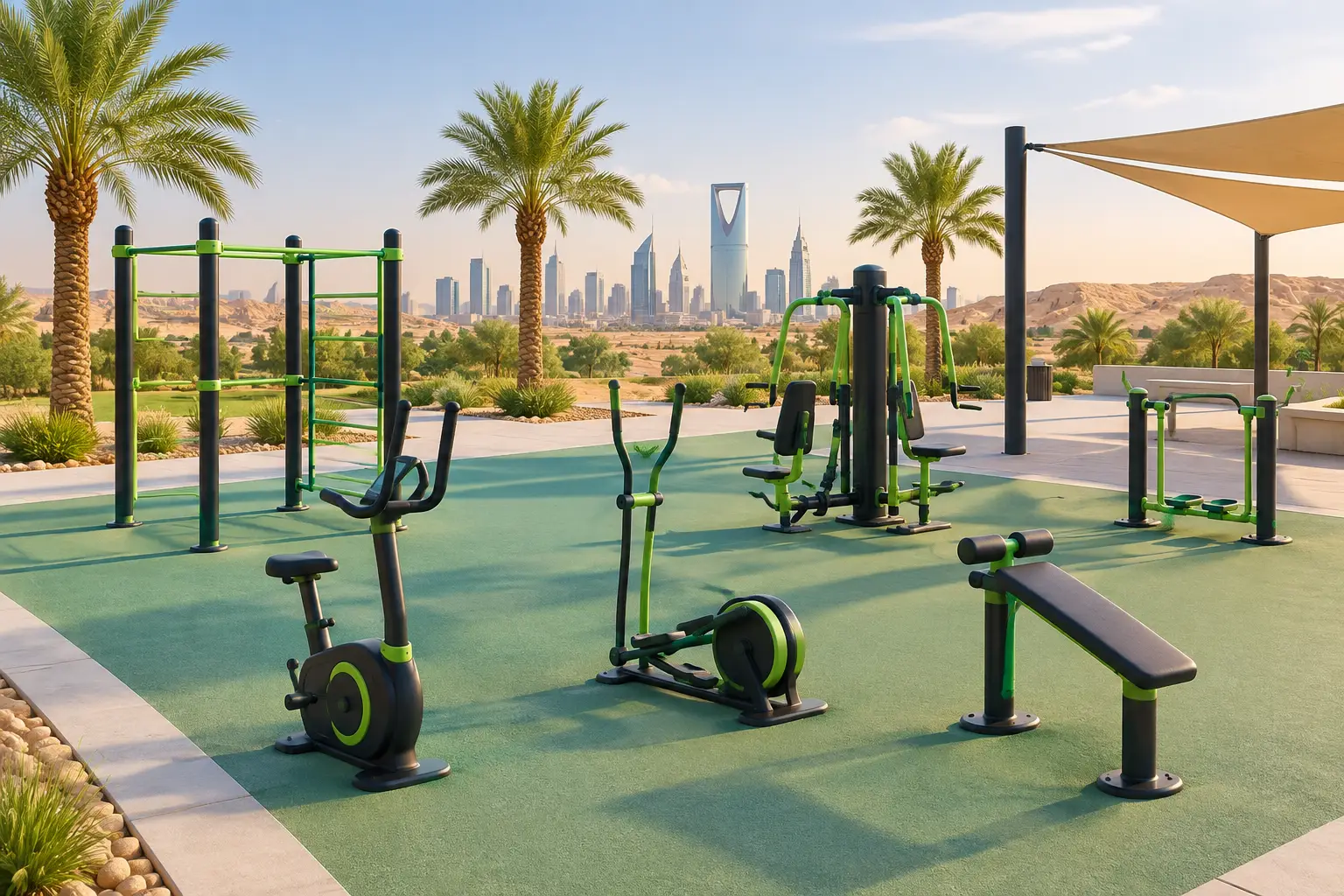
A shaded park corner can become a high-value wellness asset, while the same equipment placed on an exposed, poorly prepared slab can quickly become an underused liability. Selecting the best outdoor fitness equipment for a Saudi development is not simply a question of choosing popular exercise stations. It is a design, engineering, safety, and lifecycle decision shaped by heat, UV exposure, user volume, accessibility, and the purpose of the wider destination.
For municipalities, schools, compounds, hospitality projects, and mixed-use developments, the strongest result is an outdoor fitness area that feels intuitive from day one and remains safe, attractive, and operationally sound for years. That requires equipment and surfacing designed as one coordinated system.
What Makes Outdoor Fitness Equipment Fit for Saudi Conditions?
Outdoor equipment in Saudi Arabia must perform through sustained sun exposure, high surface temperatures, dust, and regular cleaning requirements. A station that looks suitable in a catalog may not be appropriate for an open public realm in Riyadh, Jeddah, Dammam, or a destination environment with extended daily use.
Material specification is the first control point. Structural frames should use corrosion-resistant, heavy-duty steel systems with a durable exterior coating designed for UV stability and abrasion resistance. Hardware should be tamper-resistant and protected against corrosion. Moving components, where included, need sealed bearings or similarly protected mechanisms that can maintain smooth movement without becoming a frequent maintenance concern.
The equipment itself is only part of the performance equation. Metal contact points can become uncomfortable in direct sun, while dark surfacing may retain significant heat. Shade structures, orientation, planting, and material color selection should be considered early in the layout. These choices improve user comfort and help keep the space active during more of the day.
Compliance also matters. Public-facing fitness areas should be selected and installed against applicable recognized safety standards, with age suitability, clear operating instructions, fall zones, and maintenance access addressed before installation begins. A well-equipped area is not automatically a safe one. Clearance around moving parts, stable anchoring, and the correct impact-attenuating surface are fundamental.
The Best Outdoor Fitness Equipment Starts With User Intent
The right equipment mix depends on who will use the area and what the site needs to achieve. A school may prioritize simple, durable stations that support supervised physical education. A residential compound may need accessible, low-intimidation equipment for adults of varying fitness levels. A premium destination may combine functional training with a carefully designed running route, landscape features, and shaded recovery spaces.
Avoid building a collection of isolated machines with no clear training logic. Users should be able to move naturally through warm-up, strength, mobility, cardiovascular activity, and recovery. This creates a more welcoming experience for first-time users while allowing regular users to build a complete session.
Core equipment categories for a balanced zone
A versatile outdoor fitness area usually brings together several distinct categories:
- Bodyweight and calisthenics stations such as pull-up bars, parallel bars, push-up rails, and suspension training frames. These are highly durable, adaptable, and suitable for a broad range of users.
- Cardiovascular equipment such as air walkers, cross trainers, cycles, skiers, or elliptical trainers. These should be commercial-grade and selected carefully, as moving parts require a defined inspection and maintenance plan.
- Strength and resistance stations including leg press, chest press, rowing, and multi-user resistance units. These can make the area more approachable for adults who prefer guided movement paths.
- Mobility and balance elements such as stretching rails, step platforms, balance beams, and low-impact movement stations. These broaden the area’s appeal, especially for seniors and rehabilitation-focused users.
- Functional training structures that support step-ups, hangs, squats, climbing, and group circuits. In parks, campuses, and compounds, these structures often offer the strongest value per square foot.
The ideal mix is rarely the largest one. A compact fitness zone with six well-positioned, high-use stations can outperform a crowded installation with twelve machines and inadequate circulation.
Design the Layout Around Movement, Not Equipment Count
Outdoor fitness spaces work best when they are designed as part of the site rather than added after landscaping or civil works are complete. The equipment zone should have clear visibility from pedestrian routes, appropriate separation from vehicle access, and practical proximity to parking, restrooms, drinking water, or other recreational assets where relevant.
Begin with circulation. Users need a logical entry point, visible rules, and enough room to move between stations without crossing active exercise paths. Equipment requiring swinging or rotating movement needs its full operating clearance, not just enough space to physically fit on the slab. Group training areas require more open space than individual equipment bays.
Zoning can improve both safety and user experience. Place dynamic cardio and functional training stations where circulation is generous. Locate stretching and low-intensity mobility equipment in quieter areas, ideally with shade. If the development serves families, a fitness zone near a play area can be effective, but it must remain physically distinct so children do not enter active equipment clearances.
Accessibility should be integrated rather than treated as an afterthought. Step-free access routes, firm and stable surfacing, seating nearby, readable signage, and equipment appropriate for different physical abilities make the space more inclusive. This is particularly valuable for public parks, health-focused communities, education campuses, and large residential developments.
Surfacing Is a Safety System, Not a Finish Layer
The equipment base has a direct effect on fall protection, drainage, cleanliness, appearance, and maintenance. For outdoor fitness areas, the surface should be selected according to the equipment type, fall-height requirements, anticipated traffic, and the architectural character of the project.
EPDM rubber flooring is a common high-performance option because it can provide impact attenuation, slip resistance, color flexibility, and a clean visual finish. Its thickness must be engineered for the critical fall height and the specific equipment arrangement. A thin decorative rubber layer is not a substitute for a compliant safety surface.
Poured-in-place systems can create continuous, accessible surfaces with fewer trip points than loose-fill materials. They are particularly suited to institutional and premium developments where visual quality and ease of cleaning are priorities. However, installation quality is critical. Base preparation, binder quality, drainage design, and curing conditions all influence long-term performance.
Artificial turf may suit functional training zones, sled areas, or fitness routes, but it should not be assumed to deliver impact protection unless the full system has been engineered for that purpose. Concrete is durable and useful for pathways or selected workout pads, yet it is not appropriate beneath equipment where impact attenuation is required.
Plan for Heat, Shade, and Daily Operation
Saudi outdoor fitness design should respond to real usage patterns. In hotter months, facilities are most likely to be used early in the morning and after sunset. Lighting, shade, visibility, and thermal comfort therefore influence participation as much as the equipment selection itself.
Shade can be provided through purpose-built canopies, tensile structures, mature planting, or adjacent building forms. It should not interfere with equipment operating zones or reduce head clearance. Consider the sun path when positioning stations so users are not forced to face direct glare during exercise.
Lighting should support safe evening use, clear wayfinding, and visual security without creating harsh glare or dead zones. Durable fixtures, protected cable routing, and service access are essential for public and high-traffic environments. Drainage also deserves early attention. Even in arid regions, occasional heavy rainfall can expose weaknesses in grading, base construction, and surface joints.
A practical maintenance plan protects the initial investment. Operators should schedule visual checks for loose components, surface wear, damaged coatings, and unauthorized modifications. Periodic inspections should assess anchors, moving parts, signage, surfacing condition, and drainage performance. Specifying equipment with readily available replacement parts and establishing clear contractor accountability reduces downtime over the asset’s life.
Specify for Long-Term Asset Value
The best outdoor fitness equipment is not necessarily the lowest-cost equipment at procurement stage. A more useful measure is whole-life value: expected service life, maintenance demand, user capacity, safety performance, warranty coverage, and the ability to replace components without disrupting the entire area.
For public-sector and developer-led projects, a full-scope approach gives decision-makers greater control. Site survey, concept planning, equipment selection, civil works, foundations, surfacing, installation, inspections, and maintenance planning should align under one coordinated delivery strategy. This limits the gaps that can occur when equipment, flooring, and construction are treated as unrelated packages.
StepX Sports approaches outdoor fitness areas as complete recreational environments built for Saudi conditions, combining durable equipment, engineered safety surfacing, precision installation standards, and practical long-term support.
A successful outdoor fitness zone gives people a reason to stay longer, return more often, and make movement part of daily life. Specify it with the same care applied to courts, tracks, and public spaces, and it can become a visible, lasting part of a development’s wellness legacy.