
Athletic Surface Lifecycle Cost Guide for Saudi
Recent Posts
Selecting Turf Infill Materials for Saudi Sports
September 14, 2026
How to Upgrade Campus Recreation for Daily Use
September 13, 2026
Best Padel Court Materials for Saudi Conditions
September 12, 2026
Best Outdoor Fitness Equipment for Saudi Sites
September 11, 2026
Share Post
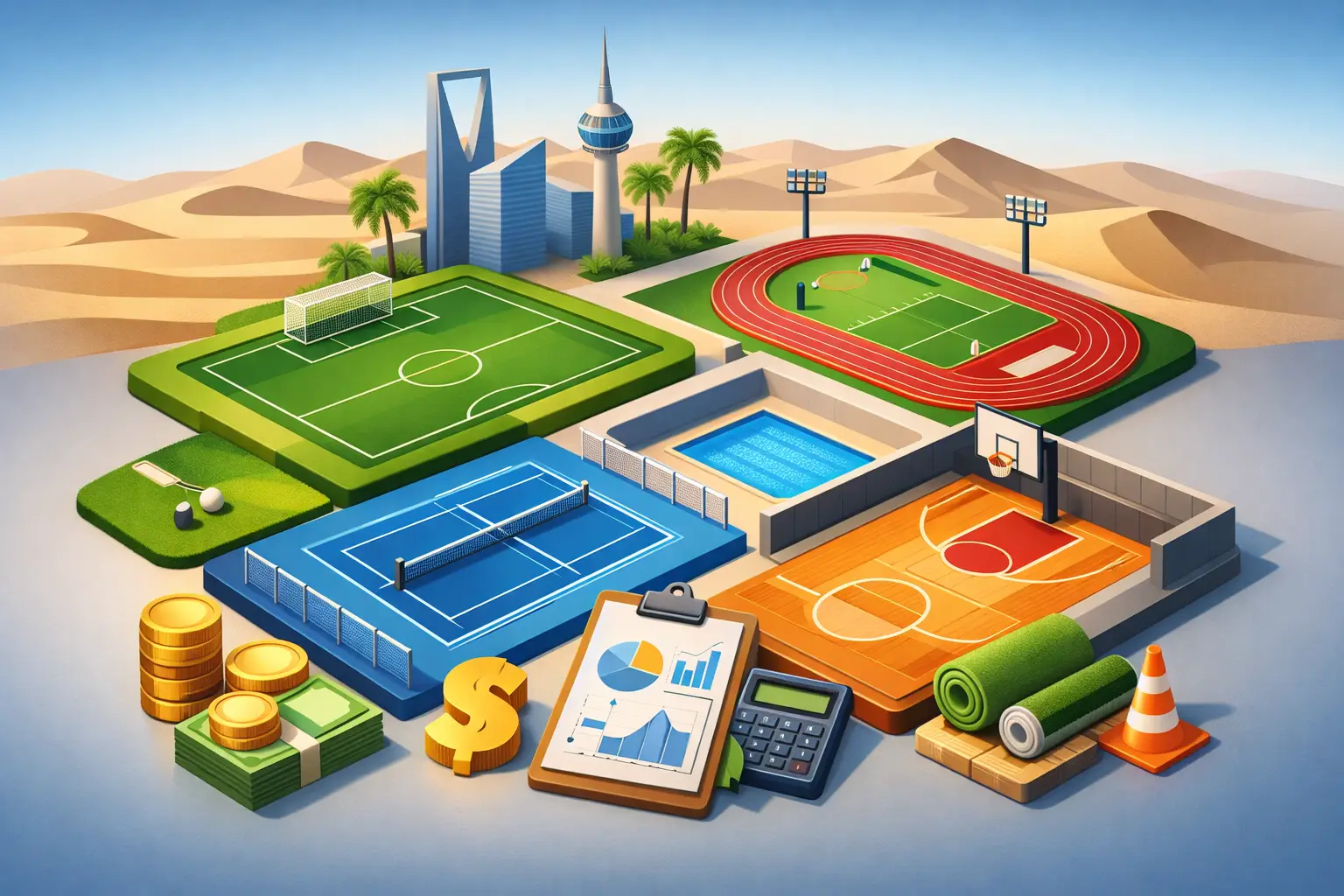
A low tender price can become the most expensive decision in a sports facility project. A court that fades, cracks, loses drainage performance, or requires premature resurfacing disrupts users, pressures operating budgets, and weakens the value of the wider development. This athletic surface lifecycle cost guide helps project owners assess the full cost of ownership before specifying a court, track, pitch, or recreation area.
For developers, municipalities, schools, compounds, and destination operators, the objective is not simply to buy a surface. It is to commission a safe, consistent, durable asset that performs through Saudi Arabia’s heat, UV exposure, sand, heavy traffic, and demanding public use.
What Lifecycle Cost Really Includes
Lifecycle cost is the total expenditure required to plan, build, operate, maintain, repair, renew, and eventually replace an athletic surface over its working life. The installation contract is only the starting point.
A credible budget considers design development, site investigation, civil works, base construction, drainage, materials, installation, inspections, routine maintenance, repairs, downtime, and end-of-life renewal. It should also account for the operational consequences of failure. If a school court is closed during term time or a hospitality facility cannot offer a promised amenity, the cost extends beyond the repair invoice.
The lowest initial cost may be appropriate for a lightly used private recreation zone with modest performance requirements. It is rarely the right benchmark for a high-traffic municipal court, a school campus, or a premium destination asset where safety, appearance, and availability are part of the operator’s reputation.
Start With the Site, Not the Surface
Surface selection must follow the site conditions and intended activity. A material specification cannot correct an unstable subbase, poor falls, inadequate drainage, or unfinished utility coordination.
In Riyadh, Jeddah, Dammam, and developing regional destinations, heat cycles and exposure can place significant stress on sports surfacing systems. Subgrade condition, soil movement, groundwater, existing slab quality, surrounding landscape irrigation, and access for maintenance equipment all influence the asset’s long-term cost.
A full-scope assessment should establish how water leaves the playing area, where it will discharge, whether the base can retain its profile under use, and how edges connect to curbs, fencing, lighting foundations, and adjacent paving. Water trapped below or beside the surface can accelerate defects even in environments where annual rainfall is limited.
Early investment in correct grading, compaction, drainage, and base tolerances is often one of the strongest lifecycle-cost controls available. It reduces the likelihood that a visible surface defect becomes a civil reconstruction issue later.
The Athletic Surface Lifecycle Cost Guide by System
Different sports systems carry different cost profiles. The right choice depends on expected use, user age, maintenance capacity, design intent, and the required service life.
Acrylic courts
Acrylic systems are widely used for tennis, basketball, multi-sport courts, and recreational zones because they offer clean appearance, consistent ball response, and straightforward maintenance. Their lifecycle performance depends heavily on the asphalt or concrete base beneath them.
Routine cleaning, line inspection, crack monitoring, and periodic recoating help preserve color, texture, and slip resistance. When the base is correctly engineered and movement is controlled, planned resurfacing is generally more predictable than major reconstruction. Where base cracking is ignored, however, resurfacing alone may only conceal a recurring problem.
Artificial turf fields and landscape sports zones
Artificial turf can provide high availability and a polished appearance for football, multi-use games areas, cricket practice zones, and recreational landscapes. Lifecycle cost varies significantly with pile height, fiber quality, infill selection, shock-pad requirements, seam detailing, drainage design, and intensity of play.
Owners should budget for regular grooming, debris removal, infill management, seam checks, sanitization where appropriate, and replacement planning. A turf system that is used continuously without maintenance can compact, lose play consistency, and create localized wear in goalmouths, entry points, and training lanes.
For high-use fields, the question is not whether maintenance is required. It is whether maintenance has been designed into the operating plan from day one.
EPDM and polyurethane flooring
EPDM rubber and polyurethane systems are often selected for playgrounds, outdoor fitness spaces, running areas, and multi-purpose recreation environments because they support impact attenuation, comfort, and visual design flexibility. Their performance relies on proper layer thickness, substrate preparation, drainage, and material compatibility.
Low-quality binders or weak installation control can lead to granule loss, discoloration, brittle areas, or separation at joints. A system specified for heat resistance and installed to controlled thicknesses will usually have a stronger lifecycle profile than a lower-cost alternative with no verified installation standard.
Running tracks
Running tracks require precise geometry, stable foundations, drainage, and a surface system suited to the expected athletics program. A school training track, community jogging loop, and competition-focused facility do not need the same specification, but each needs a clearly defined performance target.
Cleaning, joint inspections, localized repairs, and careful management of unauthorized vehicle access protect the surface. Track damage from service vehicles or poor edge transitions can be disproportionately expensive because repairs must maintain level, texture, and lane continuity.
Build a Budget Around Four Cost Periods
A practical lifecycle plan separates costs into four periods rather than treating maintenance as an afterthought.
First, include capital delivery: surveys, design, permits where required, civil works, drainage, foundations, surface materials, equipment, fencing, lighting interfaces, testing, and handover. This phase defines most future maintenance exposure.
Second, estimate routine operations. This includes cleaning, brushing or grooming, debris control, minor line or joint repairs, inspections, and staff time. These costs are relatively modest but essential because they prevent small issues from becoming early failures.
Third, establish a planned renewal allowance. Acrylic recoating, turf replacement, rubber surfacing renewal, or track restoration should be anticipated as a future capital event. The interval will depend on traffic, exposure, quality of installation, and maintenance discipline. Planning the reserve protects the facility from deferred maintenance cycles that degrade user experience.
Finally, model unplanned risk. Base settlement, vandalism, irrigation leaks, flood events, vehicle damage, and neglected drainage can trigger costs outside a standard maintenance budget. Contingency is not pessimism. It is responsible asset management.
Measure Value Beyond Material Price
When comparing proposals, owners should request more than a per-square-foot surface rate. A meaningful comparison identifies base build-up, drainage assumptions, material brand and technical data, thicknesses, installation methodology, warranties, testing, maintenance requirements, and exclusions.
It should also clarify who is accountable when the interface between civil works and surfacing fails. Split scopes may appear competitive at procurement stage, yet they can create disputes when cracking, ponding, or edge failure emerges. Integrated design-and-build delivery gives the owner clearer responsibility across the complete system.
Useful evaluation questions include whether the surface is engineered for local UV and temperature conditions, whether the subbase is designed for actual traffic, and whether the contractor can support inspection, repair, and renewal after handover. Certified materials matter, but their value is realized only through correct storage, preparation, installation, and quality control.
Design for Maintenance Access and Safe Use
Good lifecycle planning is visible in small details. Maintenance access should not require driving across a running track or artificial turf field. Drainage channels must be accessible for cleaning. Fence gates should be wide enough for approved equipment but controlled enough to limit unauthorized vehicles. Landscape irrigation must not overspray courts or create persistent wet edges.
The facility should also be designed around how people will actually use it. A multi-sport court near a school entrance may require more durable perimeter detailing than an enclosed private court. A public outdoor fitness zone may need higher wear resistance and easier cleaning than a low-traffic residential amenity. Designing to the real operating pattern prevents over-specification in one area and premature wear in another.
Make Lifecycle Decisions Before Tender
The strongest time to control cost is before the project goes to market. Define the expected user load, desired asset life, maintenance capability, safety requirements, and renewal strategy in the brief. Then select a system and construction detail that can meet those conditions without relying on optimistic assumptions.
StepX Sports approaches athletic infrastructure as a long-term community asset, not a short-term finish. When the base, drainage, material system, installation standard, and maintenance plan are aligned, a sports surface can continue delivering safe play, visual quality, and reliable availability long after opening day.
The useful final question is simple: will this specification still serve the people using it five, eight, or ten years from now? A lifecycle-led answer creates facilities that keep communities moving and protects the development value behind every square foot.