
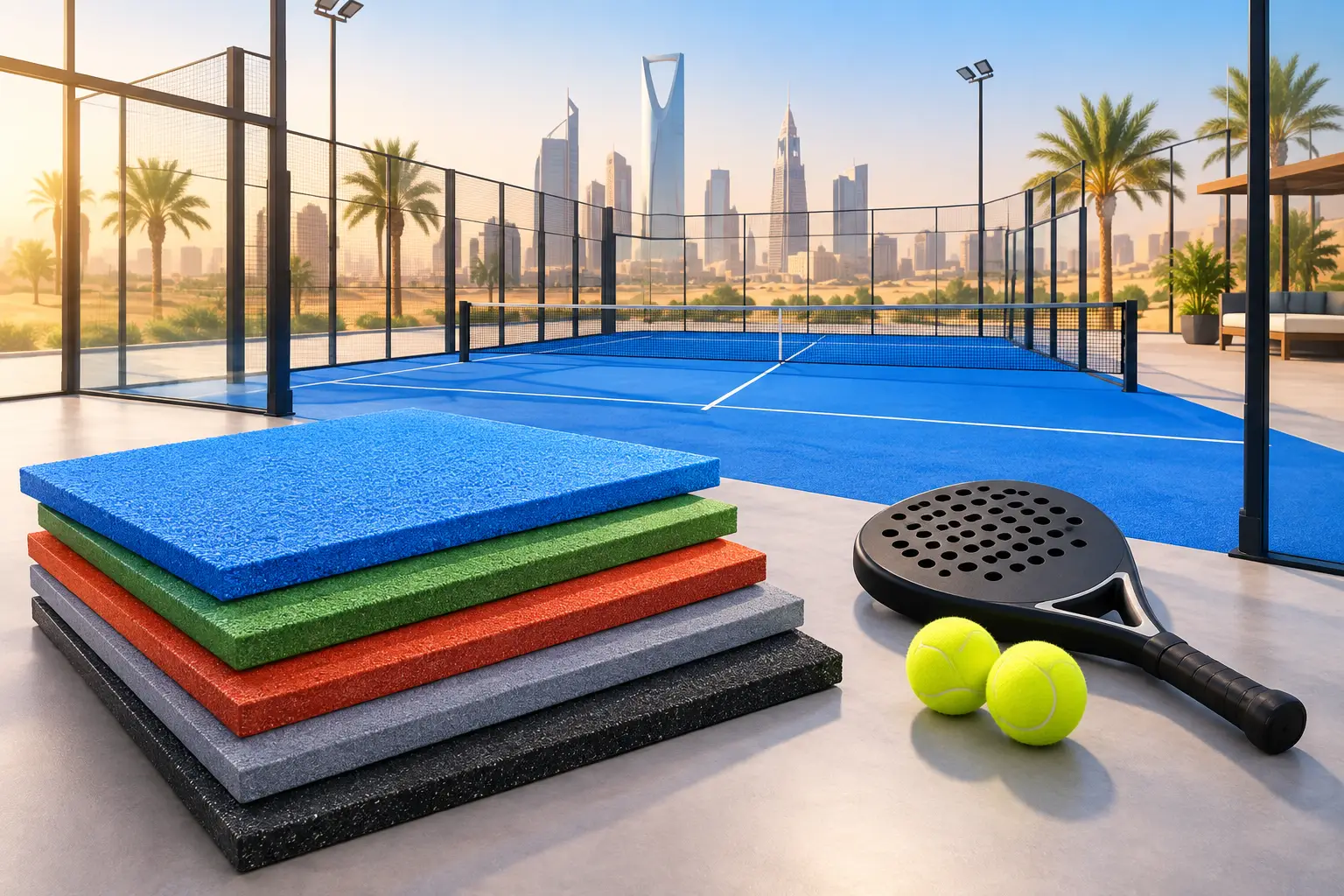
Riyadh Padel Flooring Options for Lasting Play
Recent Posts
Selecting Turf Infill Materials for Saudi Sports
September 14, 2026
How to Upgrade Campus Recreation for Daily Use
September 13, 2026
Best Padel Court Materials for Saudi Conditions
September 12, 2026
Best Outdoor Fitness Equipment for Saudi Sites
September 11, 2026
Share Post
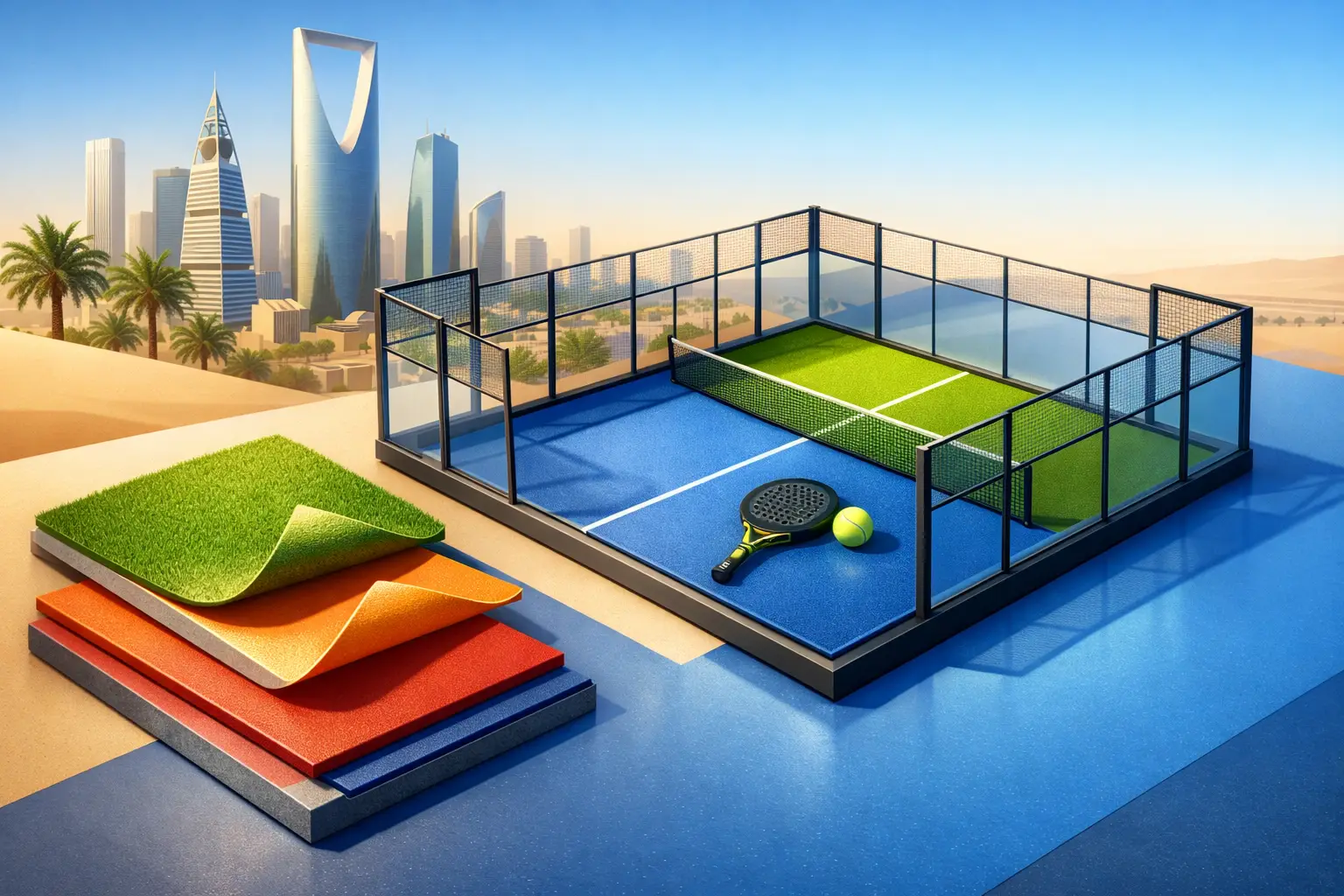
A padel court can look complete when the glass, steelwork, lighting, and turf are in place. Its long-term success, however, is decided lower down. The right Riyadh padel flooring options must manage extreme surface temperatures, repeated player movement, sand migration, drainage, and the operational demands of a high-traffic facility. For a developer or operator, flooring is not a cosmetic finish. It is a performance system that protects the investment in the entire court.
Artificial turf remains the established playing surface for padel, but not every turf specification is suitable for Riyadh. Fiber construction, pile height, infill quantity, shock absorption, backing strength, and sub-base preparation all affect how the court plays on day one and how it performs after years of heat and use. The correct choice starts with the intended player profile and ends with precision installation standards.
Riyadh Padel Flooring Options Start With Court Use
A residential court, a premium club court, and a public-sector recreation facility may all use artificial turf, yet they should not necessarily use the same specification. The expected hours of play, player ability, maintenance resources, and level of exposure should guide material selection.
For private villas and compounds, a quality sand-dressed artificial turf can provide a comfortable, polished playing experience with practical maintenance requirements. The priority is consistent footing, clean appearance, and reliable drainage without overengineering a court that will see moderate daily use.
For commercial clubs, hotels, schools, and destination developments, the surface must withstand concentrated foot traffic around serving positions, net approaches, and rear-court movement. These projects benefit from higher-density turf systems with durable yarns, stable backing, controlled sand infill, and a base designed to preserve evenness under sustained play. When courts operate from morning into the evening, recovery from wear is a central commercial concern.
Municipal and institutional facilities require another level of consideration. High user turnover, varied footwear behavior, and intensive programming place greater pressure on the surface and its perimeter details. A flooring specification should be selected for predictable playability, straightforward maintenance, safe access, and a practical replacement cycle that supports long-term asset management.
Artificial Turf: The Primary Padel Surface
Artificial turf is the preferred surface for modern padel because it supports controlled movement, ball behavior, and player comfort. It is usually installed as a sand-dressed or lightly sand-filled system. The sand stabilizes the fibers, supports traction, and helps maintain the surface’s playing characteristics.
Texturized turf offers a dense, resilient appearance and can work well where a comfortable, lower-maintenance surface is the objective. Its curled fibers provide stability and help distribute infill across the court. It is often a sound option for moderate-use courts when paired with a properly engineered base and suitable drainage.
Monofilament turf uses straighter individual fibers and is commonly specified for higher-performance environments. It can provide a more defined playing response and strong visual presentation, particularly when the yarn quality, stitch rate, and backing are selected for heavy usage. The trade-off is that premium monofilament systems require disciplined installation and ongoing infill management to retain their intended performance.
Hybrid systems combine texturized and monofilament yarns. They are often chosen for facilities seeking a balance of player comfort, visual quality, fiber recovery, and wear resistance. For a high-profile development, this can be a practical route when the court needs to look premium while operating reliably throughout the year.
Pile height should never be selected by appearance alone. A taller pile may feel softer but can alter ball response and require more careful infill control. A shorter pile can feel faster and more direct, yet it may place higher demands on base smoothness and installation accuracy. The appropriate pile height is the one that works with the selected yarn, sand type, infill volume, and anticipated playing intensity as a complete system.
The Role of Sand Infill
Silica sand is not an afterthought. Its grading, cleanliness, distribution, and quantity influence grip, fiber support, drainage, and ball bounce. Poorly graded or contaminated sand can compact unevenly, migrate toward the edges, and create inconsistent footing. Insufficient infill leaves fibers unsupported; excessive infill can make the surface heavy, slow, and less comfortable underfoot.
In Riyadh, routine brushing and infill redistribution are especially important. Wind, intensive play, and cleaning practices can move sand away from high-action areas. A planned maintenance regime protects surface consistency far more effectively than reactive repairs.
Shock Pads and Player Comfort
A shock pad is an optional elastic layer installed beneath the turf. It can improve impact attenuation, add comfort, and help create a more forgiving feel under repeated movement. For premium clubs, schools, and facilities focused on active-lifestyle programming, it can be a valuable part of the player experience.
However, a shock pad is not automatically the right choice for every project. It increases initial investment and must be compatible with the drainage approach, turf backing, and final court height. On a low-use private court with a well-designed base, a quality turf system without a shock pad may be entirely appropriate. On a high-usage court intended for long sessions and broad user groups, the additional comfort can support the facility’s positioning and operational value.
The decision should be based on performance goals, not a generic product upgrade. A full-scope contractor evaluates the pad, turf, adhesive, seams, base, and drainage together so the layers perform as one engineered assembly.
Base Construction and Drainage Decide Durability
Even the best artificial turf will underperform on an unstable or poorly drained base. The flooring system depends on a level, correctly sloped, structurally sound foundation. In most projects, this means a prepared concrete or asphalt base with drainage provisions appropriate to the site and court design.
Flatness matters. Small irregularities beneath the turf can affect bounce, create visible rippling, and accelerate localized wear. The base must also account for the padel structure, glass supports, perimeter containment, and the interface between the playing surface and surrounding walkways.
Riyadh’s climate creates a particular challenge: surfaces experience intense heat for extended periods, while occasional heavy rainfall can expose drainage weaknesses quickly. A court should move water efficiently without allowing it to remain trapped within the turf system or at perimeter edges. Drainage is not simply about adding outlets. It requires coordinated falls, suitable base detailing, clean drainage paths, and installation workmanship that does not obstruct water movement.
Where a project is exposed to direct sun for most of the day, UV-stabilized yarns, durable backing, and heat-conscious material selection are essential. No surface can eliminate the effect of high ambient temperatures, but a properly specified system reduces premature fading, fiber fatigue, adhesive failure, and unnecessary maintenance pressure.
What Not to Use as the Main Playing Surface
Acrylic and polyurethane systems are high-performing choices for tennis, basketball, multipurpose courts, and other applications. They are not usually the primary choice for a conventional padel court. Padel requires the traction, controlled slide, and ball interaction associated with artificial turf, while the enclosed glass court creates a distinct playing environment.
Hard coatings may be relevant for adjacent walkways, spectator zones, entry areas, or multi-sport spaces within the same development. EPDM rubber flooring can also be effective around outdoor fitness and children’s activity zones. These materials have clear roles in a recreation masterplan, but they should not be substituted for a purpose-designed padel turf system simply to simplify procurement.
Selecting a Flooring Partner, Not Just a Product
Flooring performance depends on execution as much as material quality. A turf roll with strong technical data can still fail early if the base is uneven, seams are weak, adhesive is poorly applied, infill is inconsistent, or the surface is installed without allowing for local site conditions.
Decision-makers should expect a contractor to assess the proposed location, access constraints, sun exposure, drainage routes, base condition, court usage, and maintenance plan before finalizing a specification. Material sourcing should be traceable, while installation teams should follow controlled procedures for jointing, stretching, infill application, and final inspection.
StepX Sports approaches padel surfaces as part of a complete recreational asset: court structure, civil works, drainage, surface system, lighting interfaces, safety details, and long-term support. This integrated approach gives developers and operators clearer accountability from concept through handover.
A padel court earns its reputation through every rally played on it. Choose flooring that delivers predictable traction, consistent bounce, and durable comfort under Saudi conditions, then protect that performance through disciplined installation and maintenance.