
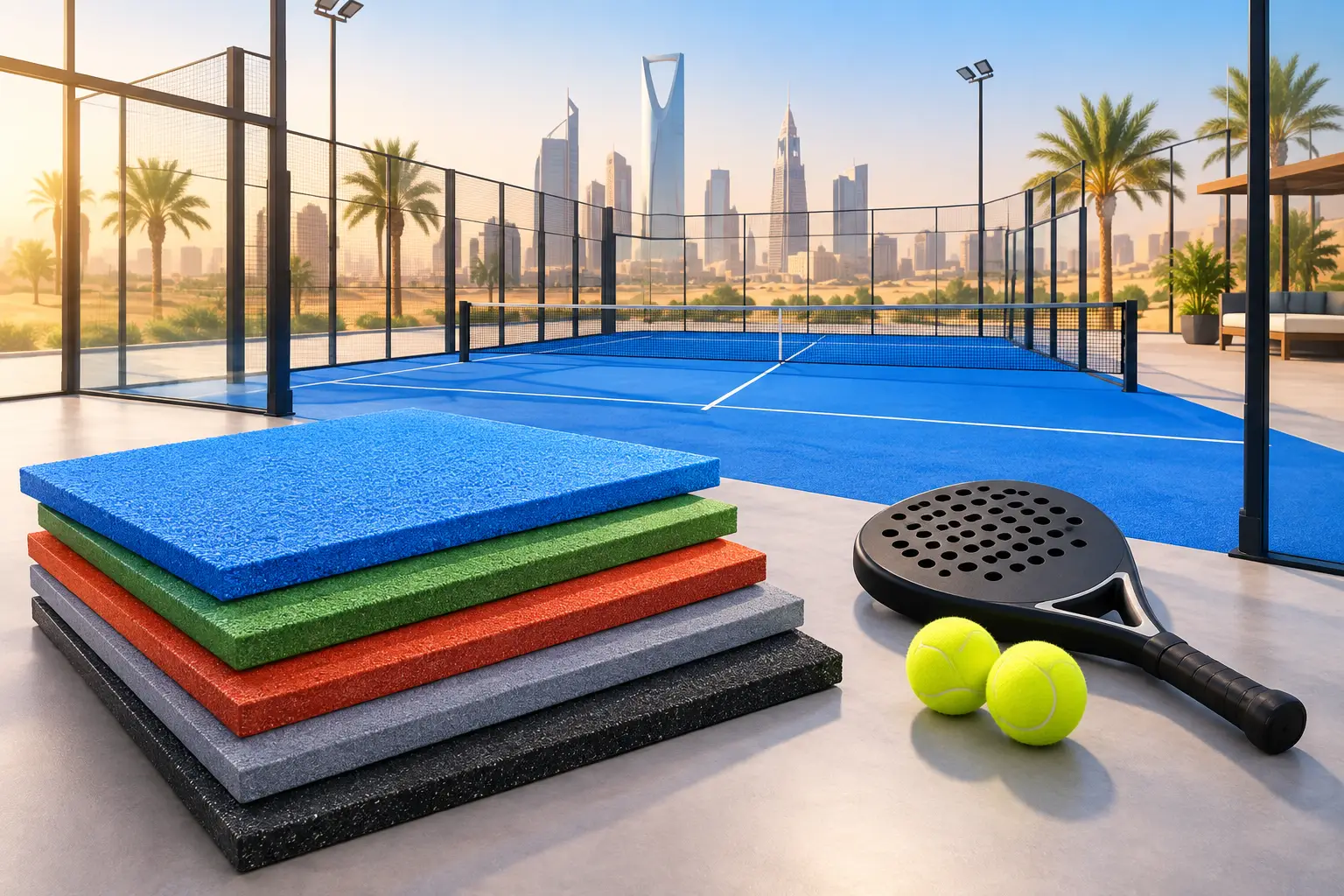
Best Padel Court Materials for Saudi Conditions
Recent Posts
Selecting Turf Infill Materials for Saudi Sports
September 14, 2026
How to Upgrade Campus Recreation for Daily Use
September 13, 2026
Best Outdoor Fitness Equipment for Saudi Sites
September 11, 2026
Riyadh Padel Flooring Options for Lasting Play
September 10, 2026
Share Post
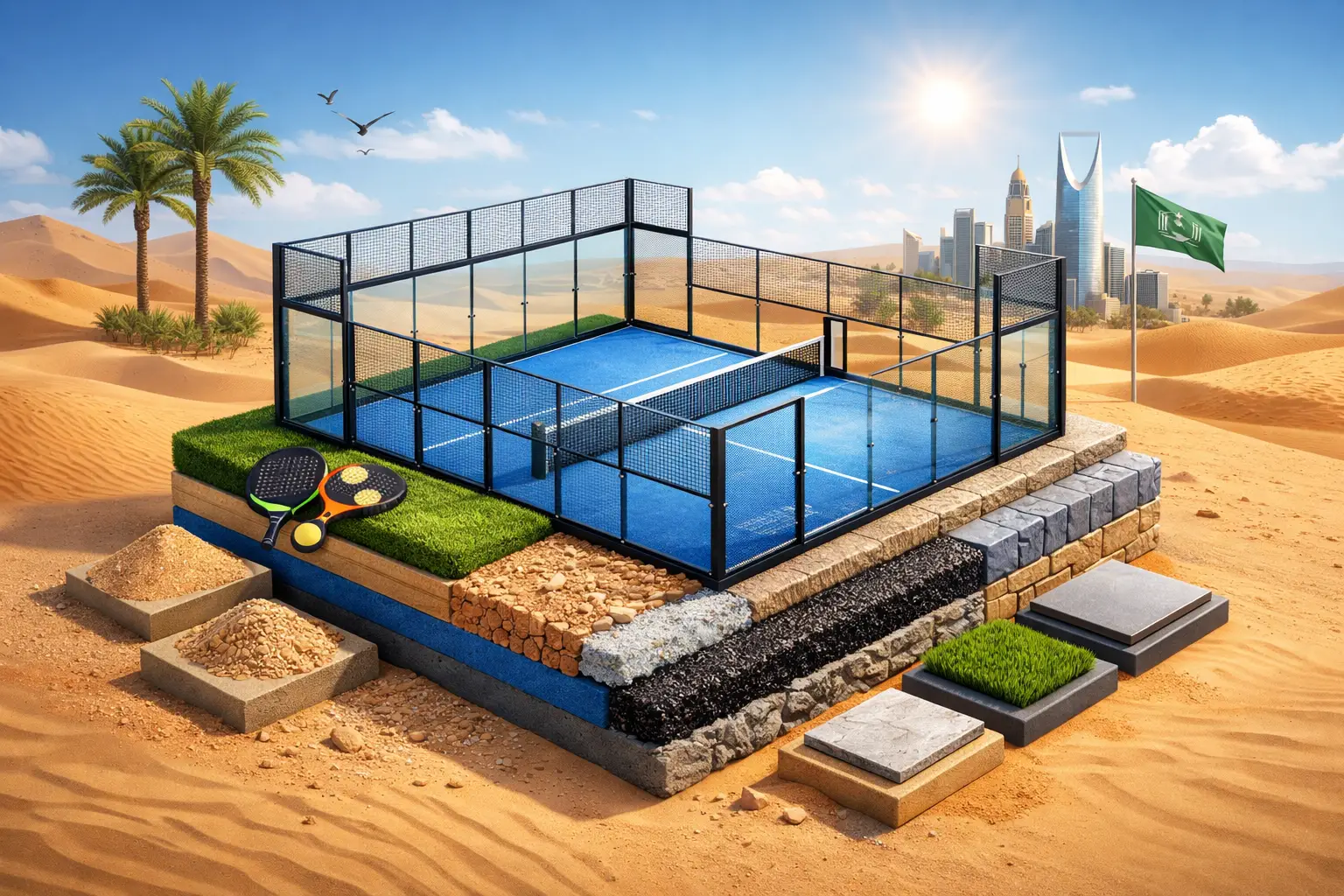
A padel court can look complete on opening day and still become an expensive operational problem within a few summers. In Saudi Arabia, the best padel court materials are not selected for appearance alone. They must perform as one engineered system under intense UV exposure, high surface temperatures, wind-blown dust, heavy evening use, and demanding expectations for safety and finish quality.
For developers, schools, compounds, hospitality operators, and public-sector clients, the material decision affects more than game play. It determines maintenance budgets, downtime, user confidence, asset life, and the long-term reputation of the facility. A high-performance court begins with correct civil works and continues through the steel frame, glass, artificial turf, drainage, lighting, and installation controls.
What Defines the Best Padel Court Materials?
There is no single material that makes a court successful. A padel court is a coordinated structure where each component must support the next. Premium glass cannot compensate for a weak foundation, and high-quality turf will not deliver consistent play if the base holds water, shifts, or develops uneven levels.
The right specification depends on whether the court is enclosed or open-sided, private or commercial, coastal or inland, and lightly used or operated at high booking volume. A destination venue in Riyadh may prioritize intensive use and glare control, while a coastal project near Jeddah may require greater attention to corrosion resistance. In all cases, material selection should begin with a site assessment, not a generic product schedule.
The foundation and sub-base set the standard
The court base is the least visible part of the project and one of the most consequential. A properly engineered concrete slab provides the stable, level platform required for steel anchors, glass panels, turf, and ball behavior. It must be designed around local soil conditions, site drainage, structural loads, and the final court configuration.
For outdoor courts, the slab should incorporate controlled falls and drainage routes that move water away from the playing area. Standing water can accelerate surface contamination, affect turf performance, and create avoidable maintenance work. In regions with high heat, sound concrete design and curing practices are equally important. Poorly finished or inadequately cured slabs can crack, move, or create level variations that affect the entire installation.
A turnkey contractor should coordinate excavation, compaction, reinforcement, concrete works, drainage, and anchor positioning before the court structure arrives on site. This reduces the risk of rework and ensures the court is built to precision installation standards from below grade upward.
Galvanized steel provides structural durability
The steel structure carries the perimeter mesh, supports the glazing system, resists impact, and defines the court’s long-term stability. Hot-dip galvanized steel is a strong choice for outdoor padel courts because its protective zinc coating helps defend against corrosion. A high-quality powder-coated finish adds another protective layer while delivering a clean, project-specific appearance.
Material thickness, welding quality, connection details, and anchoring are as important as the coating itself. Frames should be engineered for wind loads, player impact, glass support, and the local exposure category. In exposed sites, particularly coastal developments, corrosion protection requires careful attention to every cut edge, fixing, weld area, and drainage point within the structure.
Not every project needs the same visual treatment. Black or dark powder-coated frames are common because they reduce visual distraction during play and create a premium appearance. However, finish selection should account for solar gain, cleaning requirements, and the wider architectural palette of the development.
Tempered glass protects play quality and user safety
Padel relies on rebound play from its glass walls, so glazing must provide reliable impact resistance and consistent performance. Tempered safety glass is the standard choice for court enclosures. It is manufactured to withstand the repeated ball and player impacts associated with the sport, while its break pattern is designed to reduce injury risk compared with ordinary glass.
Glass thickness should be selected according to the court design, panel dimensions, support arrangement, and applicable safety requirements. The focus should be on certified glass supply, correct edge finishing, high-quality fittings, and precise installation. A panel may meet the right product specification but still underperform if its supports are misaligned or its fixings are improperly tensioned.
Clear glass gives spectators strong visibility and supports the open, premium character expected from modern padel facilities. It also reveals dust and smudging more readily in outdoor Saudi environments. This is not a reason to compromise on glass quality. It is a reason to plan realistic cleaning access and routine maintenance from the start.
Artificial turf must manage heat, traction, and ball response
Artificial turf is the primary playing surface, and it has the most immediate influence on the player experience. The best padel court materials for the playing surface balance ball bounce, grip, controlled sliding, comfort, UV stability, and resistance to intensive foot traffic.
For Saudi projects, UV-resistant synthetic fibers are essential. Extended sun exposure can fade lower-grade turf, weaken fibers, and reduce the visual quality of the court well before the rest of the structure reaches its expected service life. Dense, purpose-designed padel turf with a suitable pile height provides a more consistent surface than generic landscape turf or multipurpose artificial grass.
Sand infill remains an important part of many padel turf systems. It helps support the fibers, contributes to ball behavior, and enables predictable player movement. The quantity and distribution must be carefully controlled. Too little infill can leave fibers unstable and increase wear. Too much can affect pace, footing, and cleaning requirements. The correct answer depends on the selected turf system, expected use, and whether the court is indoors or outdoors.
Color selection also deserves practical consideration. Blue and green remain popular, but the decision should consider site identity, visibility under lighting, and thermal comfort. No turf color eliminates heat, so shade strategies, operating hours, and surface maintenance should form part of the wider response.
Mesh panels, gates, and hardware need equal attention
Galvanized, powder-coated welded mesh closes the non-glass portions of the enclosure and absorbs regular ball impacts. The mesh aperture, wire gauge, frame integration, and finish must be selected to prevent deformation and maintain a clean visual line over time.
Access gates require durable hinges, secure latching, safe clearances, and smooth operation. These details are often treated as minor accessories, yet they are among the most frequently handled parts of a busy court. Commercial venues should specify hardware that can tolerate repeated daily use and can be serviced without disrupting court operations.
LED lighting extends operating value
For many Saudi facilities, evening play is the commercial and social peak. High-efficiency LED floodlighting allows operators to extend usable hours while maintaining clear visibility across the full court. Lighting positions must minimize glare for players while preventing shadows near the net, rear glass, and corners.
A well-designed system considers lux levels, uniformity, mounting heights, electrical protection, control options, and maintenance access. In outdoor environments, luminaires and electrical components should be selected for dust, heat, and weather exposure. Poor lighting can make even a well-built court feel substandard, particularly for competitive play or premium hospitality settings.
Material Selection Is Also a Maintenance Decision
The lowest initial price is rarely the lowest lifecycle cost. Courts built with weak coatings, unsuitable turf, underspecified steel, or incomplete drainage can demand early repairs and interrupt revenue-generating use. The better approach is to match materials to the operating model before procurement begins.
A private villa court may accept a different maintenance profile than a municipal facility or a high-volume commercial club. Public and institutional projects should prioritize durable finishes, replaceable components, dependable spare-part access, and surfaces that can be inspected and maintained efficiently. Developers should also define cleaning, infill grooming, structural inspections, glass checks, and lighting maintenance as part of handover planning.
Specify a Complete Court System, Not Separate Products
Successful padel delivery depends on coordination. The civil contractor, steel fabricator, turf installer, electrical team, and project manager must work from one approved design and one clear sequence of responsibilities. When materials are purchased separately without system control, tolerance conflicts and warranty gaps become more likely.
StepX Sports approaches padel courts as full-scope recreational assets, integrating site preparation, material selection, court installation, lighting, inspections, and long-term support. This model gives clients clearer accountability and helps ensure every component is built for Saudi conditions rather than simply assembled on site.
Before appointing a contractor, request detailed specifications for the structural steel, corrosion protection, glass type, turf construction, infill, drainage, lighting, anchoring, and quality-control process. Ask how the design responds to the specific location, expected traffic, exposure, and maintenance capacity. A complete answer is more valuable than a low headline price.
The strongest padel courts become active social infrastructure: places where residents, students, guests, and teams return week after week. Select materials with that long service life in mind, and the court will continue to perform long after the opening event has passed.