
How to Specify Running Track Systems for Saudi Sites
Recent Posts

Adventure Parks Built for Saudi Conditions
November 1, 2026
Artificial Turf Dust: Causes, Risks, and Control
October 31, 2026
Acrylic Court System Review for Saudi Projects
October 30, 2026
What Drives Strong Padel Court Profitability?
October 29, 2026
Share Post
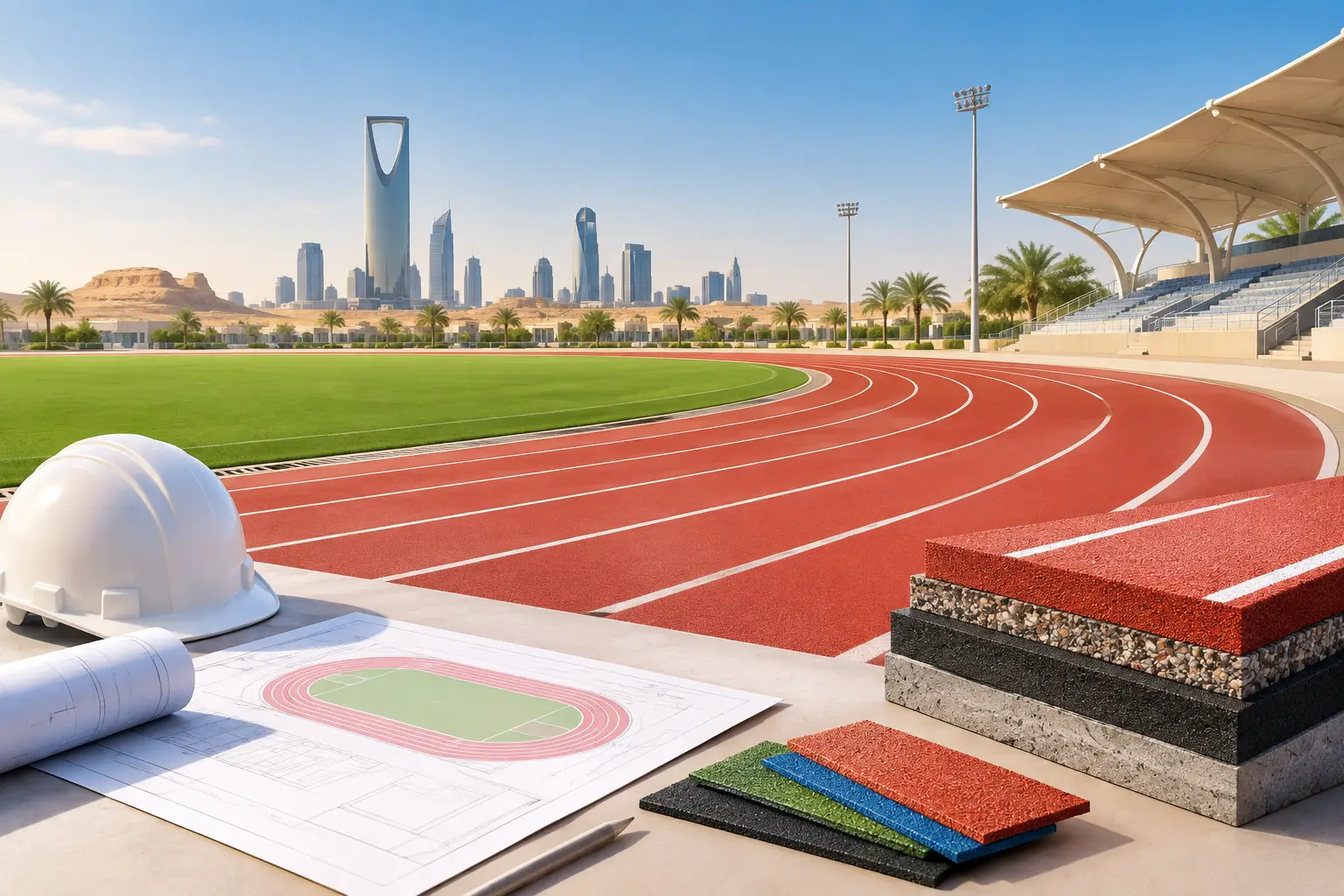
A running track can look complete on opening day and still fail its owner within a few seasons. Cracking at the perimeter, standing water after irrigation or rainfall, faded lane markings, hard underfoot performance, and loose seams usually begin with decisions made before installation. Knowing how to specify running track systems correctly means defining the intended use, engineering the foundation, and selecting materials built for Saudi conditions rather than choosing a surface by color or initial cost.
For municipalities, schools, compounds, destination projects, and private developments, the specification should protect more than a budget line. It should establish a safe, consistent athletic surface with a predictable maintenance profile and a service life aligned with the asset’s role in the wider development.
Start With the Track’s Actual Use
The first specification question is not whether the finish should be red or blue. It is who will use the track, how often, and at what level of performance.
A school or community jogging loop may prioritize comfort, slip resistance, durability, and straightforward maintenance. A competitive athletics facility must address dimensional accuracy, lane geometry, markings, event zones, and performance criteria suitable for sanctioned competition. A hospitality or residential development may need a track that integrates into landscaping and pedestrian circulation while still remaining comfortable and durable under daily use.
This distinction determines the appropriate system build-up. A surface intended for recreational training is not automatically suitable for high-intensity sprinting, spikes, or athletics events. Conversely, specifying a competition-grade system for low-volume walking can add cost without creating proportional value. The correct solution is performance-led, not product-led.
The design brief should also establish whether the facility will support sprinting, middle-distance running, walking, school sports days, fitness programming, or formal athletics events. If football, infield activities, or multipurpose programming are planned, coordinate these uses early. Late changes to the infield, kerbs, drainage, or access routes can compromise the track layout and increase civil works costs.
Define the Geometry Before Selecting the Surface
A compliant running track begins with accurate geometry. For a standard athletics venue, the layout must account for lane widths, radii, staggered starts, finish lines, relay exchange zones, run-offs, and the locations of field-event facilities. These elements should be developed against the relevant governing-body requirements when official competition is intended.
Not every project needs a full 400-meter, eight-lane track. A six-lane training track, a 200-meter school track, a straight sprint track, or a landscaped running loop can be the stronger commercial and operational choice. The available footprint, user numbers, surrounding facilities, and long-term operating model should guide the configuration.
Allow adequate safety clearances around the running surface. Fences, walls, lighting columns, benches, trees, and drainage channels should not sit within a runner’s recovery zone. Access points also need careful placement so maintenance vehicles and users do not cross active lanes unnecessarily.
For projects seeking competition recognition, the specification should identify the applicable standards from the outset and require dimensional setting-out by qualified personnel. Surface quality cannot correct inaccurate geometry.
Engineer the Base for Long-Term Performance
The visible polyurethane or synthetic surface is only one part of the system. The base is where running track durability is won or lost.
A properly engineered construction package generally includes subgrade preparation, compaction, grading, drainage provisions, aggregate layers, and an asphalt base designed to provide stable support. The exact build-up depends on geotechnical findings, site levels, groundwater conditions, adjacent paving, intended loads, and local authority requirements.
In Saudi Arabia, high temperatures and broad daily thermal movement place real demands on base construction. Poor compaction, unstable fill, inadequate asphalt thickness, or weak edge restraint can lead to cracking that transfers through the final track surface. This is why the specification should not treat the base as a separate, low-risk civil package. The civil works and sports surfacing teams must coordinate their tolerances, falls, joints, and inspection stages.
Drainage requires the same attention. A track surface needs controlled falls that move water toward designed collection points without creating uncomfortable cross-slopes for runners. Standing water accelerates surface deterioration, leaves slippery patches, and disrupts use after rain or cleaning. Drainage channels should be positioned and detailed so grates, edges, and transitions do not create trip hazards or interfere with lane use.
Require documented checks for levels, compaction, asphalt finish, and surface regularity before the final system is installed. Correcting defects at this stage is far more efficient than repairing a completed track.
Select a System Built for Heat, Traffic, and Use
Running track systems typically use polyurethane binders with rubber granules, installed in different configurations to achieve targeted performance. Common options include permeable systems, sandwich systems, full-pour systems, and spray-coated systems. Each has a place, but they should not be treated as interchangeable.
A permeable system can offer effective drainage and a resilient feel, making it appropriate for many training and community applications. A sandwich system combines a resilient rubber base layer with a sealed wearing course and can provide a durable balance of comfort, performance, and maintenance control. Full-pour systems are often selected where elite performance and precise response are required, while spray-coated options can be economical for lower-intensity facilities when specified carefully.
The right choice depends on use intensity, desired certification level, climate exposure, maintenance capacity, and budget. For Saudi projects, specify UV-stable, heat-resistant materials from certified suppliers and confirm that the complete system, not just an individual ingredient, is suitable for demanding outdoor exposure.
Color also has a performance implication. Darker finishes can absorb more heat, while lighter colors may support a more comfortable surface temperature but can show dirt differently. The choice should balance branding, visual contrast, cleaning expectations, and the local microclimate. Lane lines and markings must use compatible materials that maintain adhesion and visibility through heat, cleaning, and repeated use.
Write Measurable Performance Requirements
A strong specification avoids vague statements such as “high quality” or “premium rubber track.” Instead, it sets measurable requirements for the complete system.
Depending on the project, these can include thickness, shock absorption, vertical deformation, tensile strength, abrasion resistance, slip resistance, drainage performance, bond strength, surface regularity, UV stability, and color consistency. Where competition performance is required, reference the relevant athletics-surface criteria and testing process.
It is equally important to state what the contractor must submit before work begins. Material data sheets, samples, system build-up details, method statements, color schedules, manufacturer credentials, warranties, and quality-control procedures should be reviewed as part of the approval process. This creates traceability between the specified system and the one installed on site.
Avoid allowing substitutions based solely on equivalent appearance or lower price. A substitution may alter binder chemistry, rubber quality, thickness, UV resistance, or installation method. Any alternative should demonstrate equal or better verified performance for the full proposed build-up.
Include Installation Controls and Independent Testing
Running track installation is weather-sensitive and workmanship-dependent. The substrate must be dry, clean, stable, and within the system manufacturer’s permitted tolerances. Ambient temperature, humidity, material mixing ratios, curing times, and application thickness all affect the final result.
Specify trained installation teams, calibrated mixing and application equipment, and staged inspections. The contractor should document substrate acceptance, batch records, environmental conditions, installed thickness, and corrective actions. These records become valuable if a warranty issue or maintenance decision arises later.
For significant public, education, or destination projects, independent testing provides another layer of assurance. Testing should confirm that the installed surface meets the stated technical requirements rather than relying only on product literature. Final inspection should also verify line marking accuracy, seams, edge detailing, drainage behavior, and surface appearance.
StepX Sports applies this full-scope approach because surface performance depends on design coordination, civil preparation, material control, and precision installation standards working as one package.
Plan for Maintenance Before Handover
Even a high-performance track needs a practical operating plan. Maintenance is not complicated, but it must be defined. Routine cleaning removes dust, sand, leaves, and debris that can affect appearance and traction. Periodic inspection identifies damaged markings, isolated wear areas, clogged drainage points, or edge separation before they become larger repairs.
The handover package should include cleaning guidance, approved repair procedures, restrictions on vehicles and chemicals, warranty terms, and a maintenance schedule matched to the facility’s use. Consider nearby landscaping, as loose aggregate, irrigation overspray, and soil migration can shorten the surface’s service life if not managed.
A running track is a long-term community asset, not a decorative finish. Specify the system around real use, verify every layer beneath it, and demand measurable performance at handover. That discipline gives users a surface they can trust and gives owners an asset built to keep people moving for years.