
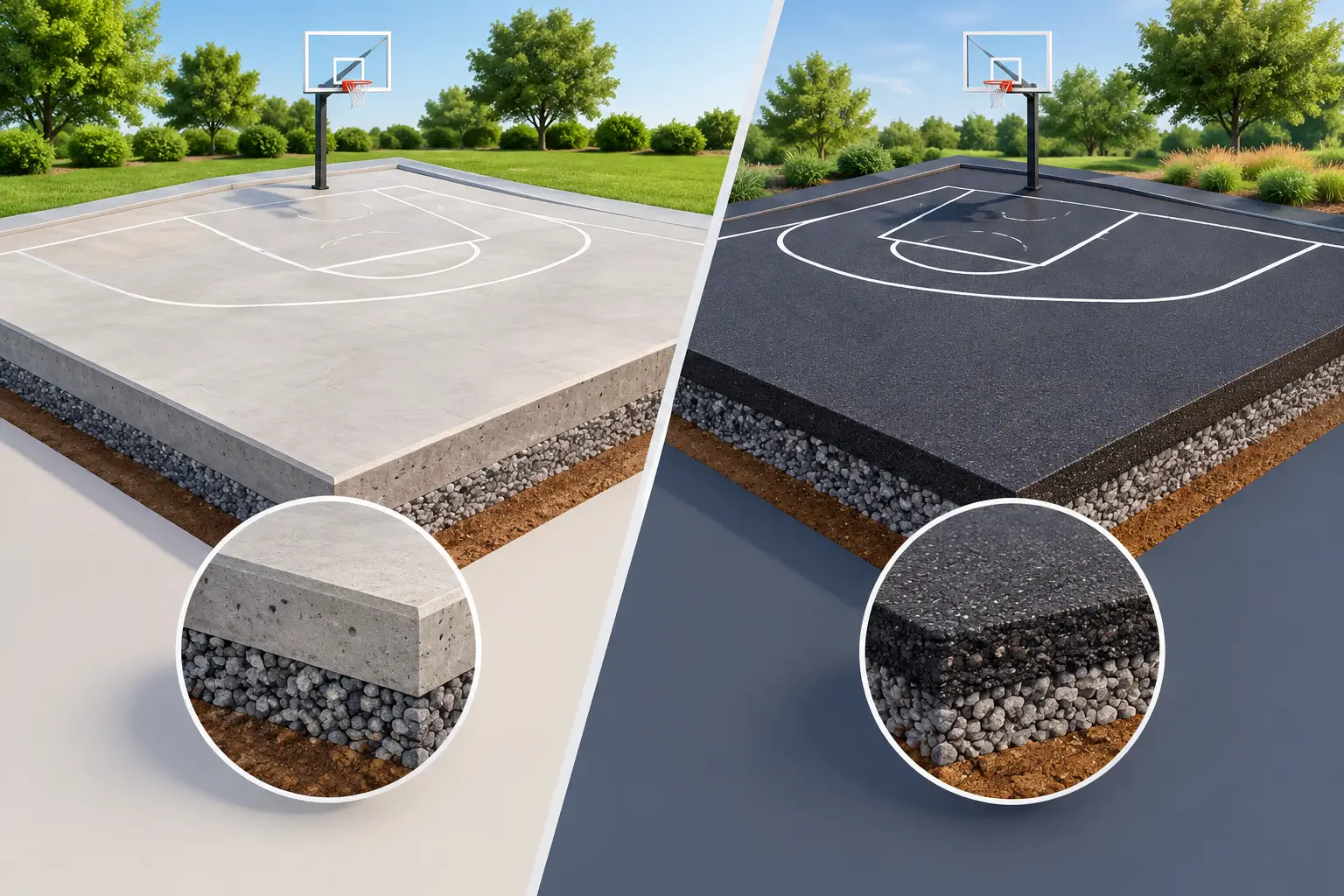
Acrylic Court System Review for Saudi Projects
Recent Posts
Adventure Parks Built for Saudi Conditions
November 1, 2026
Artificial Turf Dust: Causes, Risks, and Control
October 31, 2026
What Drives Strong Padel Court Profitability?
October 29, 2026
Sand Filled Versus Nonfilled Turf for Sports
October 27, 2026
Share Post
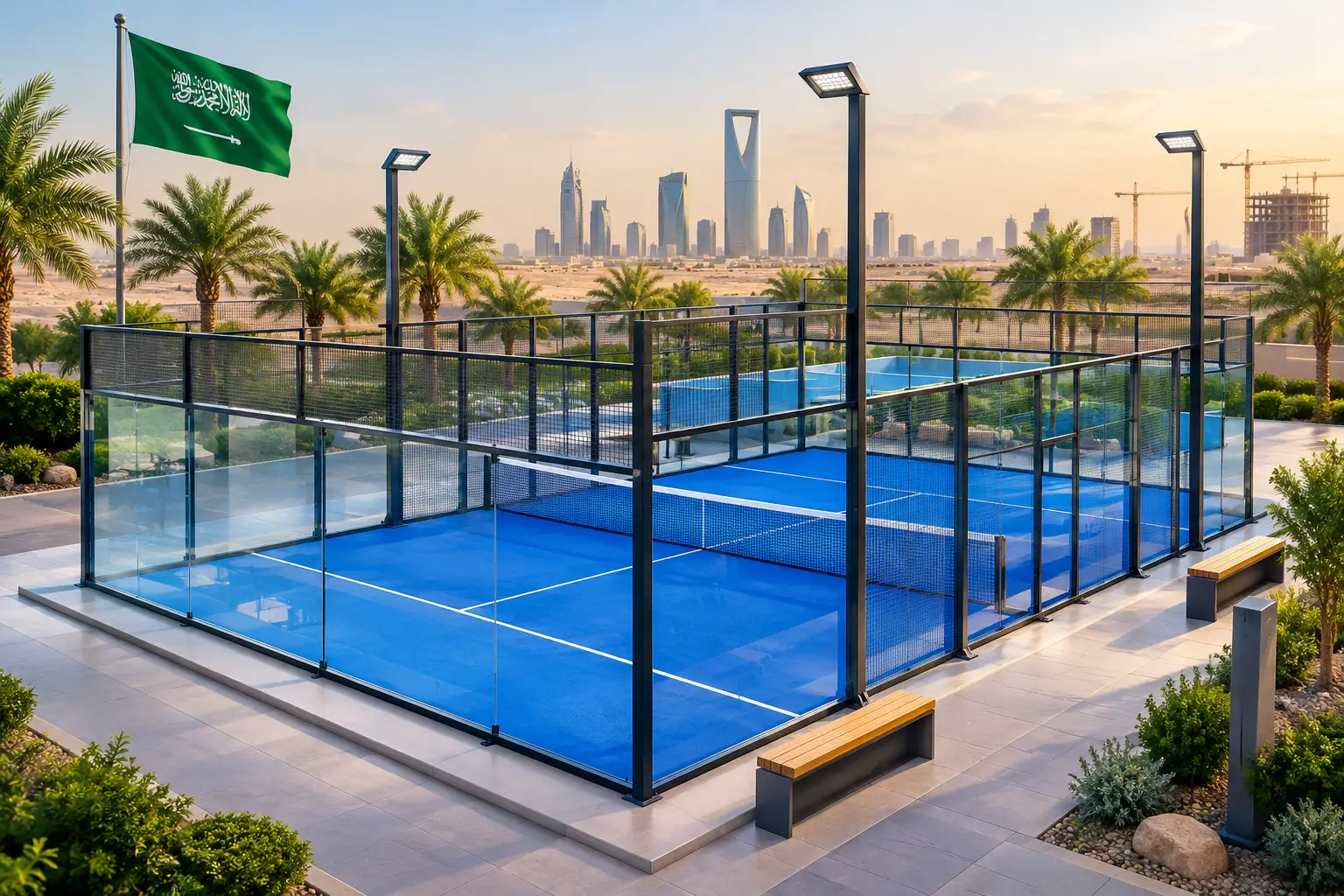
A credible acrylic court system review starts below the visible color coat. For a school, municipality, developer, or compound operator in Saudi Arabia, the real question is not whether an acrylic court looks professional at handover. It is whether the full system will retain its grip, appearance, drainage performance, and playing consistency after years of heat, UV exposure, cleaning cycles, and heavy daily use.
Acrylic surfacing remains one of the strongest choices for outdoor tennis, basketball, multisport, and recreational courts. It is clean in appearance, practical to maintain, and adaptable to different levels of play. But the system performs only as well as its substrate, layer specification, material compatibility, and installation control. A low-cost coating can resemble a high-performance court on day one. The difference becomes clear through the first summer, the first standing-water event, and the first period of intensive use.
What an Acrylic Court System Includes
An acrylic court is not simply paint applied over concrete or asphalt. It is a layered surface system designed to protect the base, provide a uniform playing plane, establish traction, and deliver a durable finished color.
The foundation is usually asphalt or reinforced concrete, built to the required levels and falls. Above it, the contractor applies the appropriate primer or preparation treatment, followed by acrylic resurfacer coats that help fill minor texture and create a consistent base for the finish. Acrylic color coats provide the final playing surface, while line markings define the sport layout. A cushioned acrylic system adds one or more resilient layers below the color coats to improve player comfort and reduce impact fatigue.
Each layer has a specific job. If the substrate moves, holds moisture, or has poor falls, surface coats cannot correct the underlying issue. If the acrylic mix is applied too thinly, or at the wrong spread rate, the finished court may wear prematurely or show inconsistent texture. System performance is therefore a construction outcome, not a product-label outcome.
Acrylic Court System Review: The Criteria That Matter
Decision-makers should assess an acrylic court package against operating conditions, not against color samples or a simple price per square meter. The following factors reveal whether a specification is suitable for a long-life Saudi project.
Substrate quality and drainage
The substrate determines the court’s future stability. It must be properly compacted, structurally sound, and finished within tight tolerance for level and slope. Outdoor courts require planned falls that move water efficiently toward drainage points without creating noticeable changes in ball behavior or player footing.
Standing water accelerates surface deterioration, carries debris across the court, and may expose weak points at cracks and joints. Drainage must be considered across the complete site, including surrounding paving, retaining edges, channels, and landscaping. A well-coated court on a poorly drained plot remains a poorly performing asset.
Concrete bases require particular attention to curing, joints, moisture condition, and crack-management strategy. Asphalt bases require sufficient density and a stable structure before acrylic application. The correct approach depends on the site, budget, schedule, expected loading, and chosen sport, but skipping substrate assessment is never a sound economy.
Heat and UV resistance
Saudi outdoor facilities face conditions that standard generic specifications do not always address. Extreme surface temperatures, direct sunlight, dust, and intense UV exposure place continuous stress on acrylic binders and pigments. A suitable system should use UV-stable materials and colors selected for long-term outdoor exposure.
Color selection also affects user comfort. Dark courts can become significantly hotter under direct sun, while lighter color zones can improve visual comfort and reduce heat absorption. This does not mean every project should use the lightest palette. Tennis visibility, basketball contrast, surrounding architecture, glare, and branding all influence the right solution. The specification should balance thermal behavior with the user’s ability to track the ball, read lines, and play safely.
Texture, traction, and playing speed
Acrylic courts need controlled texture. Too smooth, and the surface can become slippery when dust or moisture is present. Too aggressive, and it can increase abrasion on footwear, skin, and equipment while making cleaning more difficult. The aggregate grading, coat build, and application method determine this balance.
For tennis, texture contributes to ball speed and bounce characteristics. For basketball and multisport applications, predictable traction and stable footing are usually the priority. A facility intended for public recreation may need a different texture profile than a competition-focused tennis venue. This is why the intended user group should be established before material selection, rather than after the court design is finalized.
Cushioning and player comfort
Standard acrylic systems are firm, responsive, and generally lower in cost than cushioned alternatives. They are often a strong fit for community courts, school facilities, and multipurpose recreational areas where durability and straightforward maintenance lead the brief.
Cushioned acrylic systems add resilience beneath the finish layers. They can improve underfoot comfort and reduce impact loading during extended play, making them attractive for tennis clubs, premium residential developments, hospitality projects, and high-use facilities. The trade-off is higher initial investment and a greater need for precise installation. Cushion layers also do not compensate for an unstable or poorly drained base.
Material compatibility and layer control
Acrylic materials should be supplied as a coordinated system, with primers, resurfacers, cushion components where specified, color coats, and line paints designed to work together. Mixing unrelated products can create adhesion uncertainty and complicate warranty accountability.
Application conditions matter as much as product selection. Surface preparation, ambient temperature, substrate temperature, humidity, mixing ratios, coverage rates, drying intervals, and inspection between coats all affect the finished result. In hot climates, crews must manage working windows carefully so materials cure as intended rather than drying too quickly at the surface.
Common Reasons Acrylic Courts Underperform
Most acrylic court failures are avoidable. They usually begin with an incomplete site assessment, an underspecified base, or an installation program that treats coating as the main scope while neglecting civil works.
Cracking is a common concern. Acrylic coatings can bridge minor surface imperfections, but they cannot stop structural movement in the slab or pavement below. Reflective cracking, settlement, poor compaction, and movement at construction joints must be addressed through correct base design and appropriate crack-treatment details. Promising a completely crack-free outdoor court regardless of substrate conditions is not a technically reliable position.
Premature fading or wear can stem from low-quality materials, insufficient coat thickness, unsuitable pigments, or improper application. Peeling frequently points to inadequate cleaning, moisture issues, incompatible coatings, or weak substrate preparation. Slippery areas may result from an incorrect texture profile, contamination, ponding water, or inconsistent aggregate distribution.
The practical lesson is clear: court surfacing should be procured as part of a controlled, full-scope package. The contractor should take responsibility for base readiness, drainage coordination, material selection, application, line setting-out, inspection, and handover guidance.
Selecting the Right System for the Facility
The best acrylic system is determined by the facility’s purpose. A municipal multisport court may prioritize impact resistance, simple maintenance, and clear game markings. A school may require safe traction, durable finishes, and layouts that support several activities. A destination or hospitality development may place greater emphasis on visual integration, premium comfort, and a refined user experience. Private villas and compounds may need tailored court dimensions, fencing, lighting coordination, and landscaping interfaces.
This is also where a turnkey contractor adds value. Surface engineering should be coordinated with fencing, sports equipment, lighting bases, drainage, access routes, and surrounding hardscape. When those scopes are treated independently, small coordination failures can affect the entire facility: fence posts interfere with falls, equipment bases disrupt surface levels, or runoff enters the playing area from adjacent paving.
For projects in Riyadh, Jeddah, Dammam, and emerging destination developments, local construction control is especially valuable. The same acrylic system can perform very differently depending on site exposure, dust load, coastal conditions, groundwater considerations, and the quality of underlying civil works.
Maintenance That Protects the Investment
Acrylic courts are low maintenance, not maintenance-free. Routine sweeping or blowing removes abrasive dust and organic debris. Periodic washing helps preserve traction and appearance. Operators should inspect drainage points, perimeter edges, cracks, loose line paint, and areas subject to repeated equipment movement.
Avoid dragging sharp metal furniture, placing heavy unsupported loads on the court, or using harsh chemicals that may damage the finish. Small issues should be addressed early, before water and debris reach the substrate. Depending on use, exposure, and maintenance quality, resurfacing may be planned as a lifecycle renewal rather than treated as an unexpected repair.
A well-specified acrylic court becomes more than a colorful recreational feature. It is a dependable community asset that supports activity, strengthens a development’s amenity value, and gives players a surface they can trust every time they step onto it.