
What Drives Strong Padel Court Profitability?
Recent Posts
Adventure Parks Built for Saudi Conditions
November 1, 2026
Artificial Turf Dust: Causes, Risks, and Control
October 31, 2026
Acrylic Court System Review for Saudi Projects
October 30, 2026
Sand Filled Versus Nonfilled Turf for Sports
October 27, 2026
Share Post
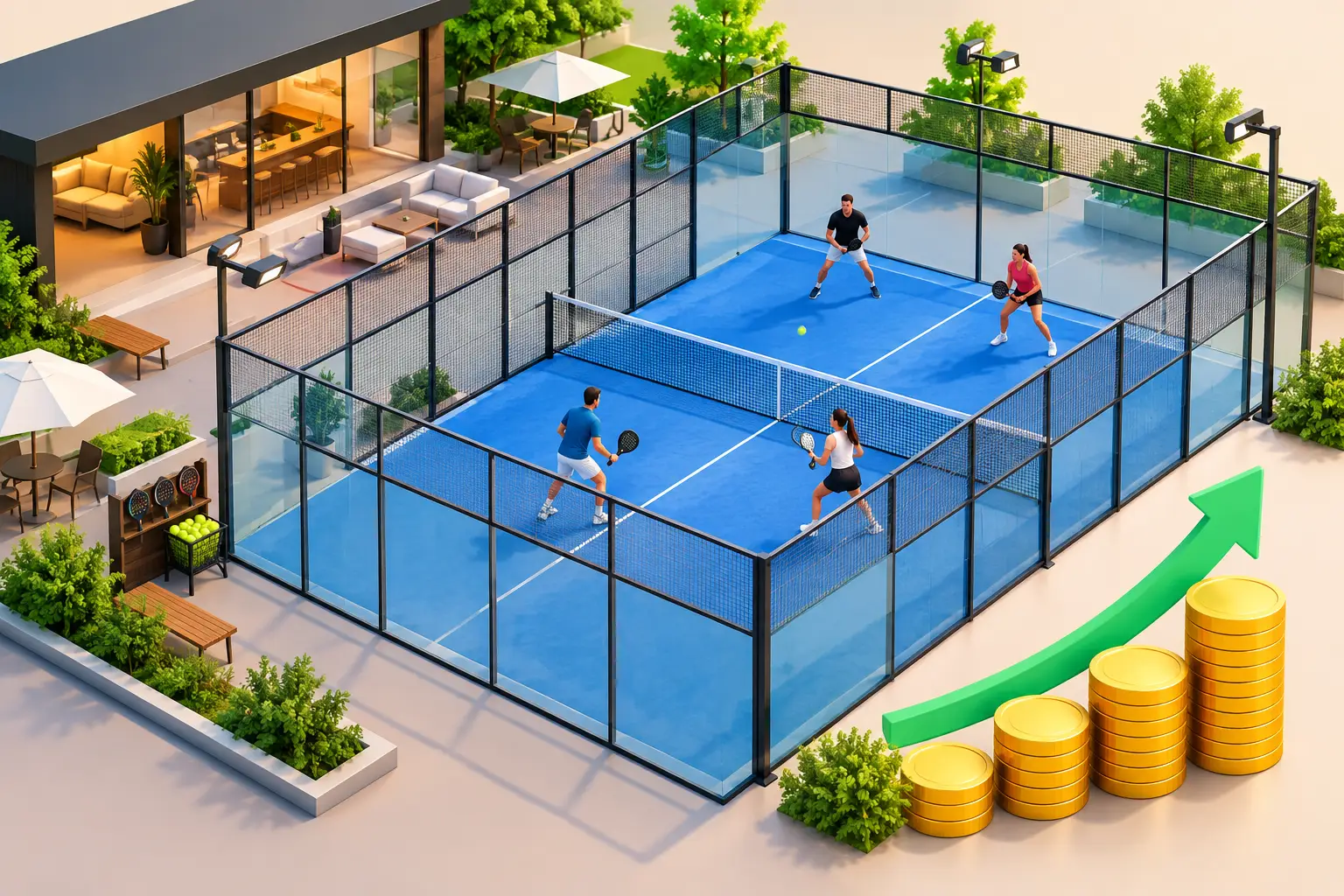
A padel court can become one of the most productive assets in a sports, hospitality, education, or residential development. But padel court profitability is not created by installing a court and waiting for demand to arrive. It is determined much earlier – in site selection, technical specification, operating model, and the quality of the construction beneath the visible playing surface.
For developers and operators in Saudi Arabia, the opportunity is clear. Padel has broad appeal, works well in social formats, and requires a smaller footprint than many traditional sports facilities. The commercial result, however, depends on whether the court is engineered as a long-term operating asset built for heat, sun, heavy use, and a premium player experience.
What Drives Padel Court Profitability?
The strongest padel business cases are based on repeatable court utilization rather than headline hourly prices. A court that commands a high booking rate only on evenings and weekends may look attractive on paper, but its annual return is limited if daytime use, school programs, corporate bookings, and off-peak memberships are not addressed.
Profitability comes from the relationship between capital expenditure, playable hours, booking conversion, operating costs, and asset life. Each element affects the others. A poorly lit court loses valuable evening capacity. An exposed court without effective climate planning may see lower daytime occupancy. A low-cost enclosure or turf system can create maintenance interruptions that weaken revenue and damage the facility’s reputation.
For a public park, the return may include community participation, healthier neighborhoods, and active use of public space. For a hotel, compound, club, or destination development, it may be expressed through guest retention, membership value, food and beverage spend, and stronger real estate positioning. Financial return still matters, but the appropriate model depends on the project’s purpose.
Utilization is more valuable than a premium price
An operator should begin with realistic assumptions about booked hours per court per day. Peak periods are usually the commercial foundation, particularly after work and after sunset. The more resilient facilities also create reasons to play outside those windows through coaching, junior academies, ladies’ programs, leagues, corporate sessions, school use, and structured memberships.
A modest increase in average weekly booked hours can have a greater effect on annual revenue than a small increase in the court rental rate. This is why programming and operations should be considered during design, not after handover. The court layout needs room for circulation, reception or check-in, waiting areas, storage, and where appropriate, shaded social space that encourages players to stay and return.
Court count also matters. A single court can serve a private villa, school, or small compound effectively, but it provides limited scheduling flexibility and no redundancy during maintenance. Multi-court facilities support leagues and events, create more inventory during peak demand, and can justify dedicated staffing. They also require a more disciplined approach to parking, access, drainage, utilities, and customer flow.
Build the Revenue Model Before Finalizing the Layout
A credible feasibility model should test several operating scenarios rather than rely on one optimistic occupancy number. Start with available hours, then apply different utilization levels for peak, shoulder, and off-peak periods. The model should distinguish between revenue from casual bookings, memberships, coaching, events, sponsorships, and ancillary spending where those income streams are relevant.
The key question is not simply, “How much can this court charge per hour?” It is, “How many quality playing hours can this facility reliably sell across an entire year?” That requires an honest view of the local catchment, competing facilities, user demographics, access conditions, and the type of experience the site can deliver.
A premium residential development may benefit from resident access bundled into service charges, with selected paid clinics or guest bookings. A commercial padel venue may prioritize digital booking, dynamic pricing, coaching packages, league operations, and tournament calendars. A university or school may measure the asset through student engagement alongside paid community hours. These models should not be forced into the same financial template.
Account for all operating costs
Revenue projections can be undermined when operating costs are treated as an afterthought. Electricity for high-quality floodlighting, cleaning, staffing, booking software, insurance, consumables, security, and routine inspections all need to be included. In Saudi Arabia, the cost of keeping the court safe and presentable through extended hot periods should be considered from day one.
Lifecycle allowances are equally important. Artificial turf may require brushing, infill management, cleaning, and eventual replacement. Glass panels, steelwork, gates, net systems, lighting, and drainage should be inspected on a planned basis. A facility with clear maintenance access and documented inspection procedures is easier to operate, safer for users, and less likely to face disruptive repairs during its busiest months.
Heat-Ready Construction Protects the Business Case
Saudi conditions place real demands on padel court systems. Intense UV exposure, high surface temperatures, dust, thermal movement, and occasional heavy rainfall can all affect performance when design and installation standards are not aligned with the site.
The visible court enclosure is only one part of the asset. Long-term reliability starts with site grading, ground preparation, structural foundation design, drainage routes, concrete quality, anchoring, and accurate setting-out. If the base does not manage water correctly or the frame is not installed with precision, later adjustments become expensive and can interrupt operations.
Material selection should reflect the operating environment. Galvanized and protected steel components, durable coatings, suitable artificial turf, reliable glass systems, and lighting designed for outdoor use all contribute to a court that remains commercially usable. The aim is not to over-specify every component. It is to specify each component at the level required for the location, expected traffic, and operating model.
Shade and comfort require a balanced assessment. Full enclosure or extensive roofing can improve daytime use in some projects, but it changes capital costs, structural requirements, ventilation, approvals, and the visual character of the development. In other locations, targeted shade for spectators, waiting areas, and circulation zones may provide better value while preserving open-air play. The right answer depends on the site and the revenue strategy.
Design for a Premium Player Experience
Players return to facilities that feel easy, safe, and well managed. Consistent lighting, clean turf, stable fencing, properly aligned glass, safe gates, and clear circulation are operational details that directly influence reviews, referrals, and repeat bookings.
Lighting deserves particular attention because evening play is often central to the business model. Poor uniformity creates visual discomfort and weakens the perceived quality of the venue. Light spill, glare, electrical access, and maintenance requirements should be reviewed before installation, particularly near residences, schools, or hospitality areas.
The same principle applies to court orientation, access, and spectator space. A padel facility should fit its surroundings rather than appear as an isolated structure placed on unused land. At a destination or mixed-use development, the courts can become a social anchor when they connect naturally to cafés, wellness areas, walkways, and landscaped gathering spaces.
Choose Turnkey Accountability Over Fragmented Delivery
Fragmented procurement can make an apparently simple project harder to control. When civil works, steel, turf, lighting, drainage, and final commissioning are managed by separate parties without clear coordination, responsibility can become unclear when defects emerge.
A full-scope, turnkey delivery approach creates a stronger chain of accountability from site review through design coordination, material sourcing, construction, installation, inspections, and maintenance planning. This is especially valuable where padel courts form part of a wider recreation package that includes acrylic courts, artificial turf, running tracks, or outdoor fitness areas.
Before appointing a contractor, decision-makers should require clarity on foundation scope, structural specifications, coating protection, turf system, lighting performance, drainage strategy, warranty terms, inspection process, and post-installation support. The lowest initial price is rarely the lowest cost over the life of a heavily used court.
A profitable padel court is ultimately a dependable place to play. When engineering decisions protect uptime, programming creates repeat use, and the facility adds genuine value to its community or development, the return extends well beyond the booking calendar.