
How to Repair Running Tracks for Long-Term Use
Recent Posts

Adventure Parks Built for Saudi Conditions
November 1, 2026

Artificial Turf Dust: Causes, Risks, and Control
October 31, 2026

Acrylic Court System Review for Saudi Projects
October 30, 2026

What Drives Strong Padel Court Profitability?
October 29, 2026
Share Post
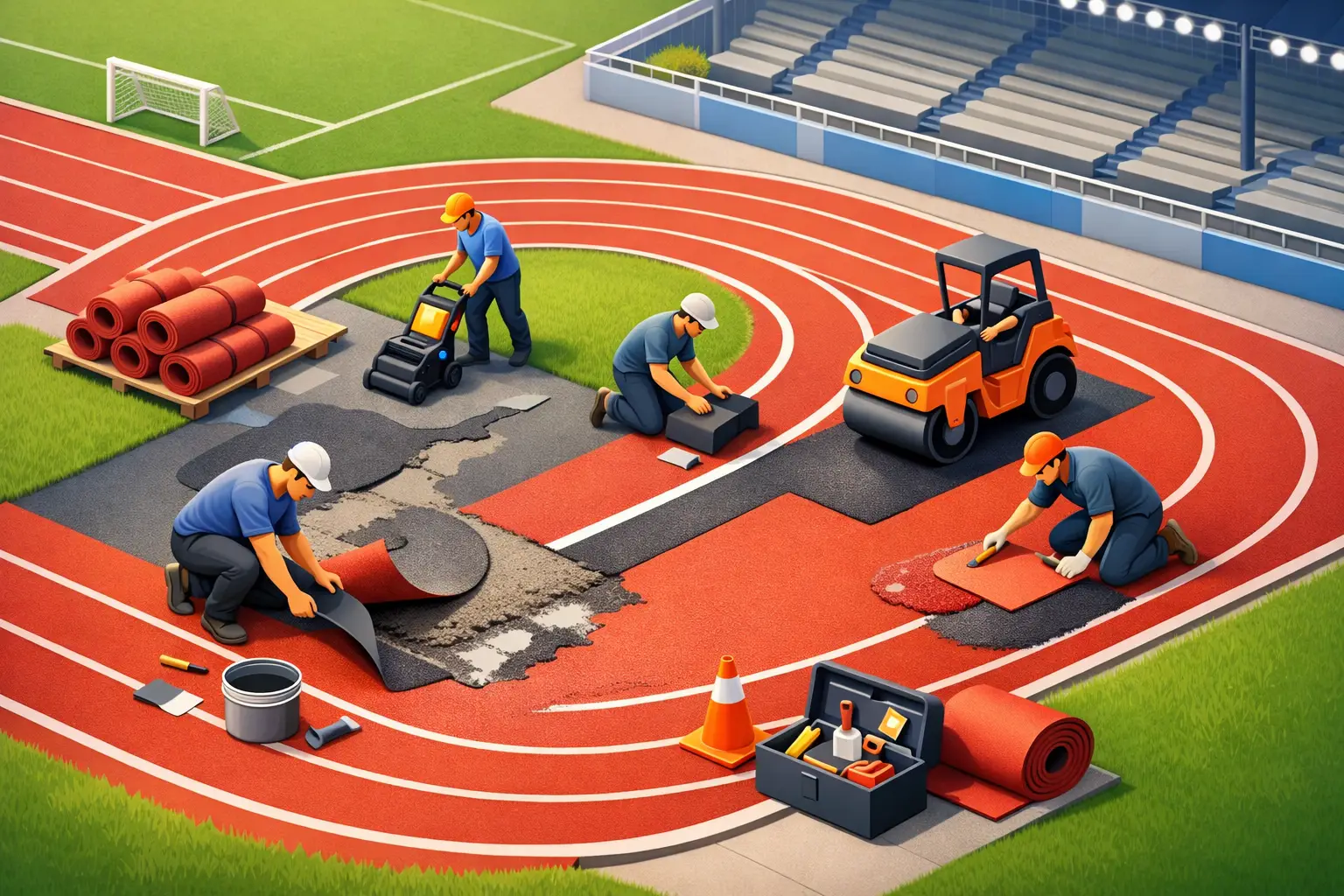
A running track rarely fails all at once. It begins with a hairline crack at a lane joint, a loose edge near the curb, fading in high-use areas, or water sitting on the surface after irrigation or rainfall. Knowing how to repair running tracks means identifying the source of the defect before selecting a repair method. A cosmetic patch can improve appearance temporarily, but it will not correct movement in the base, trapped moisture, or a coating system that has reached the end of its service life.
For schools, municipalities, compounds, and destination developments, the objective is not simply to restore color. It is to return the facility to a safe, consistent, high-performance surface that can withstand heat, UV exposure, foot traffic, maintenance equipment, and repeated athletic use.
Start With a Technical Condition Assessment
The visible surface is only one part of a running track system. Most tracks consist of a prepared sub-base, asphalt or concrete base, primer, resilient rubber layers, polyurethane binders, and a wear layer designed for traction and spike resistance. A defect in any one of these layers can appear at the surface.
A professional assessment should map the location, size, and pattern of every defect. Cracks that follow a straight line may indicate substrate joints or base movement. Localized depressions often point to settlement, poor drainage, or loss of support beneath the track. Widespread fading, brittleness, or granule loss can indicate UV degradation or wear-layer failure.
The inspection should also verify slope, drainage paths, moisture conditions, edge restraint, and the condition of curbs, drainage channels, and field interfaces. In Saudi Arabia, high temperatures can accelerate thermal movement and aging, while intense irrigation cycles can expose drainage defects that were not evident during dry periods. Repair scope should be based on these site conditions, not only on what is visible during a walk-through.
Classify the Damage Before Specifying the Repair
Minor wear and structural failure require very different responses. Surface-level defects may be suitable for localized repair, while base-related defects require excavation and reconstruction. Treating both in the same way is a common cause of repeat failures.
Typical defects include surface cracking, open seams, loose or missing rubber granules, blistering, delamination, standing water, worn line markings, and damaged perimeter edges. A trained contractor should determine whether the existing system remains sound around the affected area. A patch bonded to weak surrounding material is likely to fail at the patch boundary.
How to Repair Running Tracks by Defect Type
Surface Cracks and Open Seams
Small, stable cracks in an otherwise sound synthetic track can often be routed, cleaned, primed, and filled with a compatible polyurethane repair compound. The repair area is then leveled and finished with matching rubber granules or a compatible spray coating, depending on the original system.
The critical issue is movement. If a crack is caused by a moving asphalt joint, seasonal expansion, or settlement, filling it alone will not provide a lasting result. The affected section may need to be cut back to a stable boundary, the joint treated correctly, and the surfacing rebuilt in layers. Color matching should also be planned carefully, especially when an older track has faded under UV exposure.
Delamination, Blisters, and Loose Surface Areas
Delamination occurs when the track surface separates from the layer beneath it. It may feel hollow underfoot, lift at the edges, or form bubbles after heat exposure. Causes include inadequate surface preparation, contamination, moisture vapor, incorrect primer selection, or incompatible materials used in a previous repair.
The correct approach is to remove all unsound material, not just the visibly lifted portion. The exposed substrate must be tested for moisture, cleaned, mechanically prepared where required, and primed with a system approved for the substrate and local conditions. The replacement layer must match the thickness, elasticity, and finish of the surrounding track to avoid creating a hard spot or trip edge.
Depressions and Standing Water
Water on a track is a performance and safety concern. It can make the surface slippery, accelerate deterioration, and cause athletes to alter their stride. The repair may be as limited as correcting a small low area, but it can also require deeper intervention if the pavement base has settled or drainage infrastructure is blocked.
First, confirm whether the water is caused by inadequate slope, a blocked outlet, damaged channel drainage, or localized base failure. Surface leveling compounds can only be used where the underlying base is stable. If the depression continues to move, the track section should be removed, the base compacted or rebuilt, and the drainage fall restored before new surfacing is installed.
Granule Loss, Fading, and Worn Wear Layers
A worn running track may remain structurally stable while losing texture, color, and traction. This is common in high-traffic lanes, start areas, finish zones, and locations exposed to intense sunlight. Where the resilient base remains sound, a resurfacing program can extend asset life without the cost and disruption of full reconstruction.
Resurfacing normally involves deep cleaning, mechanical preparation, localized repairs, a compatible polyurethane coating, and fresh EPDM granules or a specified topcoat. The chosen material must be engineered for UV resistance, heat stability, and the intended use of the facility. A recreational school track, a community jogging loop, and a competition-oriented athletics track do not require the same system or budget.
Damaged Edges and Transitions
Track edges are exposed to maintenance equipment, pedestrian traffic, landscaping activity, and water intrusion. A small separation at the curb can allow moisture beneath the surface and gradually enlarge the damaged area. Repairing perimeter details early protects the wider installation.
Loose sections should be removed back to sound material, the edge restraint inspected, and the track rebuilt with a secure, flush transition. Where tracks connect to artificial turf, asphalt walkways, or concrete aprons, the finished levels must prevent trip hazards and direct water away from the system.
Material Compatibility Is Non-Negotiable
Not all rubber and polyurethane products work together. Repair materials must be compatible with the existing track construction, including its primer, binder chemistry, base layer, and top finish. Using an unverified coating may create weak adhesion, discoloration, inconsistent traction, or premature hardening.
This is particularly relevant when repairing older installations with incomplete records. A contractor may need to take material samples, perform adhesion checks, and prepare a test patch before committing to a large repair area. That extra discipline reduces the risk of replacing one visible problem with a larger system failure.
For facilities operating in Riyadh, Jeddah, Dammam, or other demanding Saudi locations, material selection should account for surface temperature, UV loading, dust exposure, irrigation practices, and the operating schedule of the site. A track built for moderate climates may need a different repair specification to deliver dependable local performance.
Control the Repair Process, Not Just the Product
Even premium surfacing materials can fail when installation controls are weak. Repairs should be scheduled within the manufacturer-approved temperature and humidity range. The substrate must be dry, clean, stable, and correctly prepared. Mixing ratios, curing times, layer thicknesses, and granule broadcast rates all affect the final result.
Access control also matters. A track should remain closed until the repaired system has fully cured and been inspected. Opening it too soon can leave permanent marks, pull material from edges, or compromise the bond before it reaches design strength.
For larger works, document the repair with before-and-after photographs, moisture readings where relevant, material batch records, thickness checks, and a final walkthrough. This gives facility owners a clear maintenance record and supports better planning for future resurfacing or capital renewal.
When Local Repair Is No Longer Enough
Localized repair is cost-effective when defects are isolated and the broader system is stable. Full resurfacing becomes the better option when granule loss, fading, cracking, or traction decline is widespread across the track. Full reconstruction should be considered when the base has extensive movement, drainage failures are recurring, or the existing system cannot meet the facility’s safety and performance expectations.
The lowest initial repair price is not always the lowest lifecycle cost. Repeated small patches can create inconsistent firmness, uneven appearance, and ongoing closure periods. A condition assessment should compare the cost of targeted repair with the expected service life of resurfacing or reconstruction, then select the option that protects both users and the long-term asset.
Protect the Repaired Track With a Maintenance Plan
A repaired running track performs best when routine care begins immediately. Regular sweeping removes abrasive sand and debris. Drainage points should be cleared, spills addressed promptly, and maintenance vehicles kept off the track unless the surface and access routes are designed for them. Sharp objects, inappropriate cleaning chemicals, and unapproved paint or adhesive products can damage polyurethane finishes.
Facility teams should inspect high-wear areas and perimeter joints at scheduled intervals rather than waiting for complaints. Early intervention is faster, more controlled, and significantly less disruptive than emergency repair during a school term, event season, or community program.
A running track is a visible commitment to active communities and better public environments. Repair it with the same precision used to build it, and the surface can continue delivering safe, consistent movement long after the first defect appears.