
Artificial Turf Dust: Causes, Risks, and Control
Recent Posts

Adventure Parks Built for Saudi Conditions
November 1, 2026
Acrylic Court System Review for Saudi Projects
October 30, 2026

What Drives Strong Padel Court Profitability?
October 29, 2026
Sand Filled Versus Nonfilled Turf for Sports
October 27, 2026
Share Post
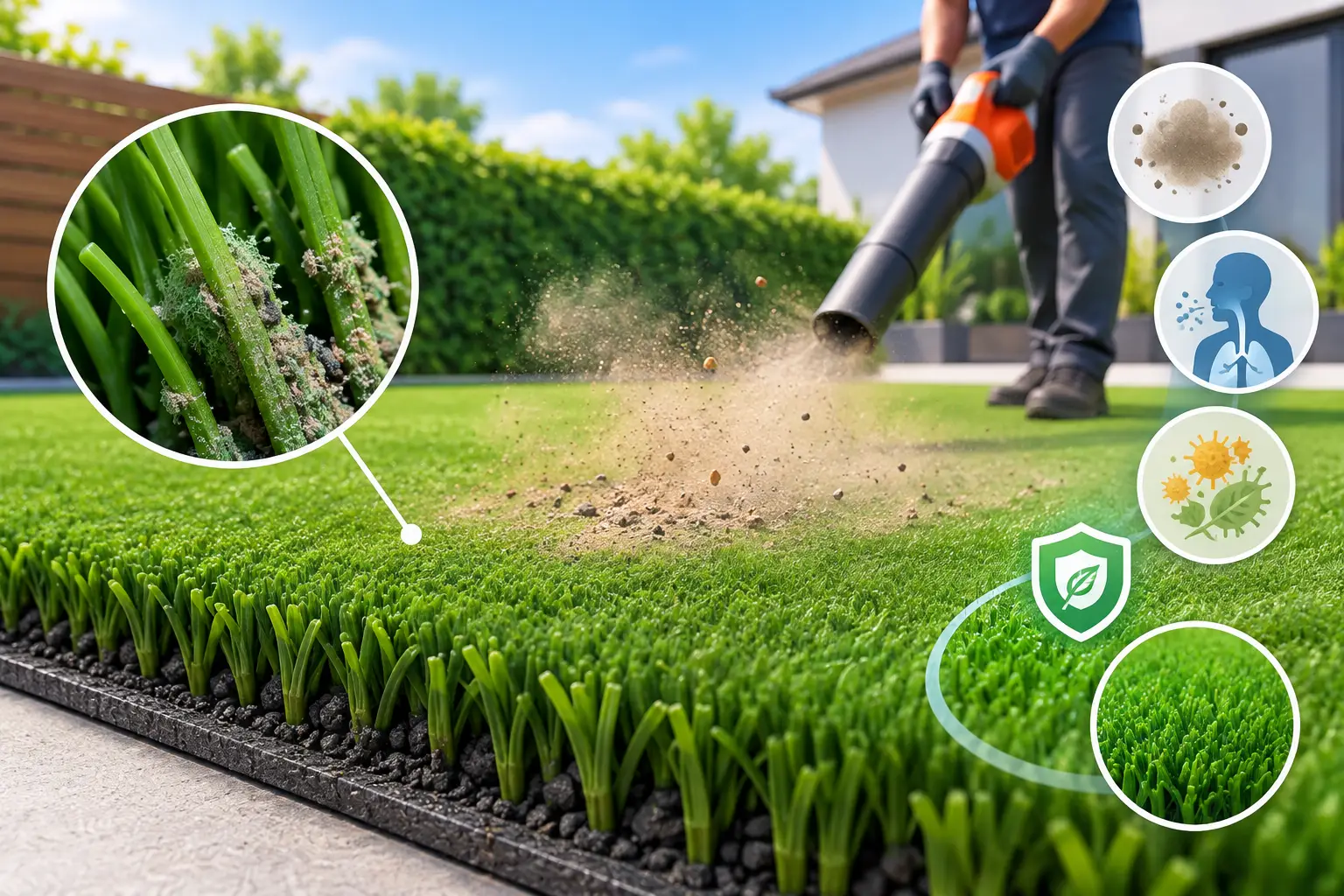
A new artificial field can look finished on handover day and still create a long-term operating issue if dust control has been overlooked. Artificial turf dust is not simply a housekeeping concern. It can change ball response, reduce drainage performance, affect player comfort, and make a premium facility appear poorly maintained well before its expected service life.
For schools, municipalities, developers, compounds, and destination projects, the right response begins with identifying where the dust is coming from. A high-performance turf system is an assembly of fibers, infill, backing, drainage layers, edging, and surrounding hardscape. Dust can enter or develop within each part of that system. Managing it requires the same engineering discipline applied to the original installation.
What Creates Artificial Turf Dust?
Dust on synthetic grass is rarely one material. Its composition and behavior matter because each source requires a different correction.
The most visible source is often windblown sand and fine soil from adjacent open land, unpaved access routes, landscape beds, or active construction zones. This is particularly relevant across Saudi Arabia, where dry conditions and seasonal winds can move fine particles across large outdoor areas. A field with insufficient perimeter protection may receive a continual supply of airborne material even when its own surface is in good condition.
Infill can also generate fines over time. Sand infill may break down through repeated trafficking, while rubber or organic infill can degrade, fragment, or collect contaminants. Aggressive brushing with unsuitable equipment can accelerate wear. So can a field that is used heavily but not groomed to maintain consistent infill distribution.
Dust may also rise from below. If the aggregate base, drainage layer, or edge restraint has been poorly constructed, fine particles can migrate upward through joints, damaged backing, or localized depressions. This is a construction-performance issue, not a cleaning issue. Surface sweeping may temporarily improve appearance while the underlying defect continues to develop.
Finally, organic debris, litter, and airborne pollutants can combine with fine sand to create a compacted surface layer. In shaded or irrigated surroundings, this mixture can retain moisture and encourage algae or biofilm. The result is a field that feels harder, drains more slowly, and loses its intended visual finish.
Why Turf Dust Matters to Facility Performance
The first impact is on play. Fine dust fills the spaces between infill particles and reduces the surface’s ability to respond as designed. A compacted, contaminated infill layer can alter traction, ball roll, bounce, and foot stability. On multi-use fields, these changes may be gradual enough to escape notice until users begin reporting inconsistent performance.
Dust also affects drainage. Water needs open pathways through the turf and into the engineered base below. When fines accumulate, they can bind infill and obstruct those pathways. Ponding after irrigation, cleaning, or rainfall is a warning sign, but it is usually a late one. By that stage, the issue may involve compaction, contamination, or a base-level drainage fault.
Heat is another concern. Synthetic turf naturally requires careful material selection and maintenance in hot climates. Dust-darkened fibers and compacted infill can retain heat differently than a clean, correctly groomed surface. While irrigation may provide temporary cooling where operationally appropriate, it does not resolve the cause of a contaminated surface. For facilities built for Saudi conditions, heat management must start with a suitable system specification, appropriate infill, and reliable maintenance access.
There is also an asset-management consequence. Premature fiber wear, visible discoloration, seam stress, and reduced drainage can shorten the usable life of the surface. Replacing a field early disrupts operations and creates an avoidable capital cost. Dust control is therefore part of protecting the original investment, not an optional aesthetic upgrade.
Assess the Source Before Selecting a Remedy
A maintenance team should not assume that every dusty field needs more brushing or more infill. The first step is a structured inspection that looks beyond the visible surface.
Review the pattern of buildup. Dust that collects consistently along one side may point to prevailing wind exposure, an adjacent road, a landscape edge, or a nearby construction activity. Dust concentrated around goal mouths, entries, sidelines, or high-use zones is more likely connected to traffic, infill displacement, or ineffective cleaning practices. Localized low points may indicate base settlement or drainage failure.
The inspection should also examine fiber condition, seam integrity, infill depth, edge restraint, drainage outlets, and transition details between turf and paving. If the facility uses irrigation, assess whether overspray is washing fines toward the field or carrying soil from planting areas onto the surface.
Where contamination is significant, laboratory testing of collected material can be useful. It can help distinguish native sand, degraded infill, organic buildup, or construction-related fines. This evidence supports a proportionate corrective plan and gives project owners a clearer basis for maintenance decisions, warranty discussions, or contractor accountability.
Designing for Artificial Turf Dust Control
The strongest dust-control strategy is established before installation. A turf system should be designed as part of its site, not treated as an isolated green rectangle.
Control the perimeter
Perimeter paving, curbs, entry mats, landscaping setbacks, and properly detailed edging reduce the amount of loose soil that reaches the field. On exposed sites, wind direction should inform the location of planting, screens, access gates, and maintenance areas. These measures are especially valuable for public parks, school campuses, and destination developments where surrounding circulation is constant.
A clean transition between turf and hardscape also makes maintenance more effective. If soil can wash directly from adjacent planting beds onto the surface, daily sweeping becomes a permanent cost rather than a solution.
Specify compatible materials
Fiber type, pile height, backing construction, infill selection, and shock pad requirements must match the sport, expected traffic, climate, and maintenance plan. There is no universal infill formula. A football training pitch, a school play area, and a decorative landscape installation have different performance demands.
Material selection should consider particle stability, dust generation, heat behavior, cleaning needs, and the availability of specialist maintenance equipment. Certified materials and clear installation tolerances provide a more dependable starting point than choosing a system solely by initial price.
Build the base with precision
A stable, correctly graded sub-base supports drainage and prevents upward migration of fines. Compaction must meet the design requirement without creating low spots or reducing drainage capacity. Geotextiles, aggregate layers, drainage channels, and edge restraints must work together as one system.
This is where full-scope delivery matters. When civil works and surface installation are separated without coordinated responsibility, small interface errors can become expensive operational problems. Precision installation standards protect performance long after the construction team has left site.
Maintenance That Prevents Compaction
Routine maintenance should remove contaminants before they become embedded and redistribute infill before uneven wear develops. The required frequency depends on usage, surrounding conditions, and the type of turf system. A lightly used residential landscape needs a different program than a municipal football field operating every day.
For high-traffic facilities, maintenance typically includes debris removal, vacuuming or mechanical cleaning where appropriate, brushing with approved equipment, infill depth checks, and periodic decompaction. Brushing direction and equipment settings matter. Incorrect methods can damage fibers, pull seams, or move infill into unwanted areas.
Operators should document inspections and actions. A simple maintenance record that captures weather events, use intensity, surface observations, drainage concerns, and corrective work helps identify patterns early. It also strengthens lifecycle planning by showing when a field needs deep cleaning, infill replenishment, localized repair, or more substantial rehabilitation.
Avoid using high-pressure water indiscriminately. It can push contaminants deeper into the infill or disturb weak seams and edges. Similarly, adding fresh infill over a contaminated layer may conceal the symptom while making compaction worse. Cleaning and decompaction should come before replenishment when dust buildup is the principal problem.
When Dust Signals a Larger Defect
Some conditions need specialist investigation rather than routine maintenance. Persistent ponding, repeated infill loss, exposed backing, wrinkling, seam separation, or dust returning quickly after professional cleaning may indicate a defect in the drainage, base, perimeter, or installation detail.
At that point, the right solution may be targeted repairs rather than full replacement. Localized base correction, seam repair, drainage improvements, edge reconstruction, or deep restorative cleaning can extend service life when completed early. Waiting until fibers are badly worn or drainage has failed across the field limits the available options.
For owners commissioning new facilities in Riyadh, Jeddah, Dammam, or major developing destinations, dust management should be written into the project brief from the start. It belongs alongside safety, drainage, heat resistance, access, and maintenance planning. StepX Sports approaches these decisions as part of a complete surface-engineering scope, built around real use conditions rather than a generic product schedule.
A clean, stable turf surface does more than look professional. It keeps recreation reliable, protects users’ experience, and gives a community asset the durability expected of a long-term investment.