
Sand Filled Versus Nonfilled Turf for Sports
Recent Posts
Adventure Parks Built for Saudi Conditions
November 1, 2026
Artificial Turf Dust: Causes, Risks, and Control
October 31, 2026
Acrylic Court System Review for Saudi Projects
October 30, 2026
What Drives Strong Padel Court Profitability?
October 29, 2026
Share Post
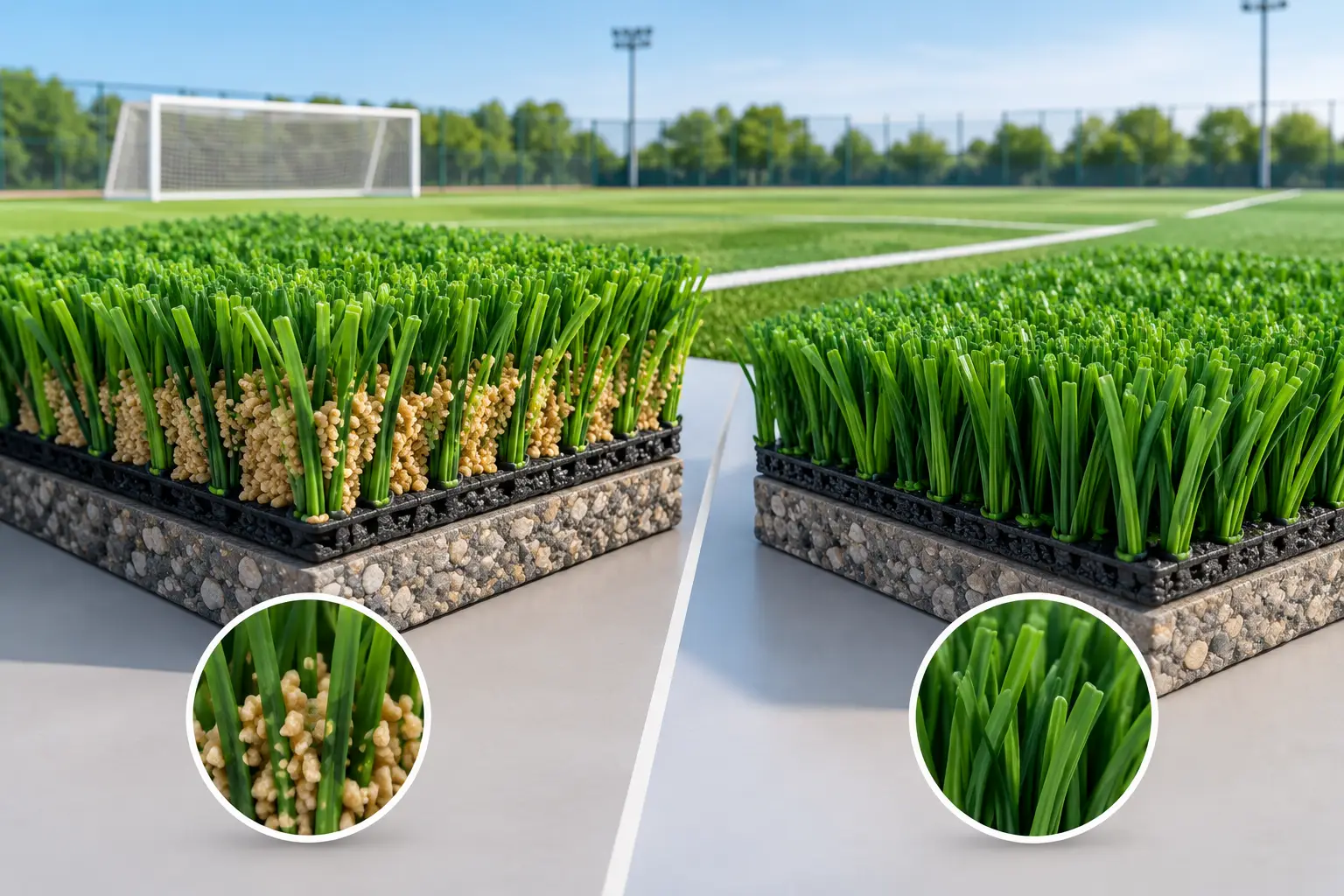
A turf system can look complete on handover day and still fail the facility operator six months later. Excessive surface heat, uneven ball roll, displaced infill, compacted fibers, or drainage issues usually trace back to an early specification decision. For developers, schools, municipalities, and compound operators, the choice between sand filled versus nonfilled turf is not simply aesthetic. It defines how the surface plays, how it is maintained, and how it performs through Saudi Arabia’s heat, dust, and heavy use.
Sand Filled Versus Nonfilled Turf: The Core Difference
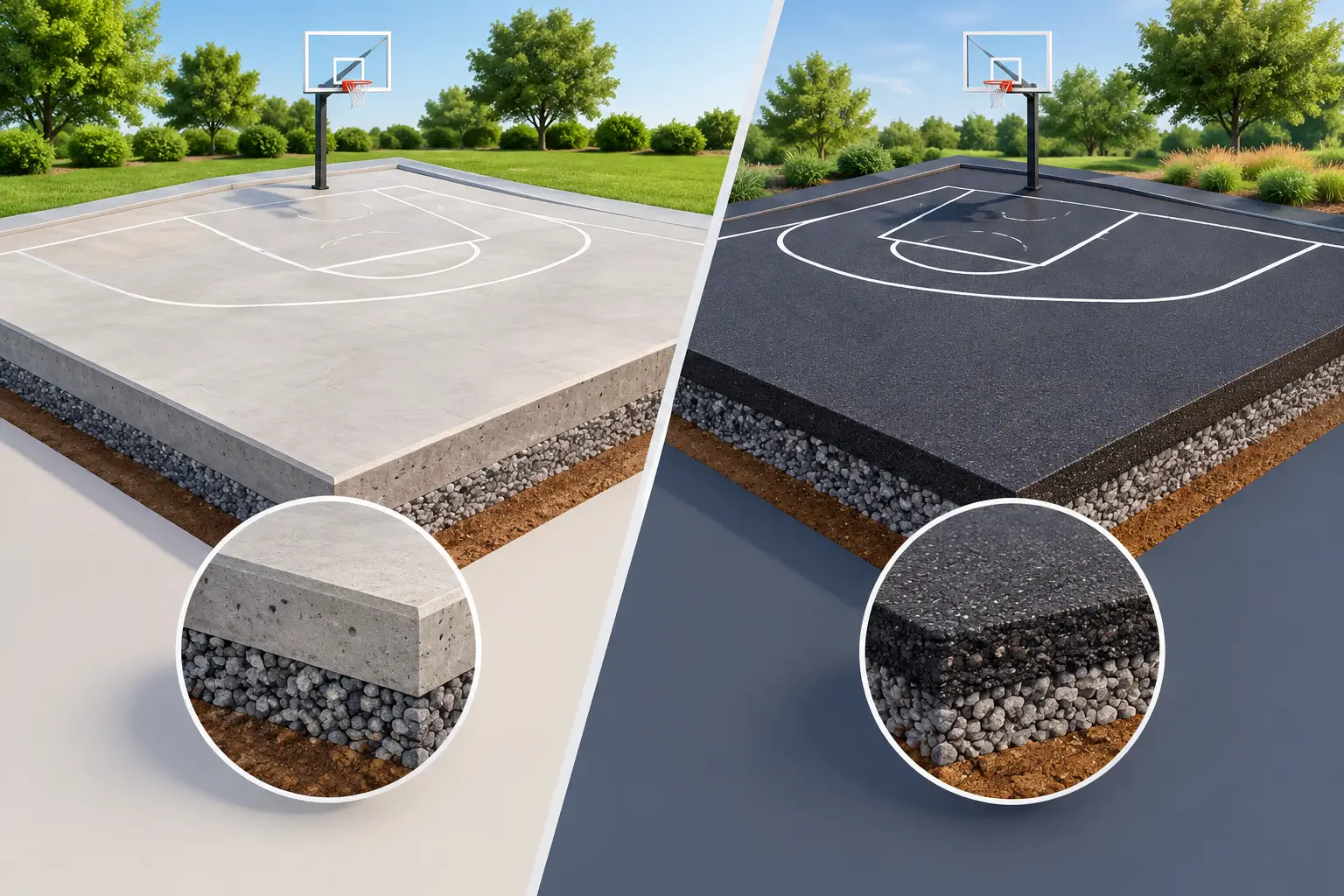
Sand-filled turf uses synthetic grass fibers installed over a prepared base, then filled with calibrated silica sand. The sand settles between the fibers, adding ballast, helping the pile stand upright, and influencing firmness, ball behavior, and stability. Depending on the application, the system may be sand-only or use additional performance layers. A true specification must identify the complete system, not just the grass color or pile height.
Nonfilled turf, often called non-infill turf, is manufactured with denser yarn construction, reinforced backing, and fiber geometry designed to hold the blades upright without loose sand. It is generally specified where a cleaner appearance, reduced loose-material migration, or simpler routine cleaning is a priority.
Neither system is automatically the better investment. The right choice depends on the sport, traffic profile, user age, exposure conditions, maintenance capability, and the performance standard expected throughout the asset’s life.
How Sand-Filled Turf Performs
Sand-filled turf is a proven solution for many multi-use recreational areas, landscape-adjacent sports zones, schools, and training spaces. Its greatest strength is system stability. Properly distributed sand increases the surface mass, supports the fibers, and reduces movement under regular foot traffic.
For facilities that need a composed, natural-looking surface with predictable footing, a calibrated sand infill can provide a strong result. The infill also protects part of the fiber length from direct traffic and ultraviolet exposure, which can support long-term appearance when the turf is correctly groomed and maintained.
The trade-off is operational discipline. Sand does not remain perfectly distributed on its own. Intense play, wind, poor drainage, and inadequate brushing can create low spots, compaction, and exposed fibers. High-use goalmouths, access points, and sideline areas need particular attention. When compaction develops, the surface can become firmer and less responsive, affecting comfort and play consistency.
Sand-filled turf also requires careful material selection. Sand must be washed, rounded, dry, and correctly graded for the selected turf. Construction sand or uncontrolled local aggregate can contain fines, dust, or angular particles that compact quickly and damage fibers. The infill depth must be measured and installed consistently, not estimated by appearance.
Best-fit applications for sand-filled systems
Sand-filled systems are often well suited to multipurpose school fields, recreational football areas, community pitches, and landscaped activity zones where the operator can commit to periodic grooming. They can be a practical choice for larger areas because the system provides weight and stability without relying solely on an exceptionally dense turf construction.
They are less suitable where operators want virtually no loose material, where enclosed footwear transitions are common, or where routine mechanical maintenance cannot be reliably planned. In those cases, the lower initial material cost can be offset by avoidable maintenance and renewal work later.
How Nonfilled Turf Performs
Nonfilled turf is designed to produce a clean, dense playing surface without a loose sand layer. The fibers are typically more tightly tufted and engineered with resilient profiles that recover after use. This can create a polished finish that is particularly attractive for premium developments, small-sided pitches, rooftop amenity spaces, play-adjacent recreation zones, and facilities where users move directly between turf and hardscape.
Without loose infill, there is less risk of sand tracking into buildings, collecting along perimeter channels, or migrating into adjacent paving. Routine care generally focuses on debris removal, brushing, inspection of seams and edges, and maintaining proper drainage. This can simplify daily site operations for hospitality properties, corporate campuses, and compounds with limited maintenance resources.
However, nonfilled does not mean maintenance-free. Dense turf must still be brushed to maintain fiber orientation, cleaned to remove dust and organic matter, and inspected for seam integrity. In Saudi conditions, airborne dust can settle deep into the pile and reduce the surface’s visual quality if routine cleaning is neglected.
The performance profile also needs closer review. A nonfilled turf product may feel firmer than a sand-filled system, particularly if it is installed over a rigid base without a shock pad. For football, intensive training, or youth use, the system should be assessed as a complete build-up: sub-base, drainage layer, leveling course, shock pad where required, turf, seams, and perimeter restraint. A premium-looking turf roll cannot compensate for an under-engineered foundation.
Best-fit applications for nonfilled systems
Nonfilled turf is often selected for decorative recreation areas, low-to-medium traffic activity spaces, padel surrounds, golf-style landscape applications, and multipurpose zones where cleanliness and appearance are major priorities. It can also work effectively in compact urban facilities where sand migration would interfere with nearby finishes or drainage details.
For high-intensity competitive football or facilities with continuous daily bookings, the decision requires more caution. The product must be purpose-built for the sport and verified for stability, traction, and shock absorption under real use. A dense decorative turf should never be substituted for an engineered sports surface simply because it appears similar at first inspection.
Saudi Heat, Drainage, and Base Construction
In Riyadh, Jeddah, Dammam, and destination developments exposed to open sun, surface temperature is a serious operational factor for every artificial turf system. Both sand-filled and nonfilled turf can become hot under direct solar exposure. Fiber color, yarn composition, pile density, infill selection, ventilation, shade strategy, and watering practices all affect usable surface temperature.
Sand can retain heat, while dense nonfilled constructions can also absorb and hold solar energy. There is no credible one-line answer that one system is always cooler. Project teams should assess the selected product, site orientation, scheduled use times, surrounding reflected heat, and whether irrigation for cooling is operationally realistic. Shade structures and programming adjustments may deliver more dependable heat-management benefits than material claims alone.
Drainage is equally decisive. Turf must be installed over a correctly graded, compacted, and permeable base designed around local soil conditions and anticipated rainfall events. Poor drainage can cause water retention, odor, seam stress, and accelerated deterioration regardless of infill choice. Perimeter drainage, accessible outlets, and accurate falls should be established before turf installation begins, not treated as remedial work afterward.
A precision-installed base also controls flatness. If the finished grade is inconsistent, sand will migrate toward low points and nonfilled turf will reveal undulations through its dense surface. This is why turnkey delivery matters: civil works, base preparation, drainage, turf installation, and final testing must operate under one coordinated quality process.
Maintenance and Whole-Life Value
The initial purchase price should not decide the specification. The relevant question is which system delivers the lowest practical whole-life cost while meeting the facility’s performance brief.
Sand-filled turf needs scheduled brushing, infill redistribution, compaction checks, debris removal, seam inspections, and periodic top-up where material has been lost. These activities are manageable when included in the operating plan, but they should be budgeted from day one. Neglect turns minor surface corrections into premature refurbishment.
Nonfilled turf reduces infill management but still needs regular brushing, cleaning, drainage inspection, and repair of any damaged seams or edges. Its long-term value depends heavily on fiber resilience and the quality of the backing. Lower-grade products can flatten under traffic and lose their intended appearance quickly.
For either system, maintenance access should be considered during design. Equipment routes, storage, water points, perimeter clearances, and cleaning schedules are operational details that protect the capital investment.
Specify the System, Not Just the Turf
A confident specification begins with how the space will actually be used. Is the surface intended for school recreation, high-frequency football, a residential amenity, a destination play zone, or a visual landscape feature? Will users wear studs, trainers, or casual footwear? Is the operator equipped to groom infill? Are there adjacent interiors, pools, paving, or drainage channels that make loose sand undesirable?
The procurement package should define pile height, fiber type, density, backing strength, tuft bind, UV resistance, infill material and depth where applicable, shock absorption targets, drainage requirements, seam method, edge restraint, and base tolerances. Samples are useful, but they are not a performance specification. The installed system must be evaluated as a complete engineered assembly.
StepX Sports approaches this decision through site conditions, use intensity, safety requirements, and long-term operating expectations. That process helps clients select a surface built for Saudi conditions rather than a generic product selected from a catalog.
The best turf is the one that remains safe, stable, and playable after thousands of hours of use. Set the performance brief early, require accountable installation standards, and choose the maintenance model your facility can sustain.