
Best Drainage Solutions for Courts in Saudi Arabia
Recent Posts
Selecting Turf Infill Materials for Saudi Sports
September 14, 2026
How to Upgrade Campus Recreation for Daily Use
September 13, 2026
Best Padel Court Materials for Saudi Conditions
September 12, 2026
Best Outdoor Fitness Equipment for Saudi Sites
September 11, 2026
Share Post
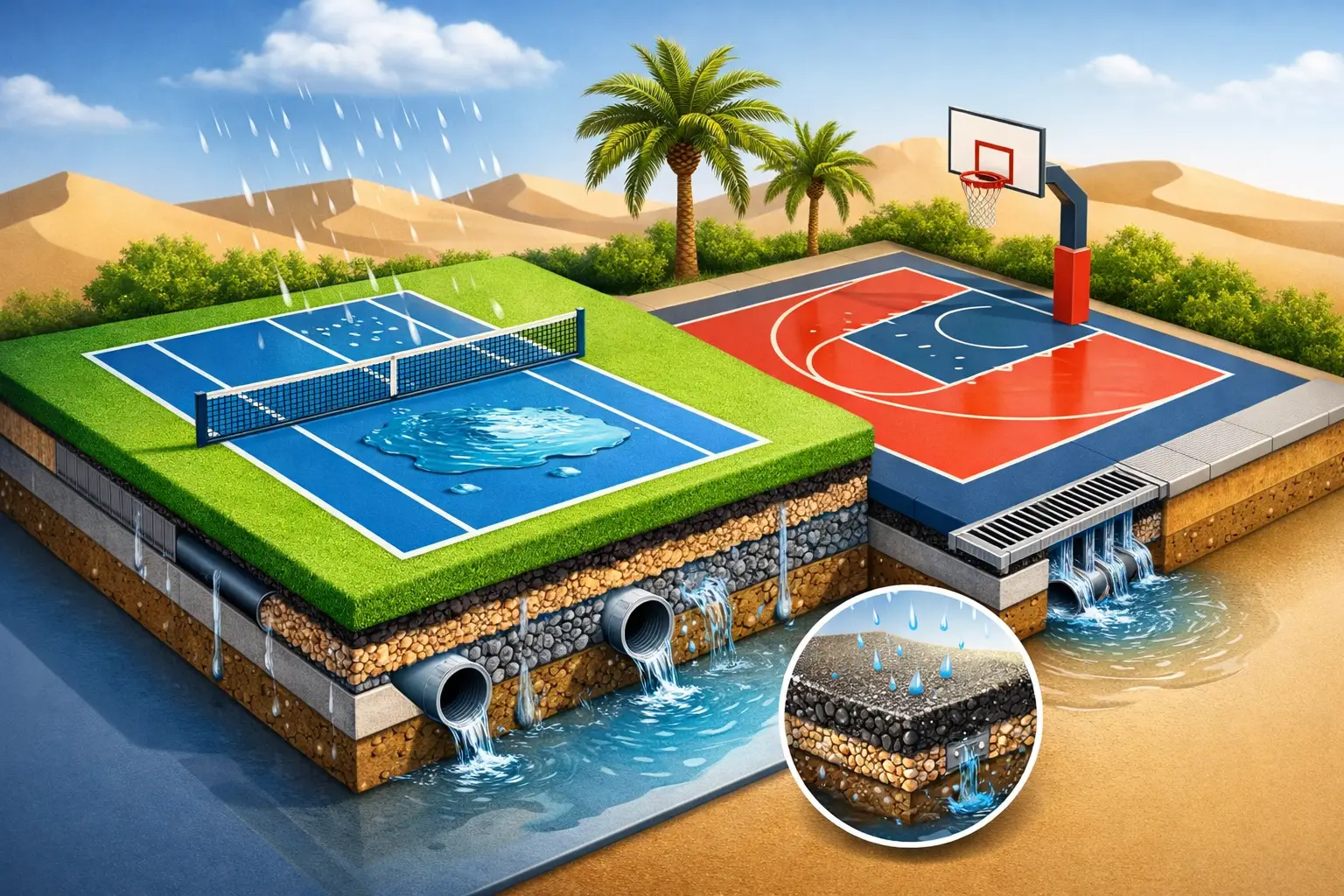
A court can look flawless at handover and still fail its first serious rain event. Water that remains on the playing area can soften base layers, stain acrylic finishes, create slip hazards, and accelerate cracking at the perimeter. For developers, schools, municipalities, and compound operators, the best drainage solutions for courts are not a single drain product. They are an engineered system that moves water from the surface, through the construction layers, and safely away from the facility.
Saudi Arabia’s dry climate can create a false sense of security. Rainfall may be infrequent, but storm events can be intense and fast-moving. On a hardscape-heavy site in Riyadh, Jeddah, Dammam, or a destination development, runoff from nearby roofs, walkways, and roads can reach the court faster than the court itself can shed water. Drainage must therefore be designed for the full site, not treated as an afterthought beneath the sports surface.
What the Best Drainage Solutions for Courts Must Do
A properly drained court protects more than daily playability. It preserves the engineered relationship between the surface, base course, subgrade, fencing, and surrounding paving. When water is allowed to collect or migrate beneath the slab, the result can be settlement, edge failure, surface depressions, and repeated maintenance costs that were avoidable during construction.
The right approach depends on the court type and site conditions. An outdoor acrylic basketball or tennis court typically relies on precise surface falls and perimeter collection. Artificial turf fields require water to pass through the carpet and infill into a free-draining base. Padel courts add another consideration: their enclosed glass and steel structure concentrates runoff at the perimeter, making collection details especially important.
A high-performance drainage design should achieve four outcomes:
- Remove water quickly enough to reduce ponding and return the court to service.
- Prevent moisture from weakening or washing out the base and subgrade.
- Control water arriving from adjacent areas, not only rain falling directly on the court.
- Discharge runoff to an approved point without creating erosion, flooding, or maintenance problems elsewhere on the site.
These outcomes require coordinated civil, structural, and surface-engineering decisions from the earliest design stage.
Start With Grading, Not Drains
The most effective drainage component is often the one that cannot be seen: correct grading. Outdoor hard courts need a controlled fall across the finished surface so water moves toward designated collection points rather than remaining in low spots. The slope must be sufficient to shed water, yet subtle enough to protect ball behavior, player comfort, accessibility, and the visual quality of the finished court.
For most court projects, a uniform, laser-controlled slope is preferable to improvised falls formed during finishing. A surface that drains in several conflicting directions can create unpredictable play and leave water trapped at transitions. The exact fall should be confirmed by the sport, surface system, court dimensions, governing requirements, and local drainage strategy.
Grading extends beyond the playing area. Finished levels of walkways, spectator zones, planters, and adjacent buildings must prevent water from entering the court enclosure. A court built at the lowest point of a development will remain vulnerable even with perimeter drains. Where site levels are constrained, the design may need intercept drains, raised thresholds, or a more comprehensive stormwater plan.
Base Preparation Determines Long-Term Performance
A well-graded surface cannot compensate for an unstable base. Beneath acrylic, polyurethane, rubber, and turf systems, each compacted layer must be built to the specified levels, density, and drainage characteristics. Soft spots, poor compaction, and unsuitable subgrade soils can hold water or allow differential settlement after storms.
For engineered sports infrastructure, the base is not simply a platform for the finish. It is a performance layer. Its bearing capacity, moisture behavior, and tolerance to thermal movement affect the life of everything above it. On sites with expansive soils, made ground, high groundwater, or uncertain existing fill, geotechnical assessment should inform the drainage and pavement design before construction begins.
Surface Drainage for Acrylic and Hard Courts
Acrylic sports courts, basketball courts, and multi-use game areas are generally designed as impermeable or near-impermeable surfaces. Water must travel across the finish to a low edge or collection channel. Precision installation is essential because minor depressions can create persistent puddles, particularly around net post areas, gates, and fence lines.
Perimeter channel drains are often the most practical option where runoff needs to be captured at one or more court edges. These linear channels should be selected for anticipated flow, loading, grate safety, debris exposure, and access for cleaning. A drain at the correct elevation but without a maintainable outlet is not a solution. It becomes a narrow storage trough that overflows during a storm.
Spot drains can work in constrained areas, such as at corners or between courts, but they are more dependent on exact grading and can be prone to debris blockage. They should not be used merely because they require less visible channel length. On a large hard court or a court exposed to runoff from nearby paved areas, a continuous intercept drain usually provides more predictable collection.
Drain locations must also respect the player environment. Grates should sit flush, remain stable under foot traffic, and avoid openings that create heel or ball risks. The detail at the court edge should preserve the intended playing dimensions and allow for future resurfacing without blocking drainage paths.
Subsurface Drainage for Artificial Turf and Padel Courts
Artificial turf systems manage water differently. Rain passes through the turf backing and infill, then into an aggregate drainage layer below. The system relies on a stable, permeable base with sufficient fall toward collection pipes or perimeter outlets. If fine particles contaminate the aggregate, or if the base is poorly compacted, permeability can decline and the turf may remain wet long after rainfall.
A typical turf drainage strategy may combine a graded stone base, geotextile separation where appropriate, perforated collector pipes, and perimeter drainage. Pipe spacing, diameter, pipe gradients, and discharge points must be designed for the site rather than copied from a standard detail. Soil type, court size, expected rainfall intensity, and upstream runoff all change the required capacity.
Padel courts commonly use artificial turf over a draining base, but their perimeter requires special attention. Glass panels, steel posts, gates, and enclosure footings can interrupt natural runoff routes. Water should not sit against structural elements or collect at gate thresholds. Integrated perimeter channels and correctly detailed foundation drainage help protect both the play surface and the court structure.
Control Runoff Before It Reaches the Court
Many drainage failures begin outside the fence. A court positioned below a parking area, clubhouse roof, landscaped berm, or road can receive concentrated runoff that exceeds the capacity of its own drains. This is particularly relevant on institutional campuses and master-planned communities, where separate work packages can create gaps between landscape, road, and sports-facility design.
Intercept channels, swales, catch basins, and graded hardscape can divert external water before it reaches the court. The best choice depends on aesthetics, available land, maintenance capability, and the wider stormwater network. A landscaped swale may suit a park setting, while a covered trench drain may be more appropriate for a premium hospitality or urban development.
Discharge also requires discipline. Water should connect to an approved stormwater system, controlled soakaway arrangement where conditions allow, or another engineered destination. Sending runoff toward neighboring plots, building entrances, or retaining walls merely transfers the problem.
Design for Maintenance, Sand, and Heat
In Saudi conditions, drainage maintenance is not limited to rain season. Windblown sand, leaves from landscape planting, litter, and fine construction debris can obstruct grates and catch pits. A channel drain that performs well on day one may lose capacity if it cannot be inspected and cleaned easily.
Maintenance access should be specified during design. This includes removable grates, accessible catch pits, cleanouts for collector pipes, and clear responsibility for inspection after major storms. Facility operators should also inspect court edges for cracking, settlement, displaced sealant, or turf movement that may redirect water into the base.
Heat adds another layer of risk. High thermal exposure can stress surface coatings and joints, while rapid temperature changes after rainfall can reveal weaknesses in the substrate. Materials, joint details, and installation sequencing should be selected for local conditions, not borrowed from a mild-climate specification.
Turnkey Coordination Protects the Asset
Drainage is where fragmented procurement can become expensive. The civil contractor may form the base, the drainage contractor may install channels, and the sports-surface installer may arrive last. Without one coordinated set of levels and accountability, small errors accumulate at interfaces.
A full-scope sports contractor can coordinate survey control, earthworks, sub-base construction, drainage components, surface installation, and final testing as one system. StepX Sports applies this integrated approach to courts and recreational environments built for Saudi conditions, with installation decisions tied directly to long-term performance and maintenance requirements.
Before approving a court design, ask for the finished-level plan, drainage routes, discharge strategy, drain maintenance access, and clear responsibility for each interface. A court should be tested with water before final handover, not after the first storm exposes a low spot.
The strongest drainage solution is the one users never have to think about: the court clears quickly, the surface stays stable, and the facility remains ready for the next game.