
Court Drainage Requirements for Lasting Play
Recent Posts
Selecting Turf Infill Materials for Saudi Sports
September 14, 2026
How to Upgrade Campus Recreation for Daily Use
September 13, 2026
Best Padel Court Materials for Saudi Conditions
September 12, 2026

Best Outdoor Fitness Equipment for Saudi Sites
September 11, 2026
Share Post
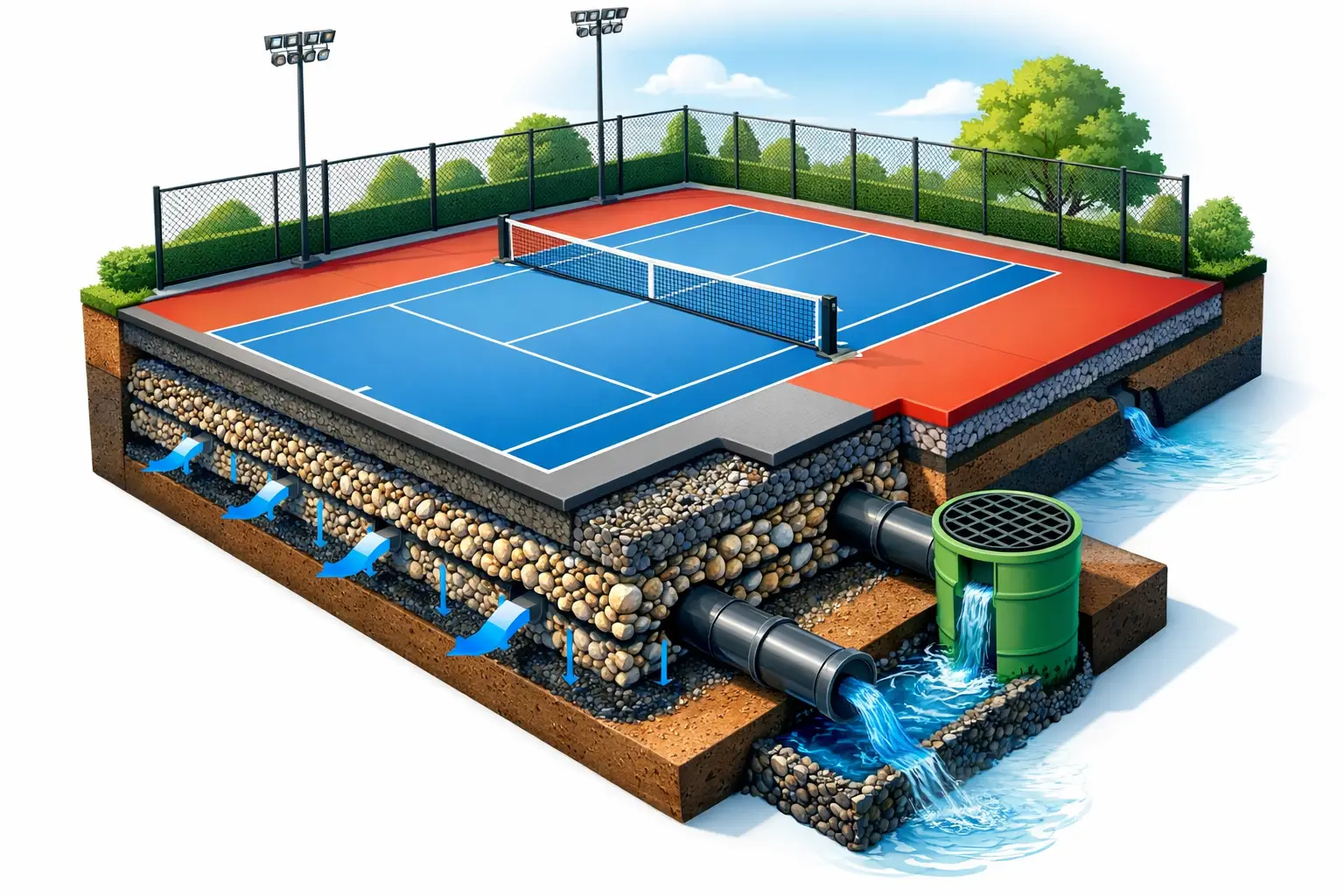
A court can look complete on handover day and still be vulnerable from the first major storm. Water that remains on an acrylic court, padel surround, or artificial turf system does more than interrupt play. It can soften subgrades, stain finishes, accelerate cracking, undermine fencing footings, and create slip hazards. Court drainage requirements must therefore be designed into the full civil package, not treated as an accessory added after the surface is selected.
For developers, schools, municipalities, compounds, and destination operators, drainage is a direct asset-protection decision. A properly engineered system keeps the playing area usable, protects the investment below the surface, and reduces reactive maintenance over the life of the facility.
Court Drainage Requirements Start Below the Surface
The visible sports surface is only the final layer of a drainage strategy. Performance begins with a site assessment that considers topography, soil conditions, anticipated rainfall intensity, surrounding hardscape, groundwater conditions where relevant, and the intended court system. An outdoor basketball court has different drainage behavior from a porous artificial turf pitch, while a padel court introduces enclosed edges, glass, steel posts, and a concentrated roofless playing zone that must shed water predictably.
The first requirement is a stable, compacted formation that will not lose bearing capacity when wet. In many Saudi sites, this means evaluating whether native soils are suitable for support or whether unsuitable material, weak pockets, or expansive soils require treatment, replacement, or a designed subbase. Surface water management cannot compensate for an unstable foundation.
Above the formation, the aggregate base must be graded, compacted in controlled lifts, and shaped to support the specified falls. For impermeable systems such as acrylic sports courts, the base and slab work together to move water across the surface toward collection points. For permeable turf systems, the aggregate profile may also carry water downward and laterally to perforated drainage pipes or outlets. The design must match the surface construction rather than applying one generic detail to every facility.
Set Falls That Move Water Without Affecting Play
Court slopes are a balance between drainage and sporting performance. If the fall is too flat, water can pond in low areas and along edges. If it is too steep, it may be noticeable underfoot, affect ball behavior, or make the facility feel poorly built. The finished grade must be established before surfacing starts because acrylic coatings and similar finish systems are not intended to correct significant level errors.
A common design approach for hard courts is a consistent crossfall or single-direction fall toward a drainage edge. Exact slope values should be confirmed by the project civil engineer, the governing authority, the sport requirements, and the selected surface manufacturer. The critical issue is consistency. Localized depressions are often more damaging than an overall slope that is slightly conservative, because they create persistent puddles that cycle through heat, evaporation, and contamination.
Laser-controlled grading, level surveys, and pre-surface water testing provide practical quality control. Before the final coating or turf installation, the contractor should confirm that the base drains as intended and that water does not collect at gates, net-post sleeves, court corners, or transitions to walkways. These are the details most likely to be missed when drainage is treated as a separate scope.
Do Not Drain Toward the Building or Public Walkway
A court should never become a collection surface that directs runoff toward building entrances, service yards, pedestrian routes, or neighboring plots. Finished levels must coordinate with adjacent paving, retaining walls, planter edges, and access roads. This coordination is particularly important on compact urban sites, school campuses, and hospitality developments where a court is one element within a larger public realm.
Drainage discharge also needs a defined destination. Depending on site conditions and approvals, water may connect to a stormwater network, a designed swale, an infiltration system, or another approved collection point. Discharging uncontrolled runoff onto adjacent land is not a durable or responsible solution.
Choose Drains for the Court Type and Site Constraints
Drainage components should be selected around hydraulic need, maintenance access, and the physical demands of the facility. Perimeter trench drains are often effective along the low side of acrylic courts and multi-use games areas. They collect sheet flow before it reaches adjacent paving or walls, while grates can be chosen to withstand pedestrian and maintenance traffic.
For artificial turf fields, a below-surface network of perforated pipes within a free-draining aggregate layer may be appropriate. The pipe layout, spacing, depth, and outlet capacity depend on soil permeability, field dimensions, rainfall design criteria, and the turf system. A turf carpet with perforations does not make the entire facility self-draining if the subbase is poorly graded or outlets are undersized.
Padel courts require particular attention. Water can concentrate at the perimeter where the playing surface meets the steel and glass enclosure. Drainage channels must be located and detailed so they do not interfere with anchoring, door clearances, glass tolerances, or player movement. The channel grates should sit accurately relative to the finished surface and resist clogging from windblown sand, leaves, and court debris.
The same principle applies to running tracks and outdoor fitness zones. Water must move away from wearing surfaces and structural edges without creating open channels, abrupt level changes, or grates that present a trip risk. A coordinated layout is safer and easier to maintain than a collection of drains added wherever water happens to appear.
Design for Saudi Heat, Dust, and Short Intense Storms
Saudi Arabia’s dry climate does not reduce the need for drainage planning. In fact, long dry periods can allow sand, litter, and fine sediment to accumulate in channels and outlets. When a short, intense rainfall event arrives, neglected drains can block quickly. High heat also increases movement stresses in slabs and asphalt bases, which can expose low points or cracks over time if the structural and drainage design is not coordinated.
Court drainage requirements for Saudi conditions should account for both peak storm response and routine maintenance. Drain channels need accessible catch pits or inspection points. Grates should be removable where cleaning is required. Outlets must remain reachable after landscaping, paving, and fencing are installed. A drainage system that cannot be inspected will eventually become a hidden operational risk.
Material selection matters as well. Grates, frames, pipework, and connection details must suit outdoor exposure, cleaning methods, expected loads, and the corrosion environment of the project location. Coastal projects near Jeddah or Dammam may require additional attention to corrosion resistance, while inland sites can face severe heat and airborne dust. The right specification depends on the site, but the objective remains the same: reliable flow with minimum disruption to the facility.
Coordinate Drainage With Every Trade
Drainage failures often begin at interfaces. Civil works, surfacing, fencing, lighting, landscaping, irrigation, and electrical scopes all meet around a sports court. If these packages are not coordinated, a light pole base may obstruct a drainage route, an irrigation line may cross a drain incorrectly, or new paving may create a backfall toward the court after the sports surface is complete.
A full-scope contractor should establish finished levels early and issue clear details for trench drains, outlet pipes, expansion joints, edge restraints, and surrounding pavement. During construction, compaction records, drainage line testing, level checks, and visual inspections should be part of the quality process. The final surface should be installed only after the supporting layers have been verified.
At StepX Sports, this coordination is central to turnkey delivery. A high-performance court is not simply a coating, turf roll, or enclosure. It is an engineered recreational asset where the civil foundation, drainage path, surface system, and final play experience perform as one.
Plan Maintenance Into the Operating Budget
Even well-designed drainage requires routine care. Facility teams should inspect grates and catch basins before and after seasonal weather events, remove windblown debris, check for settlement at drain edges, and monitor any recurring ponding. If water begins to stand in the same location, early investigation is far less costly than waiting for surface deterioration or base failure.
Operators should also avoid washing courts with more water than the drainage system can comfortably handle at one time. Cleaning practices, nearby irrigation, and landscape runoff can all introduce sediment into channels. A simple inspection schedule protects court appearance, user safety, and availability.
The strongest drainage solution is usually invisible during normal use. Players see a clean, dry, level surface. Operators see fewer closures and fewer repair calls. That is the standard worth setting at design stage, when every level, outlet, and edge detail can still be built correctly.