
Concrete Versus Asphalt Court Bases Compared
Recent Posts
Artificial Turf Dust: Causes, Risks, and Control
October 31, 2026
Acrylic Court System Review for Saudi Projects
October 30, 2026
What Drives Strong Padel Court Profitability?
October 29, 2026
Sand Filled Versus Nonfilled Turf for Sports
October 27, 2026
Share Post
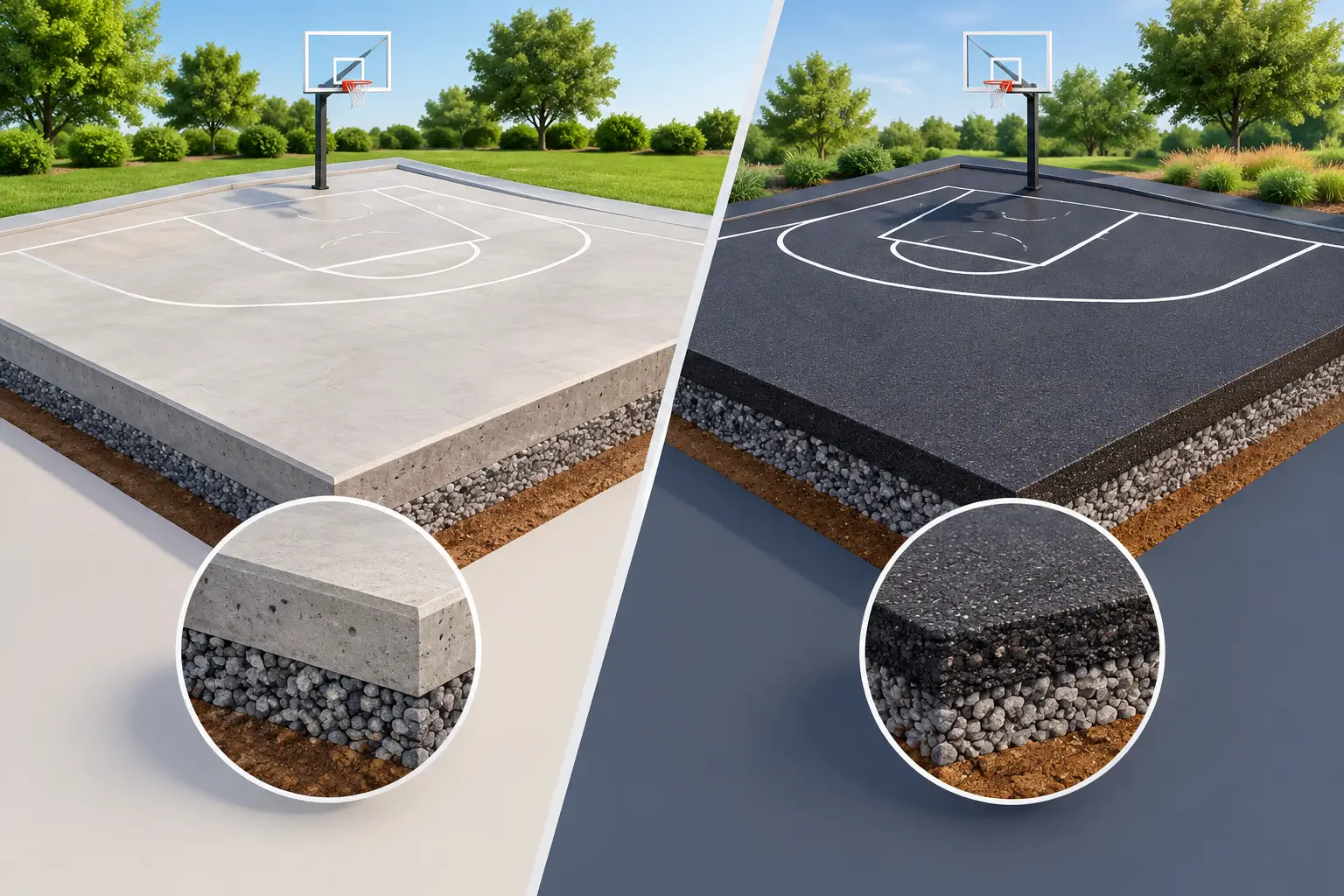
A court surface can look flawless on opening day and still fail early if the base beneath it was chosen for the wrong site conditions. The question of concrete versus asphalt court bases is not simply a matter of initial cost. It affects cracking behavior, drainage performance, construction sequencing, maintenance planning, and the long-term appearance of the acrylic finish.
For schools, compounds, municipalities, and destination developments in Saudi Arabia, the decision must account for extreme solar exposure, high surface temperatures, variable subgrade conditions, and the expected intensity of use. A court base is structural infrastructure. It should be specified with the same discipline applied to drainage, lighting foundations, and perimeter works.
Concrete Versus Asphalt Court Bases in Saudi Conditions
Both concrete and asphalt can support high-performance tennis, basketball, pickleball, and multi-sport court systems when they are engineered and installed correctly. Neither material is automatically superior in every project.
Concrete is a rigid pavement. It distributes loads through slab strength and can provide a stable, long-lasting platform where subgrade preparation, reinforcement, joints, and curing are properly controlled. Asphalt is a flexible pavement. It accommodates a degree of movement through its layered structure, but relies heavily on correct aggregate base compaction, mix design, asphalt thickness, and edge restraint.
The final playing surface does not eliminate weaknesses in the base. Acrylic coatings, cushion systems, line markings, and color finishes follow the profile and movement of the substrate below. If a slab cracks, settles, holds water, or moves at joints, those conditions can transfer through the surfacing system over time.
When a Concrete Court Base Is the Better Choice
Concrete is often selected for permanent facilities where long asset life, dimensional stability, and high structural capacity are the primary priorities. It is particularly suitable for institutional sites, public recreation areas, school campuses, and premium developments intended to operate for decades.
A properly designed concrete slab provides a firm, stable platform that is less susceptible to localized deformation under static loads. This can matter where courts share a site with maintenance vehicles, movable equipment, bleachers, fencing systems, or frequent service access. Concrete also provides strong support for fixed sporting infrastructure when foundations and court construction are coordinated from the beginning.
Its main challenge is shrinkage and thermal movement. Concrete will crack if restraint, joint layout, reinforcement strategy, curing, and subbase conditions are not managed with precision. In Saudi Arabia, large day-to-night temperature changes and intense sun exposure can increase movement demands. Every joint needs to be located deliberately, and the surfacing system must be compatible with the slab’s expected movement.
For acrylic courts, poorly planned control joints can become visible lines of maintenance. A quality design reduces unnecessary joints, keeps them away from high-play areas where possible, and uses appropriate crack-control and joint-treatment details. The goal is not to promise a crack-free slab. The goal is to manage movement predictably and protect the performance of the finished court.
Concrete also requires disciplined curing and moisture control. Rushing an acrylic system onto a young or moisture-affected slab can compromise adhesion and finish consistency. Project schedules should allow for the full construction sequence, including curing, testing, surface preparation, and coating installation.
Where Asphalt Court Bases Perform Well
Asphalt is a proven court base for many outdoor sports facilities, especially where a smooth, continuous surface and flexible response to minor ground movement are valuable. When built over a properly compacted aggregate base, asphalt can deliver excellent playability and a clean substrate for acrylic surfacing.
Because asphalt has no concrete control joints across the court, it can avoid the joint pattern that may later require attention on a slab-based system. That is one reason asphalt remains a practical option for tennis and multi-sport courts. It can also support efficient construction programs once earthworks, drainage, and base-course compaction are complete.
However, asphalt is highly dependent on material quality and temperature-aware installation. In high heat, an under-designed asphalt mix may soften, mark, or deform under concentrated loads. Thin asphalt layers, weak edges, inadequate compaction, and poorly prepared aggregate bases can lead to depressions and cracking that eventually affect ball response and water drainage.
Asphalt should not be treated as a shortcut. It requires engineered layer thicknesses, sound compaction procedures, correct slopes, and protection from construction traffic before the final surface is installed. Heavy equipment, vehicle access, and point loading near court edges should be controlled throughout the project and during operation.
For facilities expected to support only sports use, with no vehicle traffic on the court area, a well-designed asphalt base can be a cost-effective and high-performing solution. It is especially appropriate where the subgrade has been assessed carefully and the design allows for future maintenance without disrupting the wider site.
The Site Conditions That Should Drive the Decision
The right choice begins below the court. A geotechnical review, site levels, drainage routes, and intended use should be assessed before selecting either concrete or asphalt. A base material cannot compensate for an unstable subgrade or trapped water.
Subgrade and Ground Movement
Sites with variable fill, expansive soils, or evidence of settlement need closer engineering review. Concrete may bridge limited variations more effectively when designed as a suitable slab system, but it can also crack where movement is concentrated. Asphalt can tolerate minor, broadly distributed movement, yet it may reflect deeper settlement as surface depressions.
The practical answer depends on the nature of the movement, not just the presence of it. Ground improvement, geotextiles, engineered fill, and thicker aggregate layers may be more important than the final choice between concrete and asphalt.
Drainage and Court Slopes
No court base will perform well if water is allowed to pond. Standing water accelerates surface wear, increases slip risk, disrupts play, and can infiltrate vulnerable areas at edges and cracks.
The court should be formed with consistent slopes that direct water toward designed collection points without creating noticeable changes in ball behavior. Drainage channels, perimeter levels, adjacent landscaping, and access paths all need to work together. A court is only as dry as the surrounding civil works allow it to be.
Sport, Usage, and Operational Loads
For a dedicated tennis court, both concrete and asphalt can perform effectively beneath an acrylic system. For a school or community multi-court expected to host basketball, futsal training, events, and frequent maintenance activity, the operational profile may favor a more rigid concrete solution.
Padel courts require a separate structural assessment because the glass-and-steel enclosure, anchor locations, and wind loading introduce different foundation demands. The same applies to courts with large shade structures, spectator features, or integrated site furniture. These are not surface-only decisions.
Initial Cost Is Only One Part of the Budget
Asphalt may offer a lower initial cost in some project conditions, particularly when a suitable local supply chain, access, and base preparation are already in place. Concrete can require a greater upfront investment due to reinforcement, formwork, joints, curing time, and more detailed placement control.
That comparison changes when lifecycle requirements are included. A less expensive base that develops settlement, edge failure, or recurring cracks can create repeated coating repairs and operational disruption. Conversely, an over-specified slab can consume budget that would have produced greater value in drainage, shade, lighting, fencing, or a higher-grade cushioned surface system.
Procurement teams should evaluate the complete system: earthworks, subbase, base material, drainage, surface preparation, acrylic or polyurethane finish, fencing interfaces, and planned maintenance. The lowest base price is rarely the lowest facility cost over its operating life.
Precision Installation Protects the Playing Surface
Whether the specification calls for concrete or asphalt, performance depends on execution. Levels must be checked continuously. Aggregate layers need controlled compaction. Slopes must be established before surfacing begins, not corrected with excessive coating material later. Edges, drains, posts, and perimeter restraints must be coordinated before the court is paved or poured.
Surface coatings should be applied only after the base has reached the required condition for the selected system. This includes verifying cleanliness, dryness, profile, soundness, and crack treatment requirements. The finish coat is the visible part of the court, but it cannot correct structural defects below it.
StepX Sports approaches court construction as a full-scope system, combining civil preparation, base engineering, sports surfacing, and installation control for Saudi conditions. That integrated approach helps protect both the player experience and the client’s long-term investment.
A well-specified court base should disappear from the conversation once the facility is in use. Players should notice consistent bounce, secure footing, clean drainage, and a surface that remains fit for purpose through years of heat, activity, and community use.