
Padel Installer Reviews: What to Look For
Recent Posts

Adventure Parks Built for Saudi Conditions
November 1, 2026
Artificial Turf Dust: Causes, Risks, and Control
October 31, 2026
Acrylic Court System Review for Saudi Projects
October 30, 2026
What Drives Strong Padel Court Profitability?
October 29, 2026
Share Post
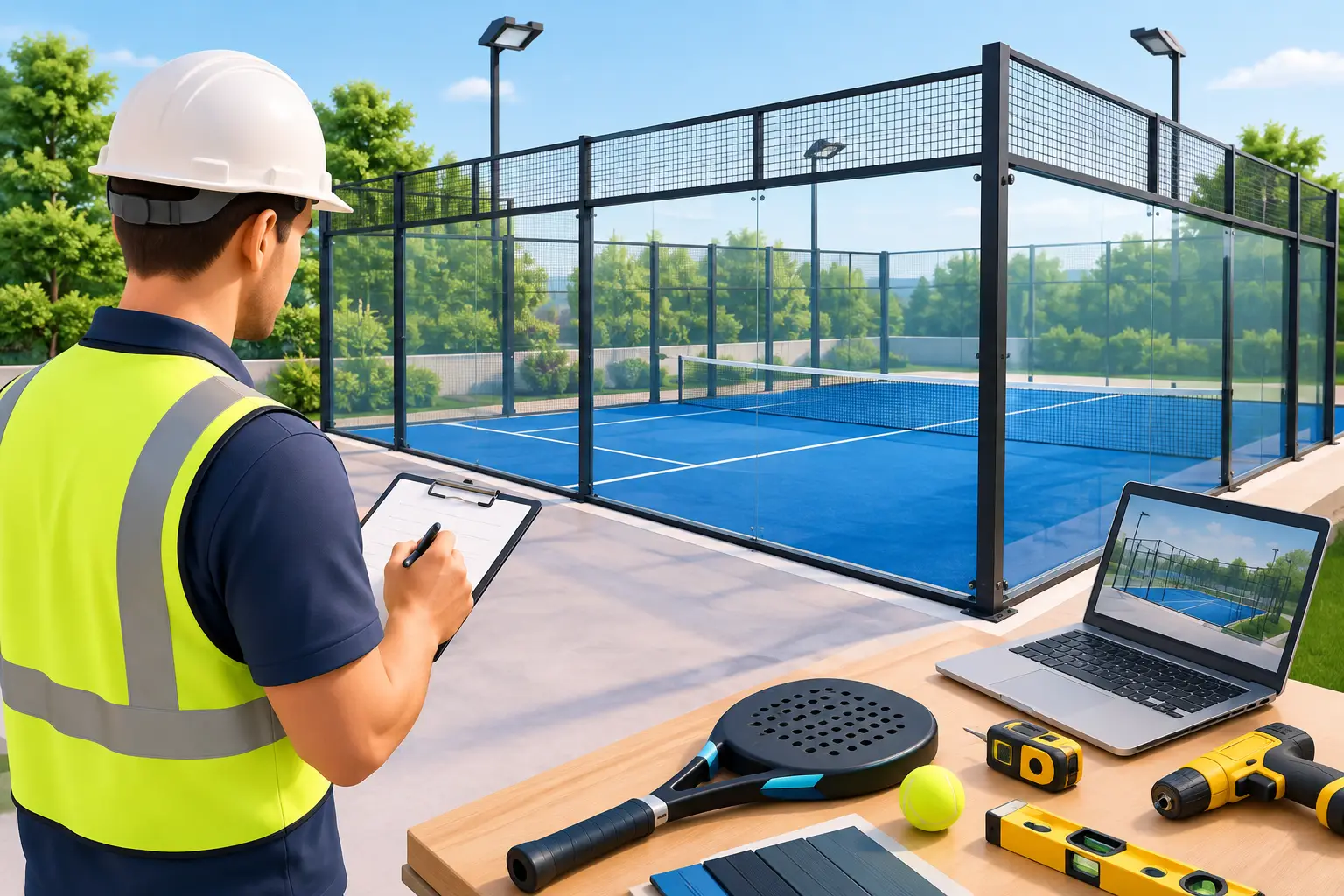
A padel court can look complete on handover day and still reveal major shortcomings after its first Saudi summer. That is why padel installer reviews deserve more attention than star ratings or a short testimonial. For developers, schools, compounds, hospitality operators, and public-sector buyers, the most useful reviews reveal how an installer performs when accuracy, heat exposure, drainage, safety, and program deadlines are all under pressure.
A padel court is a technical asset, not a packaged product placed on a slab. Its playing characteristics and service life depend on civil preparation, structural alignment, glass installation, turf selection, lighting integration, access control, and the contractor’s ability to manage every interface. Reviews can help identify that capability, but only when they are read with the right questions in mind.
What Padel Installer Reviews Should Actually Prove
The strongest review is specific. It explains what was built, the operating environment, the challenges encountered, and how the contractor responded. A comment such as “excellent work” is positive, but it does not help a procurement team assess whether the installer can deliver a high-traffic court at a destination development or a safe, low-maintenance facility at a school.
Look for evidence of scope control. Did the installer manage the project from site assessment and design coordination through civil works, court assembly, inspections, and handover? Or did the client have to coordinate separate subcontractors for foundations, electrical work, drainage, fencing, and surfacing? Full-scope delivery reduces gaps between trades, which is where expensive defects often begin.
Reviews should also indicate whether the contractor communicated clearly during the build. Delays can occur because of site access, approvals, utility conflicts, or material lead times. The relevant question is not whether every project was free of change, but whether the installer identified risks early, documented decisions, and protected the client’s schedule and budget.
Read Reviews Through the Lens of Saudi Conditions
A court that performs well in a mild climate is not automatically suitable for Riyadh, Jeddah, Dammam, or remote destination sites. High surface temperatures, UV exposure, dust, sudden rainfall, intensive use, and differing ground conditions demand an installation approach built for the local environment.
When assessing feedback, look for references to material performance over time. This may include turf fiber retention, color stability, adhesive integrity, corrosion resistance, glass hardware, lighting reliability, and drainage behavior. A well-specified court requires more than attractive finishes. Each component must work as part of a system that remains stable and safe through demanding outdoor conditions.
Reviews from operating facilities are especially valuable because they show performance beyond practical completion. Ask whether the client experienced loose turf, standing water, misaligned doors, rattling steelwork, premature coating failure, or glass and mesh movement after regular play. A contractor’s response to those issues matters as much as the original installation. Long-term accountability is a meaningful indicator of quality.
Separate Marketing Praise From Project Evidence
Every specialist contractor will present completed courts attractively. Buyers should go further by looking for verifiable project evidence behind the praise. A useful review will often mention practical details: the condition of the site before work began, the contractor’s coordination with other project teams, the quality of finishing, the safety of the handover process, or the responsiveness of the maintenance team.
It also helps to consider who is giving the review. A private homeowner may prioritize appearance, speed, and straightforward communication. A municipality or developer will likely place greater weight on compliance, documentation, durability, lifecycle value, and the ability to work within a complex construction program. Neither perspective is wrong, but they answer different buying questions.
For institutional projects, request relevant references directly and speak with clients whose facilities are comparable in scale and use. A contractor with experience on premium residential projects may be highly capable, yet a multi-court community venue or school campus introduces different demands around traffic flow, safeguarding, maintenance access, and operational resilience.
The Technical Questions Reviews May Not Answer
Even detailed padel installer reviews cannot replace technical due diligence. Reviews describe the client experience; the tender and pre-award process must confirm the engineering behind it. Ask the installer to explain how the court system will be adapted to the site rather than simply supplying a standard specification.
The discussion should cover the base construction and tolerances, including how levels will be checked before court assembly. Poor slab accuracy can affect drainage, structural alignment, glass fitment, and playing consistency. It should also cover water management. Surface water must be directed away from the court and surrounding access areas without creating settlement, slip, or maintenance risks.
Material selection requires the same discipline. The steel structure, fasteners, mesh, glass, turf, infill, and lighting should be selected for the intended operating environment and supported by clear product documentation. For an outdoor court, heat and UV resistance are operational requirements, not optional upgrades. For coastal or humid locations, corrosion protection deserves particular attention.
Safety should be visible in both the design and the construction method. This includes secure glass fixing systems, controlled access points, edge treatments, reliable lighting, and a layout that gives players, spectators, and maintenance teams sufficient clearance. If a review praises a contractor’s attention to detail, use that as a prompt to ask exactly how those details are inspected and signed off.
Questions to Ask Former Clients
A reference conversation becomes more useful when it moves beyond “Were you happy?” Ask whether the project was delivered to the agreed scope, whether site coordination was professional, and whether the court has performed as expected after opening. Then ask what happened after handover. Did the installer provide maintenance guidance, respond to defects, and remain available when the operator needed support?
It is also reasonable to ask where the client would have wanted more clarity. A credible former client may mention a change in sequencing, a weather-related delay, or a decision that needed additional explanation. That is not necessarily a warning sign. Construction projects involve variables. What matters is whether the contractor took ownership, offered practical options, and resolved the issue without compromising the finished facility.
For larger developments, ask how the installer worked with architects, consultants, civil contractors, MEP teams, and client representatives. Padel courts often sit within wider recreation zones where lighting, landscaping, circulation, electrical supply, shade structures, and drainage must be coordinated. An installer that understands these interfaces can prevent late-stage rework and protect the overall experience of the space.
Build a Better Review Scorecard
Rather than relying on a general online rating, evaluate each prospective installer against a defined scorecard. Consider project relevance, Saudi climate readiness, quality of civil works, certified material sourcing, installation team capability, safety and compliance procedures, schedule control, handover documentation, and post-installation support. Weight the criteria according to the facility’s purpose.
For example, a hospitality venue may prioritize premium appearance, lighting quality, and minimal disruption to guests. A public facility may place greater emphasis on durability, safe circulation, predictable maintenance, and capacity for intensive use. A school needs an approach that supports safe daily operation and clear accountability. The right contractor is the one whose proven process matches the operational reality of the project.
Price should be considered in the same framework. A lower initial offer can become costly when it excludes drainage coordination, uses unsuitable materials, leaves interfaces to others, or provides limited support after handover. Value comes from a court that remains playable, safe, visually consistent, and maintainable over its intended life.
Choose Accountability, Not Just Approval
Positive reviews are useful because they show whether a contractor earned trust on real sites. They should guide the conversation, not end it. The decision should rest on demonstrated technical control, relevant delivered projects, a clear scope, and a team prepared to stand behind the facility after opening.
The best padel court becomes part of a larger active-lifestyle asset: a place that attracts play, supports community engagement, and strengthens the value of the development around it. Choose an installer whose record shows the discipline to build that legacy properly.