
Synthetic Turf Versus Natural Grass: Which Performs?
Recent Posts
Selecting Turf Infill Materials for Saudi Sports
September 14, 2026
How to Upgrade Campus Recreation for Daily Use
September 13, 2026
Best Padel Court Materials for Saudi Conditions
September 12, 2026
Best Outdoor Fitness Equipment for Saudi Sites
September 11, 2026
Share Post
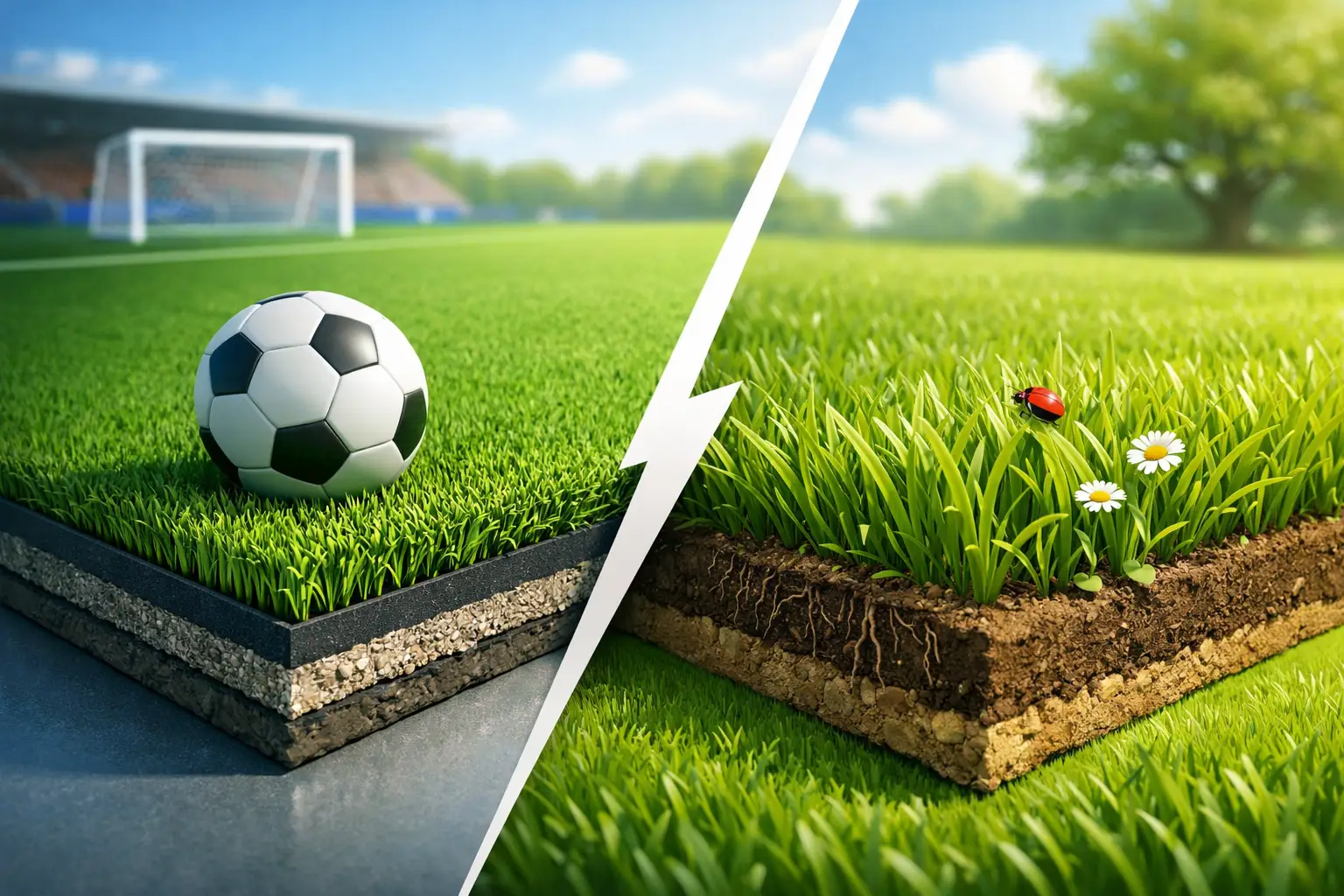
A school field that closes after every irrigation cycle, a compound lawn worn thin by weekend football, and a destination pitch expected to look premium year-round all face the same decision. Synthetic turf versus natural grass is not simply a question of appearance. For Saudi developments, it is a long-term infrastructure choice that affects water demand, user comfort, operating budgets, safety, and the number of hours a facility can remain open.
The right answer depends on the activity, site conditions, maintenance capability, and the performance standard expected by users. Natural grass can provide an exceptional playing and landscape experience when it is properly designed and intensively maintained. Synthetic turf offers predictable availability and heavy-use durability, but it must be engineered carefully to manage heat, drainage, shock absorption, and long-term wear.
Synthetic Turf Versus Natural Grass for Saudi Sites
Saudi Arabia’s climate changes the comparison. Extended heat, high solar exposure, dust, limited water availability, and frequent use place pressure on every outdoor surface. A surface that performs well in a mild climate may not provide the same value in Riyadh, Jeddah, Dammam, or a remote destination development.
Natural grass needs a healthy root zone, reliable irrigation, drainage, mowing, fertilization, pest management, and ongoing repair. It also needs recovery time. On a football field, repeated training sessions, school recesses, or community events can quickly create bare areas and compaction if the turf is not given time and resources to regenerate.
Synthetic turf does not require irrigation to stay green, and it can support a much higher volume of play with minimal downtime. That makes it a practical choice for schools, compounds, municipal parks, multi-use recreation areas, and facilities where programming runs from early morning into the evening. However, synthetic turf is not maintenance-free. It requires routine brushing, debris removal, infill management, seam inspections, and periodic professional servicing to preserve drainage, stability, and player safety.
Performance Starts Below the Surface
The visible grass blade is only one part of the system. Whether a project uses natural grass or artificial turf, subbase design determines whether the surface remains level, drains correctly, and performs consistently over time.
For synthetic turf, a precision-graded aggregate base, suitable geotextile layers, controlled slopes, and drainage provisions form the foundation of a reliable installation. The turf system must then be selected for its intended use. A decorative landscape product is not the same as a football turf system, and a multi-use school field requires different pile height, density, infill, and shock pad specifications than a private garden.
For natural grass, the growing medium, drainage layer, irrigation design, and edge details require equal attention. Poor drainage can lead to standing water, soft areas, root damage, and unusable playing conditions. In high-use facilities, reinforced natural turf systems may be considered, but they still require specialist agronomy and a committed maintenance program.
A low initial price often signals that critical layers have been reduced or overlooked. This can create costly consequences later, including settlement, poor drainage, surface wrinkles, hard playing zones, and premature replacement. High-performance recreational infrastructure should be specified as a complete system, not purchased as a roll of material.
Heat, Comfort, and Player Safety
Heat is the most important trade-off in this decision. Synthetic turf can become significantly hotter than natural grass under direct sun. The degree of heat buildup varies by fiber color, infill type, pile structure, air movement, and solar exposure, but no responsible specification should ignore this issue.
Natural grass generally provides a cooler surface because moisture within the plant and soil supports evaporative cooling. For open public spaces, family recreation zones, and passive landscape areas where people may sit, walk barefoot, or remain outdoors for long periods, this can be a meaningful advantage.
That does not rule out synthetic turf for hot climates. It means the system and operating plan must be appropriate. Shade structures, field orientation, hydration breaks, session scheduling, and heat-management procedures can reduce user exposure. In some applications, specialized infill systems or reduced-infill designs may also be considered, but every option should be assessed against play requirements, maintenance needs, and expected ambient temperatures.
Safety is broader than surface temperature. A sports turf system should provide suitable traction, ball response, shock absorption, and vertical deformation for its sport and user group. Incorrect infill levels or a compacted base can make a field feel hard underfoot. Conversely, an overfilled or poorly maintained surface may affect foot stability and ball roll. Testing, inspection, and maintenance are central to safe long-term operation.
Water Savings Must Be Measured Honestly
Synthetic turf can substantially reduce ongoing irrigation demand compared with natural grass. For water-conscious developments, this is often one of its strongest advantages. It also removes the need for fertilizers, pesticides, mowing fuel, and the intensive landscaping labor associated with healthy natural turf.
Yet the sustainability calculation should not end there. Synthetic turf has an embodied material footprint, a finite service life, and eventual replacement requirements. Its end-of-life strategy should be considered before installation, including how fibers, backing, and infill will be removed and handled. It may also need occasional rinsing or cleaning, especially in dusty locations or high-traffic hospitality settings.
Natural grass uses water and ongoing inputs, but it can provide cooling, biological value, and a softer visual connection to the landscape. Where treated water, efficient irrigation controls, suitable soil conditions, and dedicated groundskeeping are available, natural turf may remain the right choice for selected premium landscapes or professional-standard grounds.
The most effective master plans often use both materials with purpose. Synthetic turf can carry intensive sport and play activity, while natural grass can be reserved for shaded lawns, ceremonial landscapes, lower-traffic amenity zones, and areas where thermal comfort is the priority.
Cost Should Be Evaluated Over the Asset Life
Natural grass usually has a lower initial material cost, but operating costs accumulate. Irrigation, labor, fertilizers, equipment, reseeding, sod replacement, drainage repairs, and temporary closures all affect the long-term budget. The total cost rises further when a field needs regular rehabilitation because it is being used beyond its intended capacity.
Synthetic turf typically requires a higher initial investment, particularly when the design includes a properly engineered base, drainage, shock pad, quality yarn, and sport-specific infill. In return, it can provide more bookable hours and a more consistent visual standard. For an operator managing schools, clubs, compounds, or public recreation assets, that availability can create material value.
Replacement planning remains essential. Turf fibers and backing age under ultraviolet exposure and heavy use. A well-selected and professionally maintained system can deliver a long service life, but it is not permanent. Owners should establish a capital renewal allowance from the beginning rather than treating replacement as an unexpected future expense.
Match the Surface to the Facility’s Real Use
The strongest decision comes from a clear operational brief. Consider who will use the space, how often it will be used, whether it supports organized sport or informal recreation, and who will maintain it after handover.
A school with daily activity and limited groundskeeping resources will often benefit from a durable synthetic turf field. A municipal park may use synthetic turf in high-wear play zones while retaining natural landscape areas for comfort and visual character. A hospitality development may prioritize immaculate natural lawns in guest-facing areas, supported by synthetic turf for active recreation where constant appearance and availability matter most.
For multi-sport projects, the question becomes more specific. Football, cricket practice, fitness zones, and general play each place different demands on the surface. One product rarely performs equally well across every activity. The right specification should reflect intended use rather than a generic product label.
Build for Use, Not for Handover Day
A field should look good at practical completion, but its real test comes after months of sun, dust, traffic, cleaning, and competition. That is why procurement teams and developers should assess design, material sourcing, base works, drainage, installation control, testing, and maintenance support as one accountable delivery scope.
StepX Sports approaches surface selection as an engineering decision tied to the site’s use, climate, and lifecycle plan. The goal is not to favor one material in every case. It is to create a recreation asset that stays safe, usable, and visually credible long after opening day.
Before selecting a surface, define the hours of use you need to protect, the maintenance team you can realistically support, and the experience users should have in the hottest part of the year. Those answers will point to a surface strategy built for lasting community use, not just a polished project launch.