
Acrylic Versus Polyurethane Courts: Which Fits?
Recent Posts
Adventure Parks Built for Saudi Conditions
November 1, 2026
Artificial Turf Dust: Causes, Risks, and Control
October 31, 2026
Acrylic Court System Review for Saudi Projects
October 30, 2026
What Drives Strong Padel Court Profitability?
October 29, 2026
Share Post
A court surface can look complete on handover day and still be the wrong long-term specification. For developers, schools, municipalities, and compound operators, the choice between acrylic versus polyurethane courts affects player safety, capital planning, maintenance cycles, and how well the facility withstands Saudi heat and intensive daily use. The right answer is not simply the more premium system. It is the surface that matches the sport, sub-base, operating model, and performance standard of the site.
Acrylic versus polyurethane courts at a glance
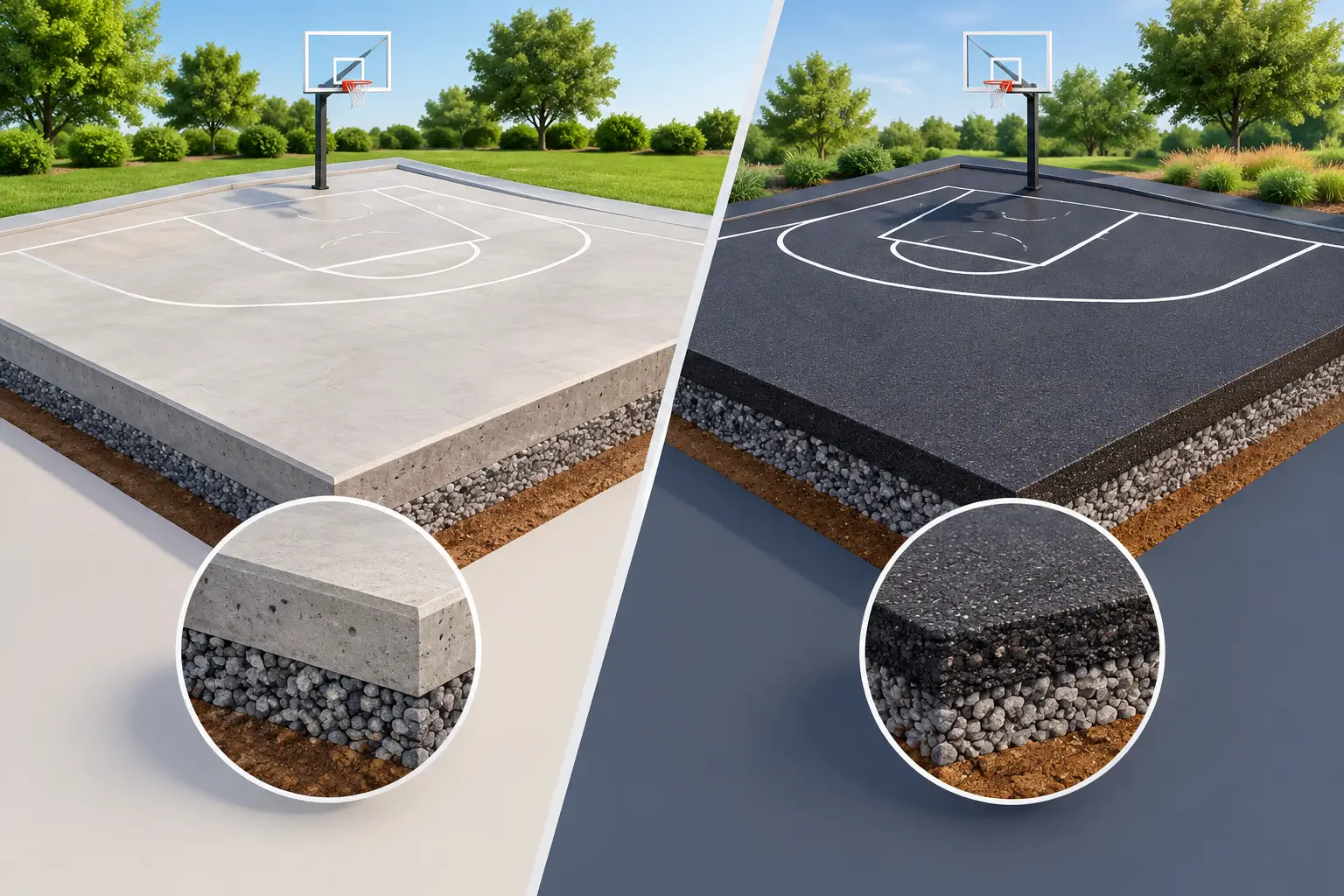
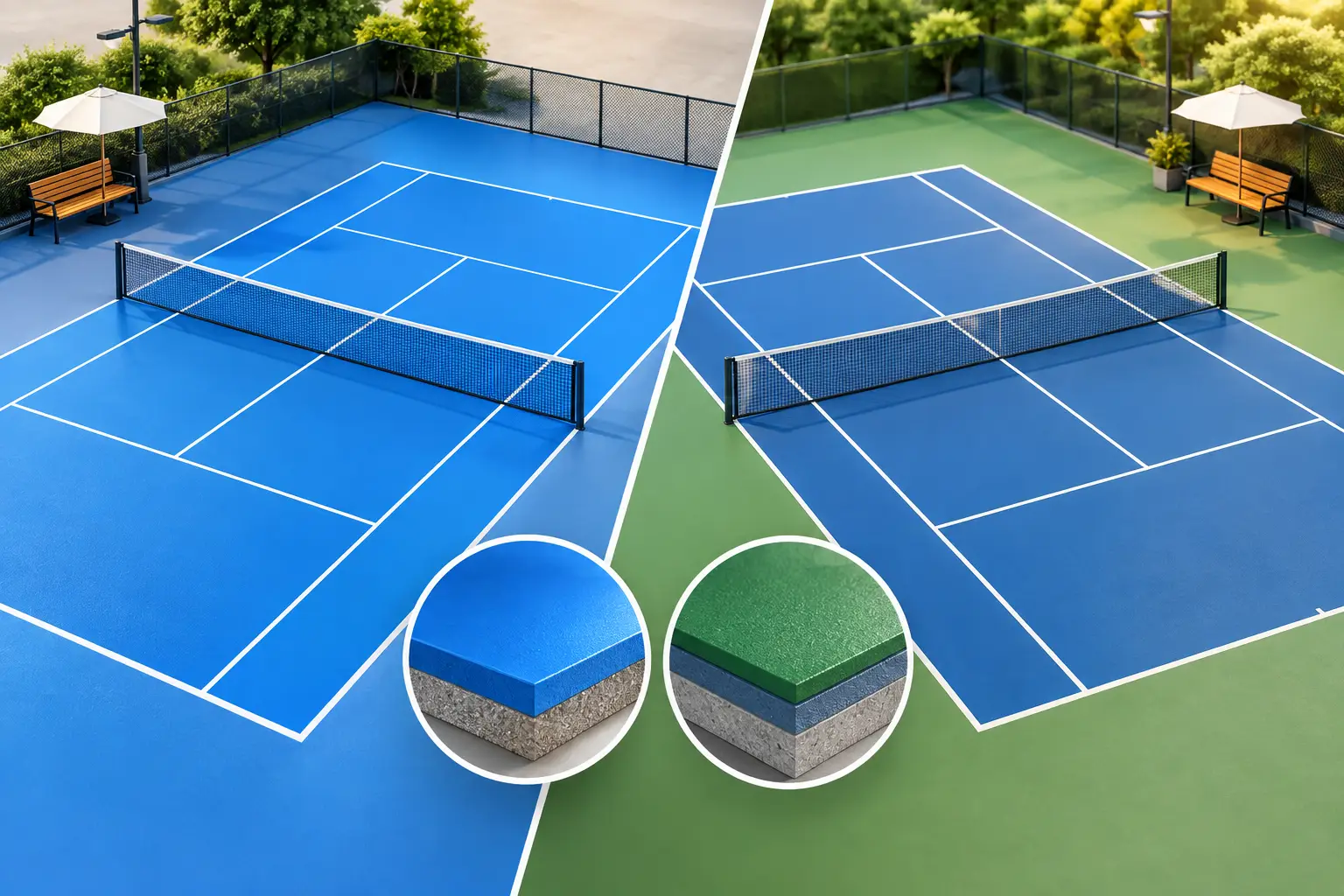
Acrylic and polyurethane are both established sports-surface systems, but they serve different performance priorities. Acrylic systems are generally hard-court coatings installed over a properly prepared asphalt or concrete base. They are widely used for tennis, basketball, multi-use games areas, and recreational courts because they provide a clean, consistent playing surface with defined line markings and relatively straightforward upkeep.
Polyurethane systems are more elastic. Depending on the system build-up, they can incorporate resilient layers that improve shock absorption, underfoot comfort, and impact protection. They are often selected for multipurpose indoor courts, school facilities, high-use recreation zones, and applications where athlete comfort and injury-risk management carry greater weight.
Neither material can compensate for poor civil works. Drainage, slope, base compaction, crack treatment, moisture control, and edge detailing determine whether either system performs as designed. A high-quality top layer installed on an unstable or poorly drained sub-base will fail prematurely.
When an acrylic court is the stronger choice
Acrylic is typically the practical choice for outdoor ball courts where speed, visual clarity, and cost-efficient lifecycle management matter most. Its textured finish can be calibrated to support traction and ball response, while its color system creates a professional, highly visible court layout.
For tennis and basketball, acrylic provides the familiar hard-court feel many users expect. The surface is firm, responsive, and suitable for regular recreational or competitive play when installed to the correct specification. It is also well suited to public parks, residential compounds, schools, and destination developments that need durable courts without the cost and thickness of a cushioned system.
In hot outdoor environments, acrylic offers another operational advantage: it is a comparatively simple system to inspect, clean, and renew. Periodic cleaning, timely crack repairs, and recoating at the appropriate interval can protect appearance and traction. This makes it attractive to operators managing multiple assets across a large site portfolio.
That said, acrylic has clear limits. It is not a soft surface, and it transfers more impact through the athlete’s lower body than a resilient polyurethane build-up. On a busy basketball court, particularly one used by younger players or for extended training sessions, the difference in comfort can be noticeable. Acrylic also follows the condition of its base. If cracking, settlement, or water movement is present below, those defects may telegraph through the coating.
Best-fit acrylic applications
Acrylic is often the right specification for outdoor tennis courts, basketball courts, pickleball courts, and multi-use games areas with a stable asphalt or concrete base. It works best where the priority is predictable play, strong visual presentation, low routine maintenance, and a durable hard-court experience.
For Saudi projects, color selection deserves more attention than it sometimes receives. Darker surfaces can become significantly hotter under direct sun. A considered color palette, correct texture, site shading strategy, and realistic operating schedule all contribute to a better player experience.
Where polyurethane earns its value
Polyurethane courts are designed for projects that require more resilience underfoot. Their layered construction can provide a more forgiving feel, particularly when paired with a shock-absorbing base layer. This can reduce fatigue during repeated running, jumping, and landing – an important consideration for basketball, volleyball, handball, school PE spaces, and multipurpose indoor halls.
For institutional buyers, the value of polyurethane often lies in its ability to support several activities within one controlled facility. A well-designed system can combine sports lines, durable finishes, traction, and impact attenuation without turning the space into a series of separate specialist courts. That flexibility is useful for schools, universities, corporate campuses, and mixed-use developments where programming changes throughout the day.
Polyurethane also allows greater control over the overall feel of the floor. System thickness, elastic layers, and topcoat selection can be aligned with the intended sport and intensity of use. This is not a reason to over-specify. A lightly used community hall does not necessarily need the same build-up as a high-traffic training center. But it gives project teams more performance options than a standard hard-court coating.
The trade-off is cost and installation discipline. Polyurethane systems require careful substrate preparation, controlled application conditions, and precise curing. Moisture vapor, surface contamination, or poor leveling can compromise adhesion and finish quality. Repairs also need to match the original system rather than being treated as a generic coating patch.
Best-fit polyurethane applications
Polyurethane is often justified for indoor sports halls, premium multipurpose courts, education facilities, fitness and activity spaces, and high-use courts where user comfort is a stated project objective. It can also be appropriate for covered outdoor environments, provided the system is specified for UV exposure, temperature movement, and the actual site conditions.
For fully exposed outdoor courts in Riyadh, Jeddah, Dammam, or other demanding Saudi locations, polyurethane should never be selected on appearance alone. The design team must verify UV stability, thermal performance, drainage, substrate movement, and the manufacturer’s approved installation parameters. A material that performs well indoors can be a poor choice in direct sun if the full system is not engineered for that exposure.
Heat, UV exposure, and drainage change the decision
Saudi conditions make surface selection more technical than a standard product comparison. High surface temperatures, ultraviolet exposure, airborne dust, sudden rainfall, and frequent cleaning can all affect performance. The court is only as durable as its complete construction assembly.
Acrylic systems for outdoor use need a correctly designed base, suitable crack-management approach, UV-stable color coats, and adequate surface drainage. Water must move off the court rather than ponding at low points, where it can accelerate staining, coating wear, and base deterioration. The finished slope must be achieved through disciplined civil works, not by attempting to correct major levels with the final coating.
Polyurethane systems need the same attention to drainage and base stability, plus stricter control of moisture and application conditions. For indoor facilities, vapor barriers, slab moisture testing, and expansion-joint detailing should be addressed before the finish is selected. For outdoor or semi-outdoor projects, thermal expansion and UV-rated system components become central to the specification.
In both cases, procurement teams should ask for the full system description rather than accepting a generic label such as “acrylic court” or “PU floor.” The specification should identify the substrate, primer, leveling requirements, resilient layers where applicable, topcoats, line-marking system, thicknesses, slip resistance, and warranty conditions.
Compare lifecycle cost, not material cost alone
The lower initial price is not always the lower-cost decision. Acrylic usually has a more accessible initial cost, especially where an existing base is sound and the project requires an outdoor hard court. Its long-term value depends on protecting that base through early crack repair, drainage maintenance, and planned recoating.
Polyurethane usually requires a higher initial investment because the material build-up and installation controls are more demanding. However, in the right setting, improved comfort, reduced impact load, and multi-sport usability can justify the premium. A school that uses one indoor court from morning PE through evening community programming may gain more value from polyurethane than from a cheaper hard surface that does not suit the full usage profile.
Lifecycle planning should include cleaning, inspections, joint maintenance, line renewal, recoating or refinishing cycles, and the operational consequences of taking a court out of service. It should also account for the cost of poor user experience. A court that becomes too hot, too slippery, too hard for its intended users, or visibly worn before its time does not serve the development’s long-term reputation.
Questions that should shape the specification
The most productive starting point is not “Which coating is best?” It is “What must this court do for the next 10 years?” Project teams should define the primary sports, expected daily traffic, user age groups, indoor or outdoor exposure, desired level of shock absorption, base condition, drainage constraints, maintenance capability, and budget horizon.
A public outdoor basketball court with heavy evening use may favor a textured acrylic system over a stable, well-drained base. A university indoor hall that hosts basketball, volleyball, and student recreation may benefit from a polyurethane system with resilient layers. A premium compound may use both: acrylic for exposed tennis and padel-adjacent activity areas, polyurethane for a covered multipurpose facility.
StepX Sports approaches this decision as a full-scope surface-engineering exercise, connecting civil preparation, material selection, installation controls, and maintenance planning. That integrated approach matters because the court surface is not a finish added at the end of construction. It is a performance system.
The strongest court specification is the one that remains safe, playable, and visually credible after years of heat, traffic, and real use. Choose the surface only after the site, sport, and operating plan have been tested against one another.