
Court Foundation Preparation Guide for Lasting Play
Recent Posts
Selecting Turf Infill Materials for Saudi Sports
September 14, 2026
How to Upgrade Campus Recreation for Daily Use
September 13, 2026
Best Padel Court Materials for Saudi Conditions
September 12, 2026
Best Outdoor Fitness Equipment for Saudi Sites
September 11, 2026
Share Post
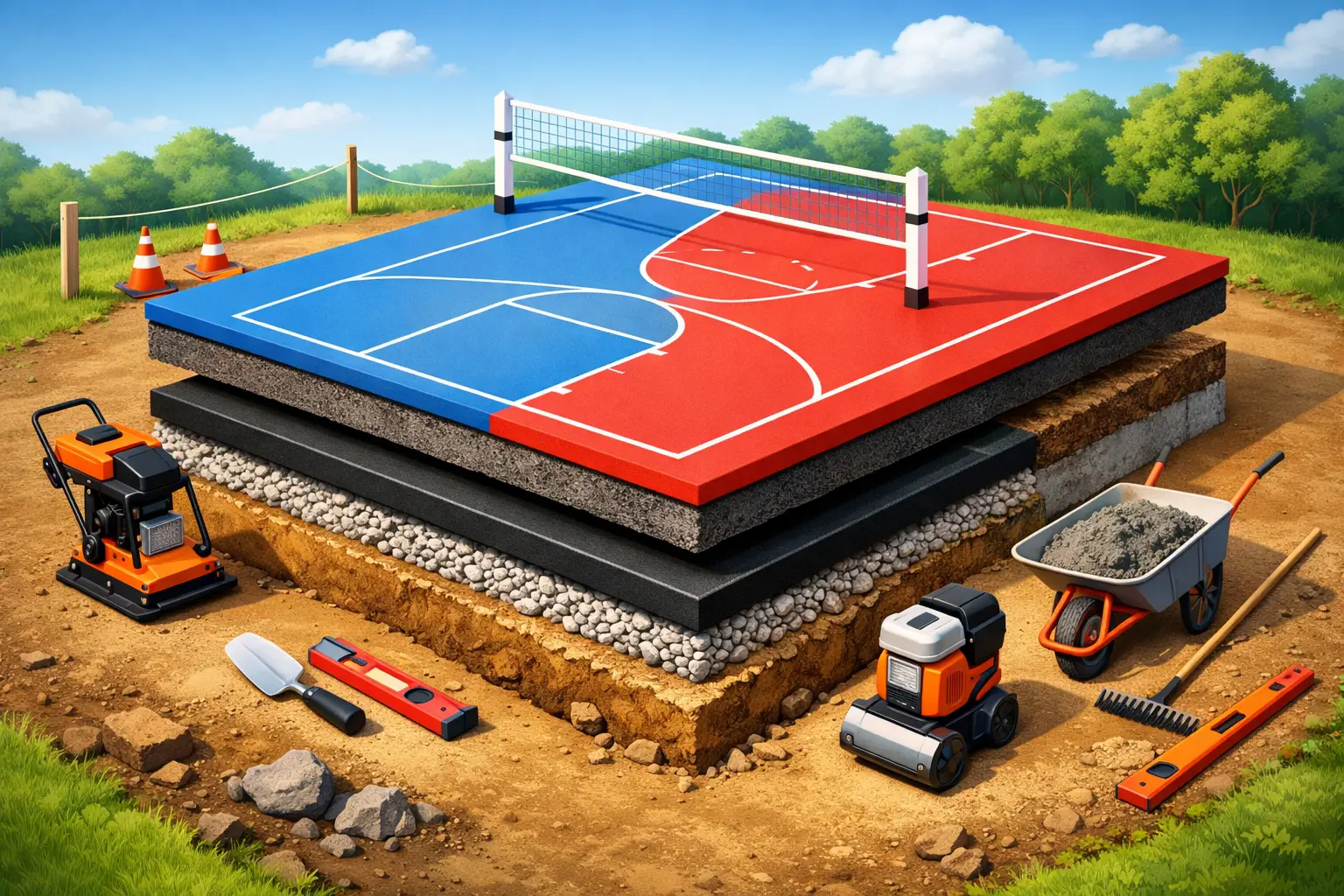
A court surface can look complete on opening day and still fail long before its expected service life. Cracking, ponding, uneven ball response, loose edges, and premature coating wear usually start below the finish layer. This court foundation preparation guide explains the civil works decisions that determine whether a sports court performs consistently through Saudi Arabia’s heat, heavy use, and seasonal rain events.
For developers, schools, municipalities, compounds, and destination operators, foundation preparation is not a background activity. It is the structural control point for the entire facility. A high-performance acrylic court, artificial turf field, padel system, or multipurpose recreation area can only perform as designed when its base is stable, correctly graded, well drained, and built to verified tolerances.
Start With the Site, Not the Surface
The surface system should follow a site assessment, not lead it. Before selecting court materials or confirming construction levels, the project team needs a clear understanding of existing ground conditions. Soil type, bearing capacity, groundwater conditions, nearby structures, access constraints, and final drainage routes all influence the foundation design.
This is particularly relevant in Saudi projects, where sites may include loose granular soils, expansive ground, reclaimed areas, variable fill, or hard strata close to the surface. A court built over uncontrolled fill may settle differently across its footprint. Even minor differential settlement can create low points that hold water or produce visible cracks through the finished surface.
A geotechnical investigation is proportionate to project scale and site risk. A private residential court on established ground may require a more limited review than a public sports complex or a padel facility with substantial structural loads. The principle remains the same: confirm what the court will be built on before finalizing what it will be built with.
Define Levels, Slopes, and Drainage Early
A court must be level enough for fair play but never flat enough to trap water. This balance requires precise setting out from the first excavation stage. Finished levels should account for the full construction build-up, including subgrade treatment, aggregate base layers, asphalt or concrete pavement, surface system, perimeter restraints, and drainage interfaces.
For most outdoor hard courts, a controlled crossfall or single-direction fall directs water toward approved collection points. The exact slope depends on the sport, surface system, local authority requirements, and site drainage strategy. Too little fall creates ponding. Too much can affect player comfort, ball behavior, accessibility, and visual quality.
Drainage must also have somewhere reliable to go. It is not enough to install channels, catch basins, or perimeter drains if the outlet is undersized, blocked, or disconnected from the wider site network. On large developments, court drainage should be coordinated with landscape grading, utility corridors, building thresholds, and stormwater systems before construction begins.
Keep Water Away From Court Edges
Court edges are frequent failure points. Water entering beneath an asphalt slab or beside a concrete base can weaken support, wash out fine material, and contribute to cracking. Finished landscaping should not direct irrigation or stormwater toward the court perimeter.
Perimeter drains, concrete curbs, edge restraints, and adjacent paving all need to work as one system. The correct approach depends on the site. A court set within a landscaped community park requires different edge detailing than a rooftop court, school campus, or enclosed padel facility.
Prepare a Stable, Uniform Subgrade
Once excavation reaches the required formation level, the subgrade must be inspected, trimmed, and compacted. The goal is not simply to create a hard-looking surface. The goal is to achieve uniform support across the entire court area and its surrounding working zone.
Soft pockets, organic material, loose fill, construction debris, and saturated areas should be removed or treated before the next layer is placed. Where the natural soil is weak or variable, the design may call for stabilization, geotextile separation, geogrid reinforcement, imported engineered fill, or deeper excavation and replacement.
Moisture control matters during compaction. Soil that is too dry may not compact effectively, while overly wet material can pump, rut, and lose stability under construction traffic. Field density testing provides evidence that the prepared subgrade meets the specified compaction requirement rather than relying on visual judgment alone.
Build the Base in Controlled Layers
The aggregate base distributes loads, supports the pavement layer, and helps preserve the designed court geometry. It should be installed in measured lifts using approved, well-graded material and compacted at each stage. Placing a full base thickness in one uncontrolled layer may leave weak zones that reveal themselves later as settlement or cracking.
The required base depth depends on soil conditions, pavement type, anticipated use, and structural loading. A recreational basketball court has different demands from a court exposed to maintenance vehicles, temporary event loads, or the structural foundations of a padel enclosure. Project teams should avoid applying a standard thickness without considering the actual use case.
During installation, levels should be checked repeatedly. A base that varies in thickness can create inconsistent stiffness beneath the final pavement. That inconsistency may not be visible immediately, but it can reduce long-term performance under thermal movement and repeated foot traffic.
Separate Court Pavement From Structural Footings
Padel courts, fencing systems, shade structures, lighting poles, and ball-stop netting often introduce concentrated foundation loads around the playing area. These elements must be coordinated with the court slab or asphalt base before construction starts.
Post-installed anchors and unplanned excavation can damage waterproofing, disrupt drainage, or crack a completed pavement layer. For enclosed padel systems, structural footings, anchor locations, electrical conduits, and finished court levels should be coordinated through one construction package. This is a key advantage of full-scope, turnkey delivery.
Select the Right Pavement Platform
The pavement platform generally consists of asphalt, reinforced concrete, or a system-specific engineered base. Each option has advantages, but neither should be selected only on initial cost.
Asphalt provides a practical, smooth platform for many acrylic sports courts when it is placed on a stable aggregate base and protected by a compatible coating system. It can accommodate certain movements better than rigid concrete, but it still requires careful jointing at interfaces, correct compaction, and adequate curing before surfacing.
Concrete may be appropriate where structural stiffness, site conditions, or a particular surface system requires it. However, concrete joints, shrinkage behavior, curing conditions, and crack-control detailing must be handled correctly. A concrete slab with uncontrolled cracking is not a suitable foundation for a precision sports finish.
The final selection depends on the sport, site constraints, budget, maintenance plan, and desired lifecycle. The lowest-cost base can become the most expensive choice if it forces early resurfacing, drainage repairs, or disruptive reconstruction.
Verify Tolerances Before Surface Installation
Surface installation should not begin as soon as the pavement appears complete. The base must first be accepted against the approved tolerances for levelness, slope, compaction, surface texture, curing, and moisture condition. This inspection stage protects both the client and the surface installer.
For acrylic systems, the pavement must be sufficiently smooth and free from standing water, contamination, loose material, and significant cracking. For artificial turf, the base must meet grading requirements and provide the correct drainage behavior. For EPDM or polyurethane systems, substrate moisture and adhesion conditions require close control.
In Saudi Arabia, installation timing also matters. Extreme heat can influence asphalt behavior, concrete curing, adhesive performance, coating application, and crew productivity. Materials should be installed within manufacturer-approved temperature and humidity ranges, with work sequencing adjusted to protect quality rather than simply maintain schedule momentum.
Protect the Foundation During the Rest of Construction
A completed base can be damaged quickly by uncontrolled site traffic. Delivery trucks, cranes, forklifts, and landscaping equipment may deform edges, contaminate surfaces, or create cracks before the court finish is installed. Access routes and temporary protection should be defined as part of the construction plan.
The same discipline applies after handover. Drainage grates should be kept clear, irrigation should be adjusted away from court edges, and maintenance teams should avoid using aggressive cleaning methods or heavy equipment that exceeds the facility’s intended loading. A well-built court foundation is durable, but it is not immune to misuse.
Build the Asset From the Ground Up
A sports court is a visible community asset, but its long-term quality is established before players ever step onto the surface. Correct investigation, engineered grading, stable subgrade preparation, controlled base construction, and verified installation tolerances create the platform for safer play, predictable maintenance, and a stronger return on investment.
For projects across Riyadh, Jeddah, Dammam, and emerging destination developments, StepX Sports treats civil preparation as part of the performance system, not a separate preliminary trade. When the foundation is built for Saudi conditions, the finished court has the stability to serve its community for years to come.