
Installing Outdoor Court Drainage for Lasting Play
Recent Posts
Selecting Turf Infill Materials for Saudi Sports
September 14, 2026
How to Upgrade Campus Recreation for Daily Use
September 13, 2026
Best Padel Court Materials for Saudi Conditions
September 12, 2026
Best Outdoor Fitness Equipment for Saudi Sites
September 11, 2026
Share Post
A court can look complete on handover day and still fail its first serious rain event. Standing water at a baseline, recurring stains along the fence line, or a soft edge beneath artificial turf are not maintenance inconveniences. They are signs that drainage was treated as an accessory rather than a core part of the civil design. Installing outdoor court drainage correctly protects the playing surface, the sub-base, adjacent structures, and the long-term value of the facility.
For public parks, schools, compounds, hospitality developments, and private estates across Saudi Arabia, the challenge is not simply moving water away. It is managing short, intense rainfall on hard ground while protecting surfaces designed to withstand extreme heat, UV exposure, and heavy use. The drainage solution must work with the court system, the site levels, and the intended maintenance plan from the start.
Why Court Drainage Is a Surface Performance Issue
Outdoor courts are engineered assemblies. An acrylic basketball or tennis court, a padel perimeter, artificial turf, and EPDM activity flooring each rely on stable layers below the finished surface. When water enters or remains within those layers, it can weaken compaction, cause localized settlement, and create cracking or uneven ball response over time.
Surface water also creates immediate operational risks. Players lose traction, puddles interrupt programming, and water carried into surrounding walkways can affect public safety. At education campuses and municipal facilities, repeated closures can reduce the practical value of an otherwise high-quality recreational asset.
The visible puddle is rarely the full problem. Water may be collecting because the court has insufficient falls, because a channel is set too high, because runoff from nearby paving is entering the court, or because the outlet has no reliable downstream path. A professional design identifies the complete water route, from rain falling on the surface to its final approved discharge point.
Start With Levels, Soil, and Water Flow
Drainage design begins before excavation. The project team should survey existing levels, identify surrounding catchment areas, review soil conditions, and confirm where collected water can legally and practically discharge. A court placed in a low point will require a different strategy from one on an open, naturally sloping site.
Finished levels deserve particular attention. The court needs controlled, consistent fall that moves rainwater without creating a noticeable slope during play. The exact gradient depends on the sport, surface specification, dimensions, local site conditions, and governing design requirements. Too little fall allows ponding. Too much can affect player comfort, ball behavior, accessibility, and the visual precision expected from a premium facility.
Saudi sites add another layer of consideration. Dry, compacted ground may absorb little water during a sudden storm, while large adjacent roofs, plazas, or parking areas can direct significant runoff toward the recreation zone. In coastal areas such as Jeddah and Dammam, groundwater conditions, salt exposure, and corrosion resistance may also influence material selection. The answer is not a standard detail applied to every site. It is a coordinated drainage plan based on measured conditions.
Protect the Court From External Runoff
A well-sloped court can still flood if surrounding hardscape drains toward it. This is a common failure on phased developments, where later landscaping, walkways, or access roads alter the original water path.
Perimeter drainage, berms, swales, slot drains, or regraded paving may be required to intercept runoff before it reaches the playing surface. The preferred solution depends on available space, expected water volume, architectural requirements, and the need for accessible circulation around the court. What matters is that the court is not made responsible for draining the entire site.
Choosing the Right Drainage Approach
Most outdoor court projects use a combination of surface grading and perimeter collection. The appropriate configuration should be determined alongside the court foundation, not after surfacing has begun.
Surface Falls and Perimeter Channels
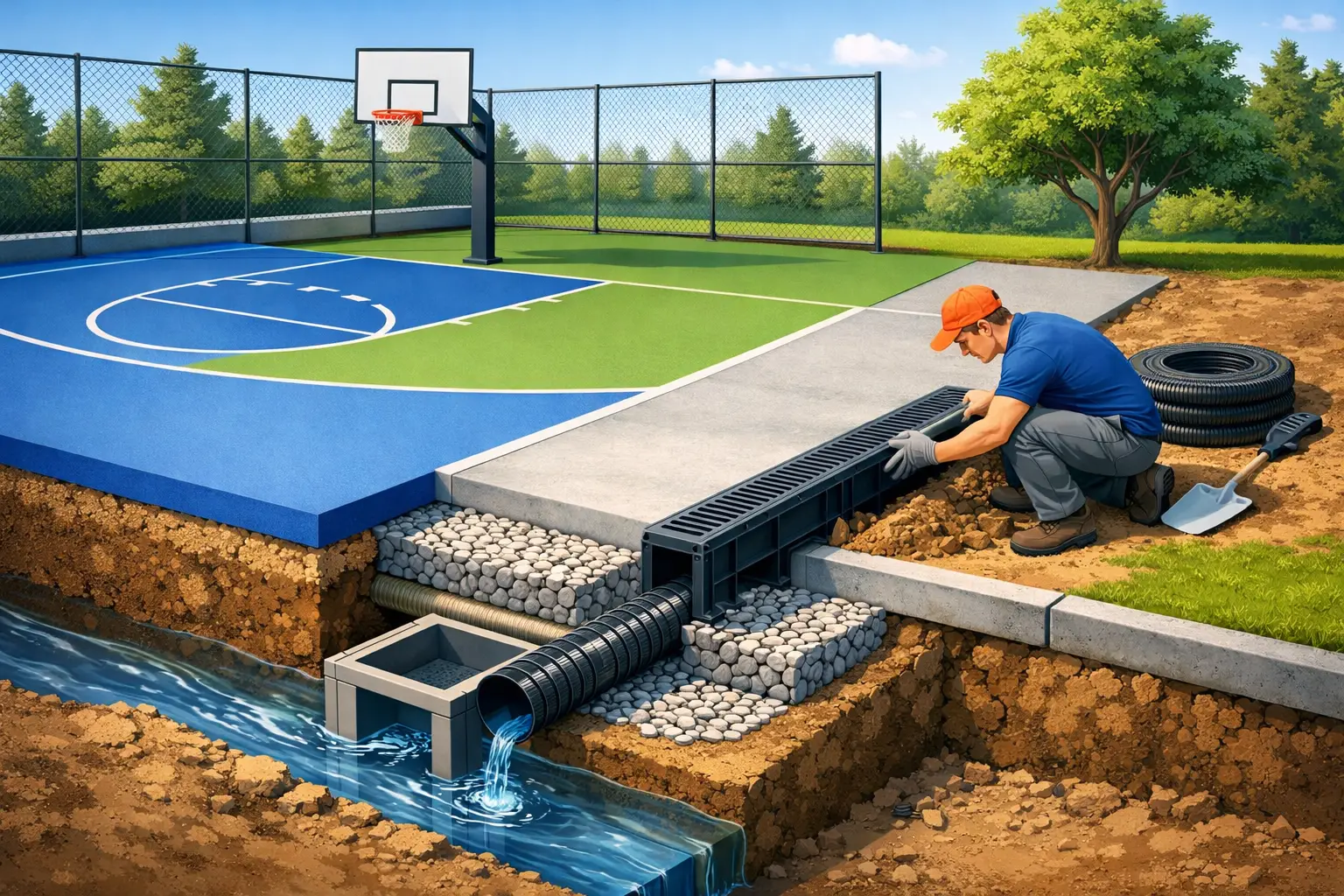
For many acrylic and hard-court systems, carefully formed surface falls direct water toward drainage channels or collection points at the perimeter. Linear channels can provide a clean, controlled collection line where site geometry demands it, particularly beside retaining walls, buildings, or tightly planned pedestrian zones.
Channels must be sized for anticipated runoff, installed at the correct elevation, and fitted with grates suitable for pedestrian loads and the surrounding use. They also need accessible inspection points. A narrow channel that cannot be cleaned is a future blockage, not a drainage strategy.
Subsurface Drainage for Turf and Permeable Areas
Artificial turf courts, landscaped edges, and certain multi-use recreation zones may require subsurface drainage. Perforated pipes set within graded aggregate can collect water that passes through the system and carry it to a suitable outlet. Filter fabric and correctly specified stone help prevent fine soil particles from entering the aggregate and reducing flow capacity.
This approach is especially relevant where native soils drain poorly or where water could accumulate beneath the surface. It does require disciplined installation. Pipe levels, trench gradients, connections, cleanouts, and aggregate compaction must be verified before the upper layers are closed.
Positive Outfall Is Non-Negotiable
Every drainage system needs somewhere to discharge. Depending on the development, this may be a stormwater network, engineered soakaway, retention area, or another approved collection system. The selected outfall must account for capacity, local authority requirements, future site development, and access for maintenance.
Drainage that ends at an undersized pit, a blocked connection, or an unapproved low area will eventually return water to the court. The system is only as reliable as its final outlet.
Build Drainage Into the Construction Sequence
Drainage is most cost-effective when it is integrated into full-scope civil works. Once an acrylic system is applied or turf is installed, correcting incorrect falls can involve removing finished materials, rebuilding base layers, and disrupting the facility schedule.
A controlled installation sequence generally begins with setting out and excavation, followed by formation preparation and proof of levels. Drainage trenches, pipes, channels, and outlet connections are then installed before the base is completed. Each layer is placed and compacted to specification, with levels checked continuously rather than assumed from initial benchmarks.
Before the final surface is installed, the contractor should inspect drainage components, verify channel elevations, and test flow where practical. On complex projects, water testing can reveal low spots or unexpected flow paths while corrections remain manageable. This quality-control stage protects the finished court, but it also gives the client clear accountability for work that will soon be concealed.
Materials Must Withstand the Site, Not Just the Storm
Drainage products beneath or around a court are exposed to heat, movement, cleaning, debris, and sometimes vehicle or maintenance loads. Material selection should reflect those conditions. UV-stable grates, corrosion-resistant components, durable pipework, correctly rated access covers, and compatible sealants contribute to service life.
There are trade-offs. Decorative grates may support the architectural language of a destination development but can have smaller openings that require more frequent cleaning. Deep channels can manage higher flows but may affect surrounding levels and cost. Permeable systems can reduce surface runoff but depend on maintenance and suitable soil conditions. The right solution balances hydraulic performance, safety, appearance, access, and lifecycle cost.
For high-traffic facilities, details at the court edge deserve the same attention as the center of the playing area. Edges must resist movement, prevent trip hazards, and maintain a clean transition between the sports surface, drainage line, fencing, and walkways.
Maintenance Preserves the Original Design Intent
Even the best installation needs routine care. Dust, leaves, sand, litter, turf infill, and landscaping debris can obstruct grates and collection points. In Saudi environments, windblown sand can accumulate quickly in shallow channels, particularly around open compounds and desert-edge developments.
Facility operators should inspect drainage before and after the rainy season, after major storms, and following nearby construction or landscaping work. Grates should be cleared, outlets checked, and any areas of slow drainage investigated early. Recurrent ponding should not be treated as normal. It can signal settlement, blocked pipework, deteriorated joints, or changes to adjacent ground levels.
For institutional owners, drainage should be included in the asset maintenance plan alongside surface cleaning, crack inspection, fencing checks, and sports equipment servicing. This creates a predictable operating routine and helps preserve consistent play conditions across the facility’s life.
Drainage Is Part of a Court’s Long-Term Legacy
A high-performance court is not defined only by its finish color, line markings, or equipment package. Its quality is established below the surface, in the grading, drainage, base construction, and inspection discipline that allow the facility to perform season after season.
For developments built around active lifestyles and community use, that reliability matters. StepX Sports approaches court drainage as part of precision, turnkey delivery: coordinated civil works that protect the surface system and support safe, uninterrupted recreation. When water is planned for early, the court remains ready for the moments it was built to host.